
[:it]Rotazione ed attività magnetica nelle stelle M. Pubblicato su A&A lo studio: “HADES RV Programme with HARPS-N at TNG. X. The non-saturated regime of the stellar activity-rotation relationship for M dwarfs” di E. González-Álvarez (INAF-OAPA)[:en]Rotation and magnetic activity in M stars. The study: “HADES RV Programme with HARPS-N at TNG. X. The non-saturated regime of the stellar activity-rotation relationship for M dwarfs” of E. González-Álvarez (INAF-OAPA) recently appeared on A&A[:]
[:it]L’emissione ai raggi X che osserviamo dalle stelle proviene dalla loro corona, ossia lo strato più esterno dell’atmosfera stellare, dove il plasma è a bassa densità ma a temperature molto elevate (fino ad alcuni milioni di gradi). L’intensità di questa emissione dipende in un modo ancora poco chiaro dall’intensità e morfologia del campo magnetico prodotto dalle stelle.
Nelle stelle di classe spettrale FGK che, come il Sole, hanno una struttura interna divisa tra uno strato radiativo ed uno convettivo, il campo magnetico viene prodotto da un processo di dinamo, innescato dalla rotazione differenziale della stella e dai moti convettivi che avvengono al suo interno. L’intensità del campo magnetico delle stelle, quindi, ed alcuni osservabili connessi ad esso, come l’intensità dell’emissione di raggi X dalla corona, dipendono dalla velocità con cui la stella ruota attorno al proprio asse. Questo legame è stato confermato da diversi studi, che osservano una correlazione tra il rapporto della luminosità ai raggi X (Lx) sulla luminosità bolometrica (Lbol) delle stelle FGK con il loro periodo di rotazione. Questa relazione, però, vale fino a valori di log(Lx/Lbol)=-3.3. Per luminosità ai raggi X più intense rispetto la luminosità bolometrica di questo limite, il rapporto Lx/Lbol “satura” ad un valore pressochè costante, non dipendendo più dal periodo rotazionale. Quale sia la causa di questo regime di saturazione non è ancora chiaro.
E’ importante comprendere se queste relazioni valgono anche per le stelle più piccole. Le stelle di classe spettrale M, infatti, sono internamente completamente convettive, per cui sono caratterizzate da un diverso processo di dinamo rispetto le stelle più calde. Lo studio della relazione tra periodo di rotazione ed emissione ai raggi X in queste stelle, quindi, può rivelare preziose informazioni sul funzionamento del loro processo di dinamo. Questo è l’obiettivo dello studio: “HADES RV Programme with HARPS-N at TNG. X. The non-saturated regime of the stellar activity-rotation relationship for M dwarfs” di E. González-Álvarez (INAF – Osservatorio Astronomico di Palermo, adesso al Centro de Astrobiologia di Madrid), recentemente pubblicato su Astronomy & Astrophysics. Ricavando dall’analisi di serie di osservazioni spettroscopiche ottenute come parte del programma HArps-N red Dwarf Exoplanet Survey (HADES) il periodo di rotazione di 78 stelle con temperatura compresa tra 3400 e 3900 K, e misurando il loro livello di emissione di raggi X da osservazioni di archivio ottenute con i satelliti XMM-Netwon e ROSAT, gli autori di questo studio hanno potuto analizzare il legame tra Lx/Lbol ed il periodo di rotazione in queste stelle. I risultati ottenuti indicano che il declino del rapporto Lx/Lbol all’aumentare del periodo di rotazione osservato per le stelle FGK vale anche per le stelle di classe spettrale M, nonostante la loro diversa struttura interna e dinamo. Gli autori di questo studio hanno anche stimato che stelle di questa classe spettrale tipicamente escono dal regime di saturazione dopo 300 milioni di anni. Fanno parte del team di autori di questo studio anche gli astronomi , , , e S. Benatti dell’INAF-Osservatorio Astronomico di Palermo.
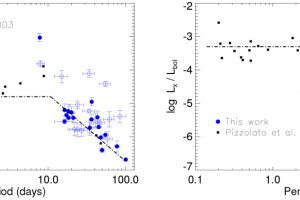
La figura (link per la figura intera) mostra l’andamento di Lx e Lx/Lbol per stelle M studiate in questo articolo ed in un precedente studio (Pizzolato et al. 2003), dove sia le stelle in regime saturo che non saturo sono ben evidenti.

di Mario Giuseppe Guarcello ( segui mguarce)
[:en]Stellar X-ray emission arises from their corona, which is the outer part of stellar atmosphere with low-density high-temperature (up to million degrees) plasma. Even if we lack a fully understanding of the details, we know that the intensity of stellar X-ray emission depends on the intensity and the morphology of stellar magnetic field.
The interior of stars of FGK spectral types, like the Sun, is divided into a radiative and a convective region. In these stars, the magnetic field is produced by a dynamo triggered by the stellar differential rotation and the convective motion in stellar interior. The intensity of the magnetic field, and that of the observable quantities related to the magnetic field, is thus related to stellar rotation. This connection has been proven by several studies focused on FGK stars, where it is demonstrated that the X-ray luminosity (Lx) and its ratio over the bolometric luminosity (i.e.: the fractional X-ray luminosity Lx/Lbol) decrease with increasing stellar rotation period. However, this relation holds up to log(Lx/Lbol)=-3.3. For higher fractional X-ray luminosity, Lx/Lbol is saturated at an almost constant value which does not depend on stellar rotation. We still don’t know exactly what is the cause of this saturated regime.
It is important to understand whether these relations hold for smaller stars. M stars, in fact, are fully convective, and thus their magnetic fields are produced with a different dynamo with respect FGK stars. The analysis of the connection between X-ray luminosity and rotation period in these stars can shade some light on their dynamo mechanism. This is the objective of the study “HADES RV Programme with HARPS-N at TNG. X. The non-saturated regime of the stellar activity-rotation relationship for M dwarfs” of E. González-Álvarez (INAF – Astronomical Observatory of Palermo, now at the Centro de Astrobiologia of Madrid), recently appeared on Astronomy & Astrophysics. From the rotation periods of 78 stars with temperature ranging between 3400 and 3900 K, obtained from series of spectroscopic observations acquired in the framework of the HArps-N red Dwarf Exoplanet Survey (HADES) project, and their X-ray luminosity obtained from archival observations with XMM-Netwon and ROSAT satellites, the authors of this study have analyzed how in these stars Lx/Lbol varies with the rotation period. They have found that the decline of the fractional X-ray luminosity with rotation period observed in FGK stars holds at low mass regime, despite their different internal structure and dynamo. The authors of this study have also estimated that M stars typically are in the “saturated” regime for their first 300 million years of evolution. The astronomers , , , e S. Benatti, of INAF – Astronomical Observatory of Palermo, are part of the authors of this study.
The figure (link) shows Lx and Lx/Lbol over the rotation period for all the stars studied in this work and the M stars analyzed by Pizzolato et al. 2003, with the “saturated” and “not saturated” regimes clearly evident.
by Mario Giuseppe Guarcello ( follow mguarce)
[:]