
[:it]Uno studio completo dell’attività coronale delle stelle M vicine al Sole. L’articolo: “Complete X-ray census of M dwarfs in the solar neighborhood. I. GJ 745 AB: Coronal-hole stars in the 10 pc sample” di M. Caramazza (Eberhard-Karls Universität Tübingen) pubblicato su A&A[:en]A study on the coronal activity in a complete sample of M stars nearby to the Sun. The paper: “Complete X-ray census of M dwarfs in the solar neighborhood. I. GJ 745 AB: Coronal-hole stars in the 10 pc sample” of M. Caramazza (Eberhard-Karls Universität Tübingen) appeared on A&A[:]
[:it]La corona è l’atmosfera più esterna nella maggior parte delle stelle, un regione dove il plasma è riscaldato a milioni di gradi dall’attività magnetica stellare. Poiché sia l’intensità che la topologia del campo magnetico dipendono dalla struttura interna delle stelle, lo studio dell’attività coronale stellare offre la possibilità sia di comprendere i fenomeni magnetici ad alta energia che avvengono nelle stelle, sia di sondare come la struttura interna delle stelle dipenda dalle loro proprietà e fase evolutiva. A causa delle alte temperature del plasma coronale, solo osservazioni ai raggi X possono permettere agli astronomi di studiare i complessi fenomeni che avvengono nelle corone.
Le stelle di classe spettrale M (con una temperatura efficace compresa tra 2350 e 3850 gradi K) sono oggetti estremamente interessanti per lo studio dell’attività magnetica delle stelle. Si tratta infatti delle stelle più comuni nell’Universo; la loro struttura interna consente la produzione di un intenso campo magnetico ed è noto che ospitano spesso pianeti di tipo roccioso. Quest’ultimo punto è particolarmente importante. Infatti, uno dei parametri che determina l’abitabilità dei pianeti attorno ad una stella è proprio l’intensità della sua emissione di raggi X, in grado di influenzare la chimica e le proprietà fisiche delle atmosfere planetarie.
Il limite inferiore di luminosità ai raggi X in queste stelle è rappresentato dal sistema binario GJ 745, due antiche stelle caratterizzate da una metallicità (cioè l’abbondanza di elementi più pesanti dell’elio) molto bassa e una debole attività magnetica. Nelle osservazioni analizzate dal team di ricercatori, la componente GJ 745 A non è osservata, mentre la stella GJ 745 B è stata rilevata grazie a un brillamento (fenomeni molto rapidi e localizzati che risultano in intense emissioni di raggi X). I livelli di emissione di raggi X di queste due stelle sono confrontabili con i “buchi coronali” osservati nella corona solare: sono regioni a bassissima attività magnetica, in cui le linee del campo magnetico sono aperte e il plasma coronale solare può fuoriuscire nello spazio interplanetario. Infine, il livello di emissione di raggi X in queste due stelle è così basso da non comportare effetti significativi, dovuti alla radiazione ad alta energia della stella, sugli eventuali pianeti. Lo studio è descritto nell’articolo intitolato “Complete X-ray census of M dwarfs in the solar neighborhood. I. GJ 745 AB: Coronal-hole stars in the 10 pc sample“, pubblicato recentemente sulla rivista Astronomy & Astrophysics. Tra i coautori, l’astrofisico S. Orlando dell’INAF – Osservatorio Astronomico di Palermo.
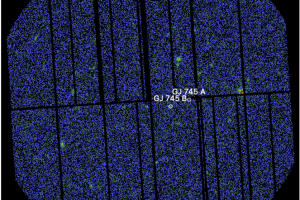
La figura (cliccare qui per visualizzarla interamente) mostra un’immagine ai raggi X del sistema binario GJ 745 ottenuta dal satellite XMM/Newton, con evidenziate le posizioni di GJ 745 A e B.

Qui potete anche esplorare un modello 3D della corona di GJ 475 B, realizzato dal team di 3DMAP-VR dell’INAF – Osservatorio Astronomico di Palermo
Mario Giuseppe Guarcello ( segui mariospiegacose) ( mariospiegacose)( follow mariospiegacose)
Segui la pagina Facebook e Instagram dell’Osservatorio Astronomico di Palermo
Iscriviti al canale Youtube dell’Osservatorio Astronomico di Palermo
[:en]
M type stars (with an effective temperature ranging from 2350 to 3850 K) are extremely interesting subjects for the study of stellar magnetic activity for several reasons. First, they are the most common type of stars in the Universe. Second, their internal structure allows for the production of an intense and complex magnetic field. Lastly, they often host terrestrial planets. This is a quite important point since one of the stellar properties that can influence the habitability of planets is X-ray luminosity of the host stars, as these high-energy photons can impact the chemistry and physical properties of planetary atmospheres.
The figure (click here to visualize it entirely) shows the XMM/Newton image of the binary system GJ 745, with the positions of the two component marked.
Here it is possible to explore a 3M model of the corona of GJ 475 B, produced by the 3DMAP-VR team of INAF – Astronomical Observatory of Palermo.
Mario Giuseppe Guarcello ( follow mariospiegacose) ( mariospiegacose) ( follow mariospiegacose)
Follow the Astronomical Observatory of Palermo on Facebok and on Instagram
Subscribe the Youtube channel of the Astronomical Observatory of Palermo[:]