
[:it]Atmosfere in fotoevaporazione nei pianeti giovani. L’articolo: “New Constraints on the Future Evaporation of the Young Exoplanets in the V1298 Tau System” di A. Maggio (INAF – OAPA) pubblicato su ApJ[:en]Photoevaporation in young planets. The study: “New Constraints on the Future Evaporation of the Young Exoplanets in the V1298 Tau System” of A. Maggio (INAF – OAPA) recently appeared on ApJ[:]

[:it]La ricerca di esopianeti attorno alle stelle giovani è di grande importanza per lo studio del processo di formazione planetaria e delle prime fasi evolutive dei pianeti. Il disco di gas e polveri da cui i pianeti si formano, infatti, ha una vita media di pochi milioni di anni, durante i quali i pianeti giovani interagiscono con il materiale in orbita attorno alla stella, innescando importanti fenomeni quali la migrazione planetaria. Inoltre, le stelle giovani sono caratterizzate da una forte emissione di raggi X ed UV, prodotti principalmente da un’intensa attività coronale. Questa radiazione energetica incidente sul pianeta ionizza e dissocia le molecole di gas nella sua atmosfera, portando ad un aumento della temperatura ed ad un’espansione dell’atmosfera che, nei casi più estremi, può evaporare (processo di fotoevaporazione).
Durante la sua missione estesa K2, il satellite della NASA Kepler ha identificato un ricco sistema planetario orbitante attorno alla stella V1298 Tau, una stella di classe spettrale K1 con un’età compresa tra 7 e 11 milioni di anni, appartenente all’associazione stellare Group 29 nel Toro. Il sistema planetario è composto da due pianeti Nettuniani (i pianeti “c” e “d”), un Gioviano (“b”) ed un pianeta dalle dimensioni simili a quelle di Saturno (“e”). Secondo misure recenti basate su osservazioni spettroscopiche, i due pianeti esterni (b ed e) hanno una massa di circa 370 e 200 masse terrestri, mentre per i due pianeti interni è stato possibile calcolare un limite superiore alla massa, pari a 76 e 99 masse terrestri. Dal rapporto tra massa e raggio, alcuni autori hanno suggerito che questi pianeti possano essere “rigonfiati” a causa del riscaldamento dovuto all’intensa radiazione energetica proveniente dalla stella.
Con l’intento di misurare il flusso di radiazione ai raggi X emesso da V1298 Tau e la sua variabilità su scale temporali brevi, il team di ricercatori guidato da A. Maggio (INAF – Osservatorio Astronomico di Palermo) ha ottenuto ed analizzato osservazioni della stella con il satellite XMM-Newton dell’Agenzia Spaziale Europea. L’analisi ha evidenziato emissione da plasma coronale con temperature comprese tra 3 e 16 milioni di gradi, ed una luminosità in raggi X pari a 1.7×1030 erg/sec (ossia 100-1000 volte più luminosa del Sole). Da questi risultati, e da specifici modelli evolutivi, è stato possibile stimare il flusso di radiazione stellare in raggi X incidente sui quattro pianeti durante la futura evoluzione della stella. Quindi, dai risultati di modelli idrodinamici di atmosfere irradiate esternamente, i ricercatori hanno concluso che i pianeti più esterni del sistema non saranno interessati dal processo di fotoevaporazione, mentre i due pianeti più interni potrebbero perdere una frazione significativa della loro atmosfera solo nel caso in cui la loro massa sia minore di 40 masse terrestri, perdendola completamente se invece è minore di 20 masse terrestri. Lo studio è descritto nell’articolo: “New Constraints on the Future Evaporation of the Young Exoplanets in the V1298 Tau System“, recentemente pubblicato sulla rivista The Astrophysical Journal. Tra i coautori dello studio, figurano anche D. Locci, I. Pillitteri, S. Benatti, e G. Micela dell’INAF – Osservatorio Astronomico di Palermo.
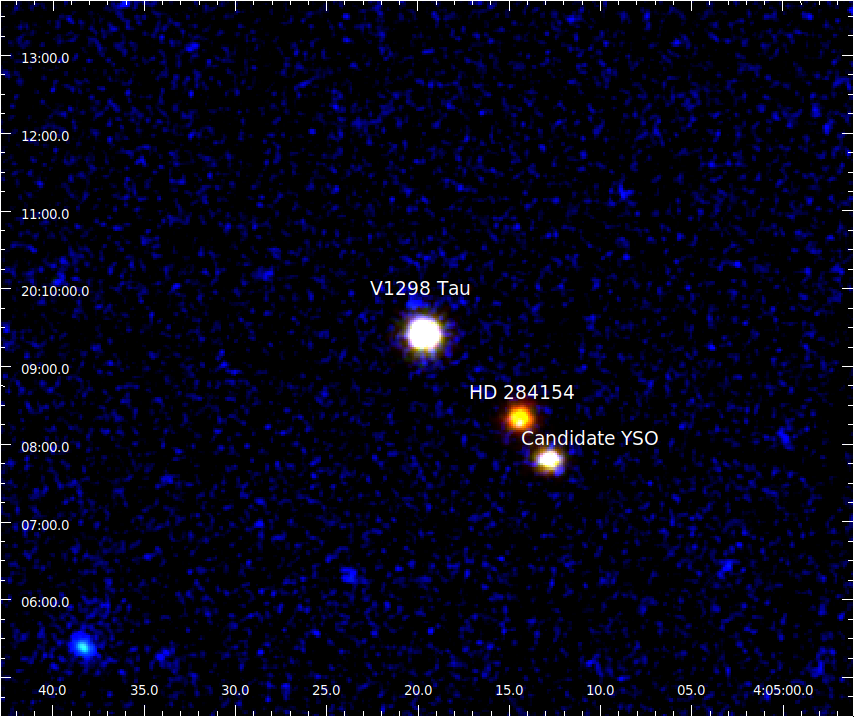
La figura (cliccare qui per visualizzare l’immagine interamente) mostra l’osservazione XMM-Newton di V1298 Tau analizzata in questo studio. Nello stesso campo sono osservate la stella HD 284154, che potrebbe formare un sistema binario largo con V1298 Tau, ed una candidata stella giovane.
Mario Giuseppe Guarcello ( segui mguarce) ( youtube)
Segui la pagina Facebook dell’Osservatorio Astronomico di Palermo
Iscriviti al canale Youtube dell’Osservatorio Astronomico di Palermo[:en]The search for young exoplanets is crucial to our understanding of the planetary formation process and the early evolution of planets. The disc of gas and dust from which planets form, in fact, typically disperse in a few million of years. Before that, the young planets interact with all the material orbiting around the star within the disk, triggering important phenomena such as the planetary migration. Besides, young stars are particularly bright in X-rays and UV bands, mainly produced by a very active corona. This energetic radiation, when incident on the planets, dissociates and ionizes the gas molecules in the planetary atmosphere, heating it up and make it expand. In the most extreme cases, planets can loose a significant fraction of their atmosphere because of this process, which is called “photoevaporation”.
During its extended mission K2, the NASA satellite Kepler identified a rich planetary system around the young star V1298 Tau, a K1 star with an age of 7-11 million of years, belonging to the Group 29 stellar association. The planetary system counts two Neptune-like planets (planets “c” and “d”), a Jovian planet (“b”), and a Saturn-size planet (“e”). According to spectroscopic measurements, the two outer planets (b and e) have a mass of 370 and 200 Earth masses, while for the two inner planets it was only possible to constrain an upper limit for their mass, equal to 76 and 99 Earth masses. According to some authors, the mass-radius ratio of these planets can be explained only assuming that the planets are “fluffy”, which means that their atmosphere is inflated because of the incident energetic radiation.
In order to measure the flux of X-ray radiation emitted by V1298 Tau, and its variability over a short timescale, the team of researchers led by A. Maggio (INAF – Astronomical Observatory of Palermo) obtained and analyzed observations with the satellite XMM-Newton of the European Space Agency. The analysis shown emission from coronal plasma with a temperature between 3 and 16 million degrees, and a X-ray luminosity of 1.7×1030 erg/sec (100-1000 times brighter than the Sun in X-rays). From these results, and adopting a specific evolutionary model, it was possible to estimate the stellar X-ray luminosity over its entire evolution. Thus, adopting an hydrodynamic model for the planetary atmospheres, the researchers found that the two outer planets are not going to loose significant amount of mass, while the two inner planets may loose part of their atmospheres if their masses are below 40 Earth masses, or even all the atmospheres if they are lower than 20 Earth masses. The study is described in the paper: “New Constraints on the Future Evaporation of the Young Exoplanets in the V1298 Tau System“, recently appeared on The Astrophysical Journal. Among the coauthors, the astronomers D. Locci, I. Pillitteri, S. Benatti, and G. Micela of INAF – Astronomical Observatory of Palermo.
The figure (click here to visualize the entire image) shows the XMM-Newton observation of V1298 Tau. Nearby there are the stars HD 284154, which may form a binary system with V1298 Tau, and a candidate young star.
Mario Giuseppe Guarcello ( follow mguarce) ( youtube)
Follow the Astronomical Observatory of Palermo on Facebok
Subscribe the Youtube channel of the Astronomical Observatory of Palermo[:]