
[:it]Brillamenti e fluorescenza di raggi X in protostelle. Pubblicato su A&A lo studio: “Deep X-ray view of the Class I YSO Elias 29 with XMM-Newton and NuSTAR” di I. Pillitteri (INAF-OAPA)[:en]Flares and X-ray fluoresence in protostars. The study: “Deep X-ray view of the Class I YSO Elias 29 with XMM-Newton and NuSTAR” of I. Pillitteri (INAF-OAPA) recently appeared on A&A[:]
[:it]Le protostelle sono stelle con pochi milioni di anni di età, che stanno ancora attraversando una fase di accrescimento e contrazione gravitazionale ed il cui nucleo non ha ancora raggiunto i valori di temperatura e pressione necessari per sostenere i processi termonucleari. Le più giovani tra queste stelle sono circondate da un disco protoplanetario di gas e polveri (protostelle di classe II) o anche dal residuo della nube protostellare da cui si sono formate (protostelle di classe I). Le protostelle sono generalmente sorgenti brillanti di raggi X, prodotti da un’attività magnetica molto più intensa di quella che caratterizza le stelle di sequenza principale come il Sole, e dalla regione dove il gas in accrescimento dal disco alla stella impatta sulla superficie della stella. Lo studio di questa emissione può quindi rivelare preziose informazioni sui processi che interessano la corona stellare di queste stelle, l’accrescimento di gas e le proprietà della regione interna del disco protoplanetario e come questa interagisce con la protostella.
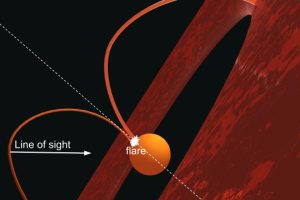
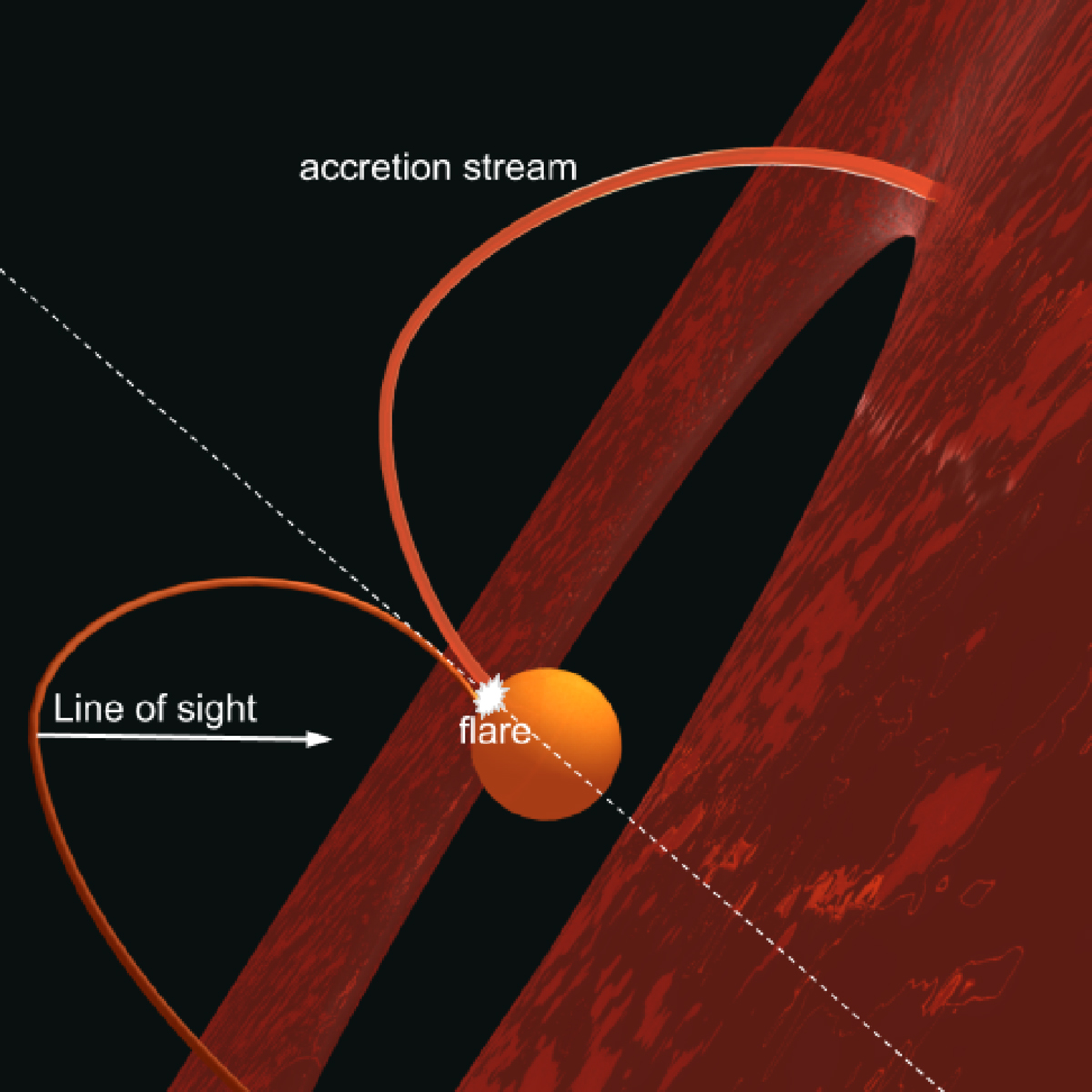
Nello studio: “Deep X-ray view of the Class I YSO Elias 29 with XMM-Newton and NuSTAR” di I. Pillitteri (INAF – Osservatorio Astronomico di Palermo), recentemente pubblicato su Astronomy & Astrophysics, è presentata una dettagliata analisi dell’emissione di raggi X della protostella di classe I Elias 29, nella regione di rho Ophiuchi. I dati analizzati da questo studio sono stati ottenuti dai ricercatori dell’Osservatorio Astronomico di Palermo grazie ad un progetto (un Large Projet) che ha permesso di ottenere osservazioni simultanee con i satelliti XMM/Newton dell’ESA e NuSTAR della NASA. Grazie alla lunghezza delle due osservazioni (83 e 125 ore, rispettivamente) è stato possibilie osservare sia l’emissione di quiescenza della protostella (proveniente principalmente dalla sua corona), che due brillamenti durati rispettivamente circa 5 ore e mezza e 14 ore. Durante questi brillamenti gli autori hanno osservato un aumento dell’assorbimento dei raggi X da parte del gas posto lungo la linea di vista. Questa evidenza è stata spiegata ipotizzando che il brillamento sia avvenuto in una regione della stella posta alla base della colonna di gas che dal disco accresce sulla stella, come indicato nella figura (link). Alternativamente, questo risultato poterbbe essere indotto da fotoni riflessi dalla nube che circonda la stella.
Un altro importante risultato riguarda l’osservazione di emissione di fluorescenza di raggi X con un’energia di circa 6.4 keV da parte della protostella. Questa emissione è stata osservata anche in altre protostelle, ed è tipicamente interpretata come emissione di fluorescenza da parte di atomi di ferro neutro situati sulla superficie del disco protoplanetario, che vengono eccitati da fotoni ai raggi X ad alta energia (>7.1 keV) emessi durante brillamenti stellari. La radiazione di fluorescenza in Elias 29, però, è stata osservata non solo durante i due brillamenti stellari, ma anche durante la quiescenza. Per spiegare questa discrepanza, gli autori di questo studio hanno ipotizzato che l’eccitamento degli atomi di ferro necessario per l’emissione di fluorescenza sia dovuta a particelle molto energetiche accelerate dall’intenso campo magnetico attorno Elias 29. Questa ipotesi è supportata dall’osservazione di raggi X energetici non compatibili con l’emissione da parte della corona stellare. Lo studio è stato realizzato con la collaborazione degli astronomi S (OAPA), , ,
di Mario Giuseppe Guarcello ( segui mguarce)[:en]”Protostars” are stars a few million years old, which are still accreting gas and contracting for their own gravity, and whose nucleus has not reached yet the temperature and pressure necessary for the onset of thermonuclear reactions. The youngest protostars are still surrounded by a protoplanetary disk of gas and dust (class II protostars) or even by an accreting envelope of gas, residual of the pre-stellar cloud (class I protostars). Protostars are also bright X-ray sources. This X-ray emission arise from a scaled up version of the stellar corona similar to that of main sequence stars, magnetic activity such as flares, and the accretion of gas from the disk onto the star.
The study: “Deep X-ray view of the Class I YSO Elias 29 with XMM-Newton and NuSTAR” of I. Pillitteri (INAF – Astronomical Observatory of Palermo), recently appeared on Astronomy & Astrophysics, shows a detailed analysis of the X-ray emission of the class I protostar Elias 29, belonging to the rho Ophiuchi star forming region. The analyzed data are part of a Large Project obtained by the astronomers of INAF-OAPA and involving the ESA satellite XMM/Newton and the NASA satellite NuSTAR. Thanks to the duration of the observations (83 and 125 hours, respectively), the telescopes observed both the quiescent X-ray emission, mainly from the stellar corona, together with two bright flares, about 5.5 hours and 14 hours long. During these flares, the authors have also observed an increase of the absorption of X-rays by material lying along the line of sight, which has been interpreted as an evidence that the flare occurred at the base of a column of accreting gas from the disk onto the star, as shown in the figure (link). Alternatively, this can be an artifact induced by the X-ray photons scattered along the line of sight by the surrounding envelope.
Another important result is the observation of fluorescence X-ray photons with an energy of about 6.4 keV from the protostar. This emission has been observed in other protostars, and typically interpreted as fluorescence emission from neutral iron atoms along the surface of the protoplanetary disk, excited by incident high energy (> 7.1 keV) X-ray photons emitted during stellar flares. In Elias 29, however, this fluorescence emission has been observed also during the quiescence, meaning that another excitation mechanism should occur. The authors have hypothesized that iron atoms are excited by high-energy particles accelerated by the intense magnetic field around Elias 29. This idea is supported by the observations of energetic X-ray emission which is not compatible with coronal emission. The astronomers S (OAPA), , ,
of Mario Giuseppe Guarcello ( follow mguarce)[:]