
[:it]Previsioni sulle osservazioni future della stella a neutroni in SN1987A. L’articolo: “Investigating the Time Evolution of the Thermal Emission from the Putative Neutron Star in SN 1987A for 50+ Years” di A. Dohi (Kyushu University) pubblicato su ApJ[:en]Predictions on the observability of the neutron star in SN1987A. The study: “Investigating the Time Evolution of the Thermal Emission from the Putative Neutron Star in SN 1987A for 50+ Years” of A. Dohi (Kyushu University) appeared on ApJ[:]
[:it]Il resto della supernova SN1987A, situato nella Grande Nube di Magellano, è un oggetto di straordinaria importanza nello studio delle supernove e dei resti di supernova. Infatti, è l’unico evento del genere avvenuto in epoca moderna ad una distanza così ravvicinata che ci permette di effettuare osservazioni dettagliate. SN1987A è stata una “core-collapse supernova”, generata dal collasso del nucleo della stella supergigante blu Sanduleak -69° 202a. I modelli teorici prevedono che il nucleo di questa stella si sia trasformato in una stella a neutroni, che però finora non è stata individuata. Tuttavia, ci sono prove concrete della sua esistenza. Un articolo pubblicato nel 2019, basato sull’analisi di osservazioni ottenute con ALMA, rivela la presenza di una densa nube al centro di SN1987A, riscaldata dall’emissione termica della stella a neutroni nascosta al suo interno. Due studi successivi, pubblicati nel 2021 e nel 2022 e basati sull’analisi di osservazioni ai raggi X, dimostrano l’esistenza al centro di SN1987A di una “pulsar wind nebula”, ovvero una nube di particelle relativistiche alimentata dall’attività della pulsar.
Lo studio dell’oggetto compatto al centro di SN1987A è di grande importanza per vari motivi. La sua giovane età, infatti, ci permetterebbe di comprendere i processi termici che coinvolgono la crosta della stella a neutroni, che, avendo tempi caratteristici di alcune decine di anni, possono essere osservati solo nelle stelle a neutroni molto giovani. Inoltre, studi basati sull’analisi spettroscopica delle righe del ferro o del titanio e sull’analisi della morfologia tridimensionale degli ejecta (cioè i frammenti della stella esplosa espulsi durante la supernova) più interni suggeriscono che l’esplosione di SN1987A sia stata altamente asimmetrica. In tal caso, si prevede che la stella a neutroni abbia ricevuto un impulso (kick) in una direzione specifica, conferendole una velocità di diverse centinaia di km/s. Una verifica sperimentale di questa velocità di kick fornirebbe un’importante diagnostica per comprendere i processi fisici in atto durante la supernova.
Come dimostrato dagli studi precedenti, le osservazioni ai raggi X sono estremamente efficaci nell’esplorare i fenomeni ad alta energia e le proprietà dell plasma a milioni di gradi che caratterizzano SN1987A, ed il suo oggetto compatto. In uno studio recente, descritto nell’articolo “Investigating the Time Evolution of the Thermal Emission from the Putative Neutron Star in SN 1987A for 50+ Years“, pubblicato su “The Astrophysical Journal”, viene presentato un nuovo modello di raffreddamento della stella a neutroni in SN1987A. Il modello viene testato combinando le osservazioni esistenti di ALMA nel millimetrico e di Chandra ai raggi X. Assumendo che la stella a neutroni sia effettivamente responsabile del riscaldamento della nube osservata da ALMA, da questa analisi il team di ricercatori presenta stime sulla velocità di kick della stella a neutroni (circa 700 km/s), sulla massa della stella a neutroni (circa 1.6 masse solari), sulla massa della nube (circa 10-8 volte la massa della stella a neutroni), e infine sui tempi scala del processo di raffreddamento guidato dai neutrini (circa 40 anni). Inoltre, il team presenta previsioni sull’osservabilità della stella a neutroni nel 2027 con Chandra e negli anni ’40 con la futura missione ai raggi X della NASA, Lynx. In queste previsioni, il parametro fondamentale risulta essere proprio la velocità di kick della stella a neutroni: Lynx dovrebbe essere in grado di individuare la stella a neutroni nel caso in cui la velocità sia quella prevista. Lo studio è guidato dall’astrofisico A. Dohi, del Dipartimento di Fisica della Kyushu University, con la partecipazione di S. Orlando e B. Olmi (INAF – Osservatorio Astronomico di Palermo) e E. Greco e M. Miceli (Università degli Studi di Palermo, associati INAF).
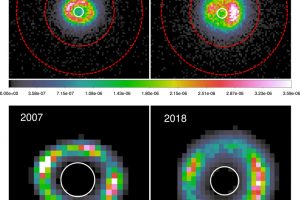
La figura (clicca qui per visualizzarla interamente) mostra due immagini ai raggi X di SN1987A ottenute con Chandra nel 2007 e nel 2018 nella banda di energia 0.5-7 keV.

Mario Giuseppe Guarcello ( segui mariospiegacose) ( mariospiegacose)( follow mariospiegacose)
Segui la pagina Facebook e Instagram dell’Osservatorio Astronomico di Palermo
Iscriviti al canale Youtube dell’Osservatorio Astronomico di Palermo
[:en]SN1987A, located in the Large Magellanic Cloud, is an object of great importance for the study of supernovae and supernova remnants. In fact, it is the only supernova that has occurred recently and is close enough to allow us to obtain detailed observations across the entire electromagnetic spectrum. SN1987A was a core-collapse supernova, resulting from the collapse of the core of the blue supergiant Sanduleak -69° 202a. Theoretical models predict that the nucleus of this star should have transformed into a neutron star after the collapse. While the neutron star itself has never been directly observed, there is substantial observational evidence supporting its existence. In a paper published in 2019, based on ALMA observations in the millimeter regime, the existence of a dense cloud in the center of SN1987A was revealed, which has been suggested to be heated by the thermal emission from the neutron star hidden within it. Two subsequent studies, published in 2021 and 2022 and based on X-ray observations, demonstrated the existence of a pulsar-wind nebula in SN1987A, which is a cloud of relativistic particles powered by the neutron star.
The search and analysis of the compact object inside SN1987A are important for several reasons. First, its young age would allow astronomers to investigate the thermal processes occurring in the crust of neutron stars, which can only be studied only in very young neutron stars given their timescale of a few tens of years. Furthermore, studies based on spectroscopy of iron lines, titanium lines, and the three-dimensional morphology of the inner ejecta (fragments of the exploding star expelled during the supernova) suggest that the explosion of SN1987A was highly asymmetric. In such a case, the neutron star should have received a specific direction impulse (kick), resulting in a velocity of several hundreds of kilometers per second. Experimental evidence of this kick velocity would shed light on the physical processes that governed the supernova explosion of SN1987A.
X-ray observations are particularly powerful for exploring the high-energy phenomena and the million-degree plasma in SN1987A, as well as for investigating its compact object. A recent study, described in the paper “Investigating the Time Evolution of the Thermal Emission from the Putative Neutron Star in SN 1987A for 50+ Years“, which was recently published in “The Astrophysical Journal,” presents a new model for the cooling of the neutron star in SN1987A. The model is tested by combining ALMA observations in the millimeter range and Chandra observations in X-rays. Assuming that the neutron star is responsible for the heating of the cloud observed by ALMA, the authors of this analysis have estimated a neutron star kick velocity of approximately 700 km/s, a mass of 1.6 solar masses, while the cloud’s mass is about 10-8 times the neutron star mass, and that the cooling process driven by neutrinos has a timescale of about 40 years. Additionally, the team has made predictions for the observability of the neutron star in 2027 with Chandra and in the 2040s with the future NASA X-ray mission, Lynx. In these predictions, the most important parameter is the kick velocity. In fact, Lynx should be able to detect the neutron star if the kick velocity matches the predicted value. The study is led by astronomer A. Dohi, from the Physics Department of Kyushu University, with the participation of S. Orlando and B. Olmi (INAF – Astronomical Observatory of Palermo), E. Greco and M. Miceli (University of Palermo).
The figure (click here to visualize the entire figure) shows two X-ray observations of SN1987A obtained with Chandra in 2007 and 2018 in the 0.5-7 keV energy range.
Mario Giuseppe Guarcello ( follow mariospiegacose) ( mariospiegacose) ( follow mariospiegacose)
Follow the Astronomical Observatory of Palermo on Facebok and on Instagram
Subscribe the Youtube channel of the Astronomical Observatory of Palermo[:]