
[:it]Una super-Terra per la stella GJ 740. L’articolo: “A super-Earth on a close-in orbit around the M1V star GJ 740. A HADES and CARMENES collaboration” di B. Toledo-Padrón (IAC) pubblicato su Astronomy & Astrophysics[:en]A super-Earth for the star GJ 740. The study: “A super-Earth on a close-in orbit around the M1V star GJ 740. A HADES and CARMENES collaboration” of B. Toledo-Padrón (IAC) recently appeared on Astronomy & Astrophysics[:]
[:it]Negli ultimi anni, le stelle di classe spettrale M (ossia stelle con temperatura efficace compresa tra i 2400 ed i 3700 gradi e massa tra 0.08 e 0.45 masse solari) sono diventate target preferenziali per la ricerca di esopianeti. Questo sia perché esse sono le stelle più comuni nella Via Lattea, sia perché il basso rapporto tra la massa e le dimensioni della stella con quella dei suoi pianeti, rispetto a stelle più massive, semplifica l’identificazione dei pianeti. Ad esempio, il satellite Kepler (una delle missioni più prolifiche in questo campo, che individuava pianeti tramite il metodo dei transiti, ossia registrando i piccoli occultamenti della stella da parte del proprio pianeta durante la sua orbita) ha scoperto un totale di 156 pianeti attorno a stelle M. Da questi dati, gli astronomi hanno stimato una media di 2.5 pianeti con periodo orbitale <200 giorni per stelle di questa classe spettrale.
Le stelle di classe M sono anche target ideali per la ricerca di pianeti attraverso il metodo delle velocità radiali, ossia tramite osservazioni spettroscopiche mirate a registrare le oscillazioni periodiche delle stelle in direzione radiale dovute all’attrazione gravitazionale dei propri pianeti ed alla loro orbita. Dalla prima scoperta di un esopianeta attorno a una stella M con questo metodo, avvenuta nel 1998, ad oggi sono stati scoperti 116 esopianeti attorno a stelle M tramite velocità radiali. La complicazione maggiore intrinseca in questa tecnica è dovuta all’intensa attività magnetica di queste stelle, che produce segnali spettroscopici che spesso possono confondere il segnale di velocità radiale dovuto alla presenza di pianeti.
Il team guidato dall’astronomo B. Toledo-Padrón dell’Instituto de Astrofísica de Canarias ha recentemente riportato la scoperta di una super-Terra con un periodo orbitale di 2.4 giorni ed un limite superiore alla sua massa di 2.96 masse terrestri, attorno alla stella GJ 740, di classe spettrale M1V ad una distanza di quasi 37 anni luce da noi. Lo studio fa parte del progetto HADES (HArps-n red Dwarf Exoplanet Survey), basato su osservazioni ottenute con lo spettrografo HARPS-N, installato al Telescopio Nazionale Galileo (TNG) dell’Osservatorio di Roque de los Muchachos nell’isola di La Palma. Gli autori hanno combinato le osservazioni HARPS-N con osservazioni spettroscopiche ottenute con gli spettrografi CARMENES all’Osservatorio di Calar Alto e HARPS all’osservatorio La Silla dell’European Southern Observatory, in Cile. I dati analizzati dal team di ricercatori sembrerebbero suggerire inoltre la presenza di un secondo pianeta con un periodo di almeno 9.3 anni, ma il segnale osservato potrebbe in realtà essere prodotto dall’attività magnetica di GJ 740. Allo studio hanno partecipato anche gli astronomi J. Maldonado, G. Micela e L. Affer dell’INAF-Osservatorio Astronomico di Palermo.
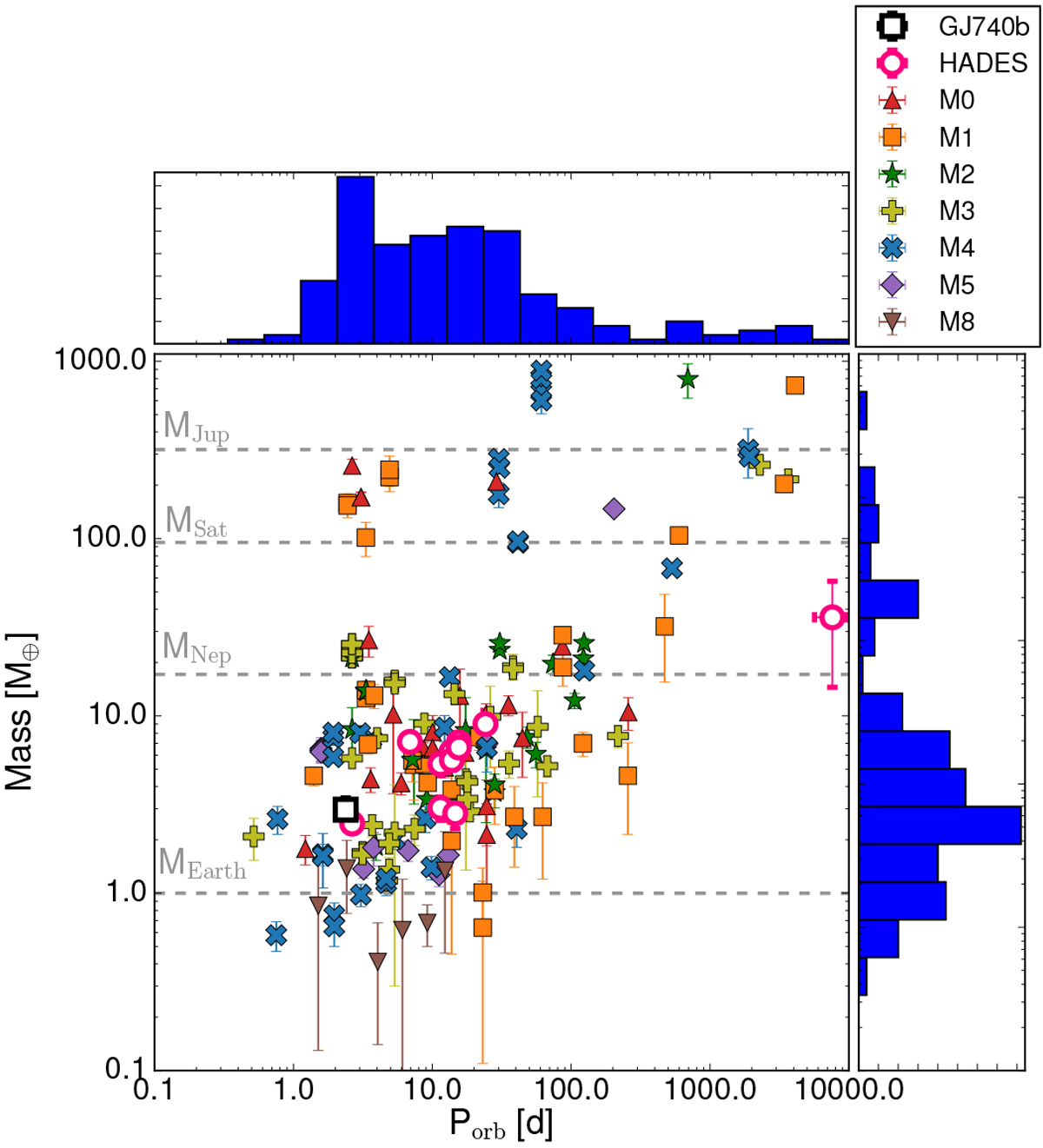
La figura (cliccare qui per visualizzare l’immagine interamente) mostra un diagramma massa vs. periodo degli esopianeti presenti nell’archivio NASA Exoplanets Archive. I diversi colori codificano le diverse classi spettrali delle stelle attorno a cui orbitano i pianeti. Il pianeta GJ 740 b è indicato con un quadrato nero, mentre altri pianeti scoperti come parte del programma HADES sono indicati con un cerchietto vuoto. Le linee orizzontali indicano la massa di Giove, Saturno, Nettuno e della Terra.[:en]In the last years, stars of spectral class M (which are stars with effective temperatures between 2400 and 3700 K and masses between 0.08 and 0.45 solar masses) have been extensively observed for the search of exoplanets. This both because they are the most abundant class of stars in the Galaxy, and because the low star/planet mass ratio, compared to stars of other spectral classes, facilitates the detection of exoplanets. For instance, the Kepler mission (which was one of the most prolific mission in this field, detecting exoplanets with the transit method, which consists in the detection of small and periodic occultations of the star by their planets as they orbit around their stars) discovered 156 planets around M stars. From these data, astronomers estimated that on average M stars host 2.5 planets with orbital period <200 days.
M stars are also the ideal targets for the search of exoplanets with the method of radial velocity. This method consists in detecting the small oscillations of the stars in the radial direction because of the gravitational attraction and the orbit of their planets, by means of spectroscopic observations. Since the first discovery of an exoplanet around a M star by radial velocity, occurred in 1998, to date 116 exoplanets around M stars were discovered with this technique. The major difficulty intrinsic in this method is due to the intense magnetic activity of these stars, which may produce spectroscopic signals that can mimic and confuse those due to exoplanets.
The team led by the astronomer B. Toledo-Padrón, of the Instituto de Astrofísica de Canarias, recently reported the discovery of a super-Earth with an orbital period of 2.4 days and a mass upper limit of 2.96 Earth masses, orbiting around GJ 740, a M1V star at a distance of about 37 light years from Earth. The study is part of the project HADES (HArps-n red Dwarf Exoplanet Survey), which is based on observations taken with HARPS-N, mounted on the Telescopio Nazionale Galileo (TNG) on the Roque de Los Muchachos Observatory in La Palma. The authors of the study have also combined the HARPS-N observations with data acquired with the spectrographs CARMENES at the Calar Alto Observatory and HARPS at the La Silla Observatory of the European Southern Observatory. These data also suggest the presence of a second planet with an orbital period of 9 years, but its radial velocity signal may be due to the stellar cycle instead. The astronomer J. Maldonado, G. Micela e L. Affer of INAF-Osservatorio Astronomico di Palermo are co-authors of this study, which recently appeared on the journal Astronomy & Astrophysics.
The figure (click here to visualize the entire image) shows a mass vs. period diagram of the exoplanets in the NASA Exoplanets Archive. The different colors mark the spectral types of the parent star. GJ 740 b is marked with a black square, while the other planets discovered in the framework of the HADES program are marked with empty dots. The horizontal lines mark the masses of Jupiter, Saturn, Neptune, and Earth.[:]