
[:it]Una nuova super-Terra scoperta attorno la stella M Gl 686, come parte del programma HADES[:en]A new super-Earth orbiting the M star Gl 686, discovered in the framework of the HADES program[:]

[:it]Le stelle di piccola massa (di classe spettrale M, con una massa compresa tra 0.075 e 0.50 masse solari) sono tra gli oggetti preferiti per la ricerca e caratterizzazione di pianeti extra-solari. Per queste stelle, infatti, la tecnica delle velocità radiali risulta essere più efficace rispetto a stelle di massa maggiore. Questa tecnica consiste nell’individuare periodiche oscillazioni della luce della stella dovute al suo moto attorno al centro di massa comune del sistema planetario. Queste oscillazioni sono tanto più grandi quanto più piccola è la massa della stella, a parità di massa del pianeta. Inoltre, la zona di abitabilità, ossia la regione attorno alla stella dove eventuali esopianeti rocciosi possono ospitare acqua allo stato liquido, è molto vicina alla stella, essendo compresa tra 0.02 a 0.2 unità astronomiche (UA, 1 UA è pari alla distanza media tra Terra e Sole), facilitando in queste stelle la ricerca di pianeti di tipo roccioso che possano presentare condizioni simili a quelle esistenti sulla Terra.
La figura (link) [:en]Low mass star (in particular M-type star, with a mass between 0.075 and 0.5 solar masses) are typical targets for the search and study of exoplanets. In these stars, in fact, the radial velocity method is more efficient than in stars with higher mass. Radial velocity consists in detecting periodic oscillations in the stellar spectra due to the motion of stars around the center of mass in common with their planetary systems, due to the Doppler effect. These oscillations are more evident in low-mass stars hosting relatively massive planets in a close orbit. Besides, the habitable zone, which is the region around each star where water can exist as liquid on planets surface, is relatively small, ranging between 0.02 and 0.2 astronomical units (AU, with 1 AU being the average Earth-Sun distance). This facilitates the search of planets with conditions similar to Earth.
One of the main problems in detecting planets using the radial velocity technique is the fact stellar activity may produce periodic oscillations of stellar spectra that can mimic those due to planets. In order to confirm the existence of a planet, it is thus necessary to analyze spectra covering a large temporal interval, in order to distinguish coherent signals, typical of planets, from signals which change over small time-scales, as those due to stellar activity.
The study “HADES RV program with HARPS-N at the TNG. IX: A super-Earth around the M dwarf Gl 686”, recently appeared on Astronomy & Astrophysics, of the astronomer L. Affer of INAF – Astronomical Observatory of Palermo, describes the discovery of a super-Earth (rocky planets whose mass is between Earth and Neptune) around the star Gl 686, a M-type star about 26 light years away from the Sun. This discovery has been possible thanks to the spectra obtained with the spectrographs HARPS-N of the Telescopio Nazionale Galileo, HARPS of the European Southern Observatory, and HIRES of Keck Observatory, together with photometric data from the surveys APACHE, EXORAP, and ASAS. The HARPS-N data were obtained in the framework of the HaArps-n red Dwarf Exoplanet Survey (HADES) project. All these spectroscopic data cover a time baseline longer than 20 years. This long temporal frame together with the precision of the used instruments, allowed the authors to detect a periodic radial velocity signal of 15.5 days, and to distinguish it from other periodic signals due to stellar activity. This signal is due to a super-Earth with a mass of 7.1 Earth masses, orbiting the star at a distance of 0.09 AU. This study, published with the participation of ,
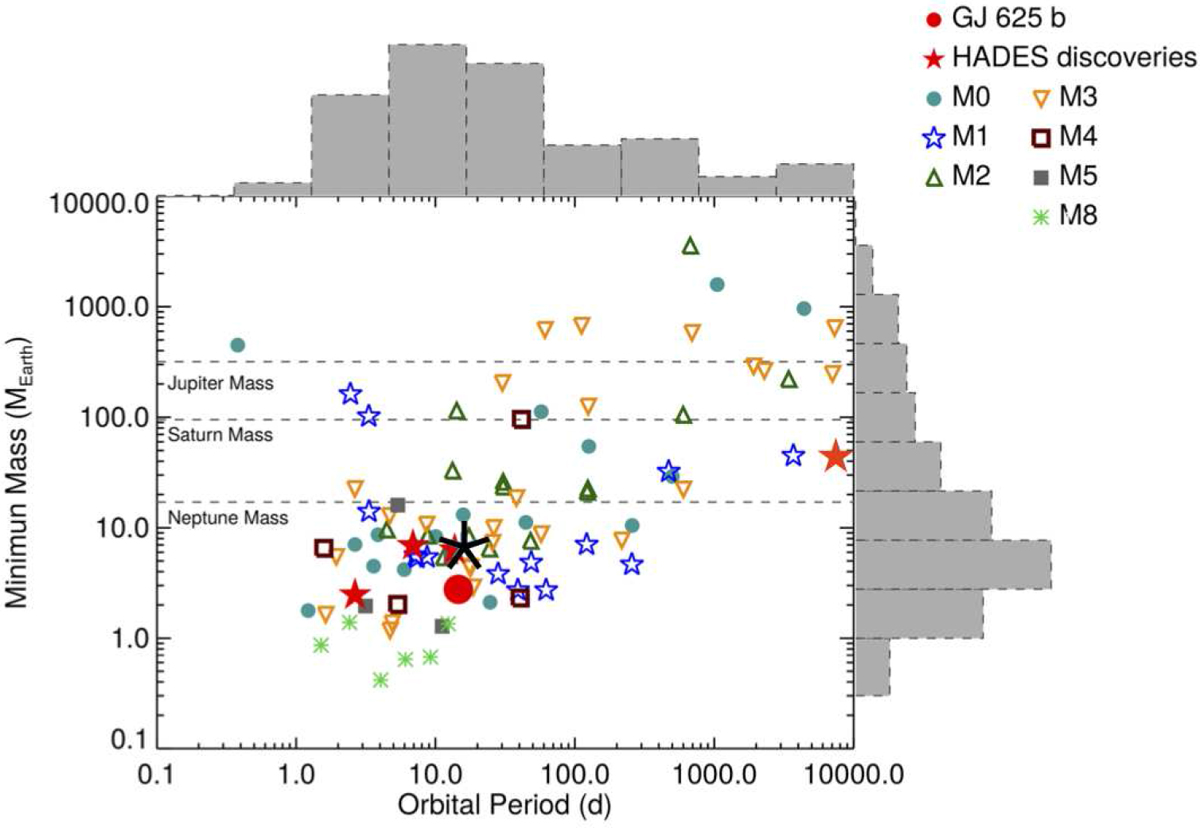
The figure (link) shows the distribution of the minimum mass vs. orbital period of planets around M-type stars. with marked the position of the planet around Gl 686.[:]