
[:it]Un giovane Saturno nell’ammasso aperto IC2602 descritto nell’articolo: “TOI-837 b: Characterisation, formation, and evolutionary history of an infant warm Saturn-mass planet” di M. Damasso (INAF – OATo)[:en]A young Saturnian planet orbiting a star in the stellar cluster IC 2602 described in the study: “TOI-837 b: Characterisation, formation, and evolutionary history of an infant warm Saturn-mass planet” of M. Damasso (INAF – OATo)[:]
[:it]——————————————————————————————————————–
Analisi di osservazioni TESS e HARPS permettono di confermare l’esistenza di un pianeta simile a Saturno orbitante attorno ad una stella associata all’ammasso stellare giovane IC 2602
——————————————————————————————————————–
Gli ammassi stellari non sono soltanto splendidi oggetti da fotografare e osservare al telescopio, ma rappresentano anche un’importante opportunità per lo studio dell’evoluzione stellare. Essi sono infatti composti da ricchi campioni di stelle di tipo diverso ma di età simile, le cui proprietà fisiche possono essere stimate attraverso osservazioni mirate e il confronto con modelli teorici.
In teoria, questo potrebbe valere anche per la ricerca sugli esopianeti, in particolare negli ammassi stellari giovani dove sarebbe possibile osservare pianeti in formazione o sistemi planetari ancora giovani. Tuttavia, la ricerca e la caratterizzazione degli esopianeti in questi ambienti presenta notevoli difficoltà osservative. Gli ammassi stellari, infatti, mostrano tipicamente campi stellari molto affollati, il che rende complicato studiare la variabilità temporale dell’emissione stellare, fondamentale per la ricerca di esopianeti tramite la tecnica dei transiti. Inoltre, le stelle giovani sono caratterizzate da un’intensa attività magnetica, che interferisce con i segnali spettroscopici utilizzati per individuare e caratterizzare gli esopianeti.
Per i motivi elencati, non sorprende l’enorme interesse che i pianeti confermati attorno a stelle giovani suscitano nella comunità scientifica. Un team di ricercatori guidato dall’astrofisico M. Damasso (INAF – Osservatorio Astrofisico di Torino) ha recentemente analizzato osservazioni ottenute dal satellite della NASA TESS e dallo spettrografo HARPS, installato al telescopio di La Silla presso l’European Southern Observatory, per studiare un esopianeta in orbita attorno alla stella TOI-837, appartenente all’ammasso stellare giovane IC 2602 (35 milioni di anni). L’analisi ha permesso di confermare l’esistenza del pianeta e di stimarne le proprietà fisiche, simili a quelle di Saturno.
Sulla base delle osservazioni e dei modelli di formazione e migrazione planetaria, i ricercatori suggeriscono diverse possibili composizioni interne del pianeta, tra cui la possibilità che possieda un nucleo massiccio (con una massa compresa tra 40 e 80 masse terrestri) e una spessa atmosfera che costituisce tra il 30% e il 60% della massa totale del pianeta, come suggerito da uno studio indipendente guidato da astronomi dell’Università di Oxford. La perdita di massa atmosferica dovuta alla radiazione stellare incidente (cioè per “fotoevaporazione”) risulterebbe piuttosto contenuta, con un tasso attuale odierno stimato in pochi millesimi di massa terrestre per milione di anni. Lo studio ha inoltre suggerito la presenza di una stella compagna di TOI-837, rendendo il sistema un probabile binario.
L’articolo, intitolato “TOI-837 b: Characterisation, formation, and evolutionary history of an infant warm Saturn-mass planet“, è stato recentemente pubblicato su Astronomy & Astrophysics e vede tra i coautori anche gli astrofisici D. Locci, A. Maggio e l’astrofisica S. Benatti dell’INAF – Osservatorio Astronomico di Palermo.
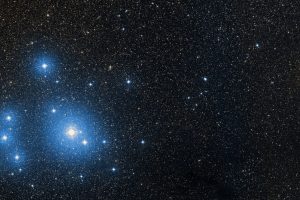
La figura di copertina (cliccare qui per visualizzarla interamente) mostra un’immagine DSS2 dell’ammasso stellare IC 2602. La posizione di TOI-837 è indicata con un cerchio giallo.

Mario Giuseppe Guarcello
Segui MarioSpiegaCose su Instagram () , Facebook (), Youtube () e X ()
Segui la pagina Facebook e Instagram dell’Osservatorio Astronomico di Palermo
Iscriviti al canale Youtube dell’Osservatorio Astronomico di Palermo[:en]
Analysis of TESS and HARPS observations confirms the existence of a Saturn-like planet orbiting a star associated with the young stellar cluster IC 2602
Stellar clusters are not only beautiful objects to photograph and observe through a telescope, but they also represent an important opportunity for studying stellar evolution. In fact, they are composed of rich samples of stars of different types but similar ages, whose physical properties can be estimated through targeted observations and comparison with theoretical models.
In theory, this could also apply to exoplanet research—particularly in young stellar clusters where it might be possible to observe planets in formation or in still-young planetary systems. However, the search and characterization of exoplanets in these environments presents significant observational challenges. Stellar clusters typically have very crowded star fields, which makes it difficult to study the temporal variability of stellar emission—an essential element in detecting exoplanets via the transit technique. Moreover, young stars are characterized by intense magnetic activity, which interferes with the spectroscopic signals used to detect and analyze exoplanets.
For these reasons, it is no surprise that confirmed planets around young stars spark considerable interest within the scientific community. A research team led by astrophysicist M. Damasso (INAF – Astrophysical Observatory of Turin) recently analyzed observations obtained from NASA’s TESS satellite and the HARPS spectrograph, installed on the La Silla telescope at the European Southern Observatory, to study an exoplanet orbiting the star TOI-837, which belongs to the young stellar cluster IC 2602 (35 million years old). The analysis confirmed the existence of the planet and allowed for an estimate of its physical properties, which are similar to those of Saturn.
Based on the observations and models of planetary formation and migration, the researchers suggest different possible internal composition for the planet, among which the possibility that it has a massive core (with a mass between 40 and 80 Earth masses) and a thick atmosphere that makes up between 30% and 60% of the planet’s total mass, as recently suggested by an indepentend study of astronomers of the Oxford University. The atmospheric mass loss caused by incident stellar radiation (i.e., through “photoevaporation”) appears to be rather limited, with the current estimated rate being just a few thousandths of an Earth mass per million years. The study also suggested the presence of a companion star to TOI-837, indicating that the system is likely a binary.
The article, titled “TOI-837 b: Characterisation, formation, and evolutionary history of an infant warm Saturn-mass planet“, was recently published in Astronomy & Astrophysics and lists among its co-authors astrophysicists D. Locci, A. Maggio, and S. Benatti of INAF – Astronomical Observatory of Palermo.
The cover image (click here to view it in full) shows a DSS2 image of the stellar cluster IC 2602. The position of TOI-837 is marked with a yellow circle.
Mario Giuseppe Guarcello
Follow MarioSpiegaCose on Instagram () , Facebook (), Youtube (), and X ()
Follow the Astronomical Observatory of Palermo on Facebok and on Instagram
Subscribe the Youtube channel of the Astronomical Observatory of Palermo [:]