
[:it]Un giovane pianeta a bassa densità per DS Tucanae A. Lo studio: “Constraints on the mass and atmospheric composition and evolution of the low-density young planet DS Tuc A b” di S. Benatti (INAF – OAPa) pubblicato su A&A[:en]A young and low-density planet for DS Tucanae A. The study: “Constraints on the mass and atmospheric composition and evolution of the low-density young planet DS Tuc A b” of S. Benatti (INAF – OAPa) recently appeared on A&A[:]
[:it]I pianeti orbitanti attorno stelle giovani (ad esempio, più giovani di 100 milioni di anni) sono oggetti di grande importanza, in quanto ci permettono di studiare i processi fisici in atto durante le prime fasi evolutive dei sistemi planetari. Scoprire e caratterizzare pianeti attorno stelle giovani, però, può essere decisamente complesso. Stelle di questa età, infatti, sono caratterizzate da una rotazione rapida ed un’intensa attività magnetica, fenomeni che producono segnali fotometrici e spettroscopici che possono mimare e confondere quelli dovuti alla presenza di pianeti.
L’intensa attività magnetica nelle stelle giovani si riflette anche in una maggiore produzione di radiazione ai raggi X ed UV. La radiazione in queste bande può avere effetti importanti sulle atmosfere dei pianeti, soprattutto nel caso di pianeti in orbite strette. A queste età, infatti, i pianeti hanno ancora atmosfere primordiali, particolarmente ricche di idrogeno. Dissociando ed ionizzando le molecole di gas, la radiazione ad alta energia deposita una grande quantità di energia nelle atmosfere planetarie, che tendono a “gonfiarsi” ed “evaporare”. Questo chiaramente influenza le proprietà (quali raggio e densità media) e l’evoluzione dei pianeti.
Uno dei pochi pianeti giovani scoperti finora orbita attorno la stella DS Tuc A, ossia la componente principale di un sistema binario di 40 milioni di anni, membro dell’associazione stellare Tucana-Horologium. Il team guidato dall’astrofisica S. Benatti dell’INAF – Osservatorio Astronomico di Palermo ha analizzato dati ottenuti con gli spettrografi ottici HARPS ed ESPRESSO dell’European Southern Observatory allo scopo di determinare la massa del pianeta. Nonostante l’intensa attività magnetica della stella, gli autori dello studio sono riusciti a determinare un limite superiore alla massa pari a 14.4 masse terrestri. Dall’analisi dei dati spettroscopici raccolti durante un transito, gli autori hanno anche potuto studiare l’inclinazione dell’orbita del pianeta, che risulta non essere perfettamente allineata. In linea di principio le osservazioni ottenute durante il transito avrebbero permesso di studiare la composizione chimica dell’atmosfera del pianeta, ma l’intensa attività magnetica ha ostacolato la rivelazione di composti chimici nell’atmosfera del pianeta, un problema che accomuna questi oggetti particolarmente giovani. Gli autori hanno anche analizzato osservazioni ai raggi X del sistema binario ottenute con il satellite XMM-Newton dell’European Space Agency, misurando una luminosità ai raggi X pari a 9.57×1029 erg s−1 per la componente principale. Grazie a questi risultati ed a modelli di evaporazione dell’atmosfera del pianeta, è risultato che il pianeta perderà circa il 10% della sua massa totale a causa dell’evaporazione indotta dalla radiazione X incidente, riducendo il suo raggio di un fattore 3 circa. Lo studio è descritto nell’articolo “Constraints on the mass and atmospheric composition and evolution of the low-density young planet DS Tuc A b“, recentemente pubblicato sulla rivista Astronomy & Astrophysics.
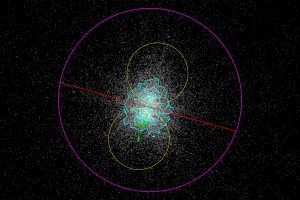
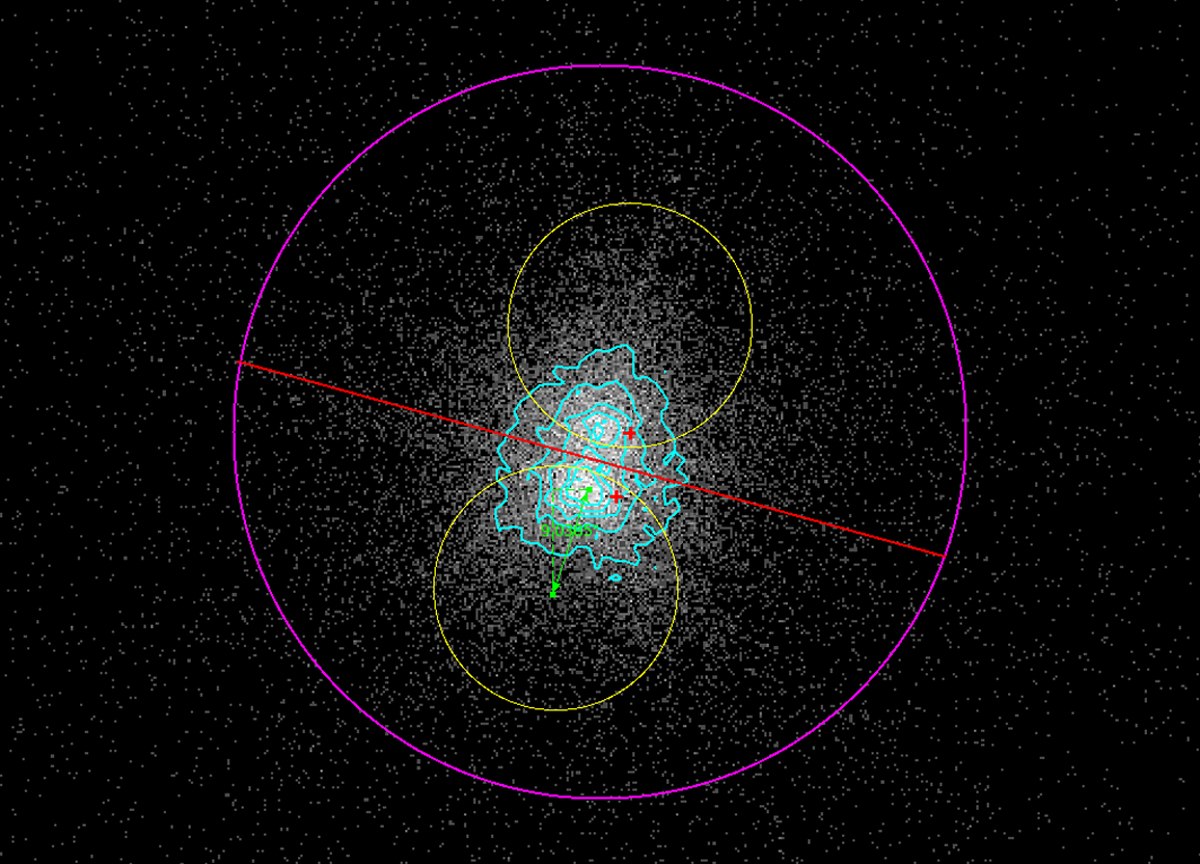
La figura (cliccare qui per visualizzarla interamente) mostra l’immagine ai raggi X del sistema binario DS Tuc ottenuta con lo strumento MOS1 di XMM-Newton. Il sistema binario è solo parzialmente risolto. Le due croci rosse indicano le posizioni delle due componenti secondo il database SIMBAD. I contorni dell’emissione ai raggi X (disegnati in azzurro) sono leggermente spostati rispetto le posizioni nominali a causa del moto proprio del sistema. I cerchi hanno un raggio di 30 arcosecondi (viola) e 10 arcosecondi (giallo).
Mario Giuseppe Guarcello ( segui mguarce) ( youtube)
Iscriviti al canale Youtube dell’Osservatorio Astronomico di Palermo
[:en]The study of planets orbiting around young stars (younger than 100 million years) can help astronomers understanding the physical processes setting the early evolution of planetary systems. However, young stars are typically characterized by rapid rotation and intense magnetic activity, phenomena which produce photometric and spectroscopic signals that can mimic and confuse those due to the presence of planets. It is thus quite difficult to discover and characterize planets around young stars.
The intense magnetic activity in young stars also produces a high level of emission in X-rays and UV bands. This radiation can seriously impact the atmospheres of planets, especially those orbiting close to the parent star. Young planets have in fact primordial atmospheres which are mainly constituted by hydrogen. The stellar energetic radiation dissociate and ionize the molecules in the gas, and thus it deposits a large amount of energy in the atmospheric layers. Under these conditions, the atmospheres inflate and evaporate, which affects both the main planetary properties (such as mass and radius) and their entire evolution.
One of the few young planets discovered so far orbits around the star DS Tuc A, which is the main component of a binary system 40 million years old, member of the stellar association Tucana-Horologium. The team led by the astronomer S. Benatti (INAF – Astronomical Observatory of Palermo) has analyzed data acquired with the optical spectrographs HARPS and ESPRESSO of the European Southern Observatory in order to better determine the mass of this planet. Despite the intense magnetic activity of the star, it was possible to estimate a mass upper limit of 14.4 Earth masses. Thanks to spectroscopic data acquired during a transit, the authors have studied the orbit of the planet, which is not perfectly aligned. In principle, these observations would have allowed the authors also to study the chemical composition of the atmosphere, ma the intense magnetic activity of the star hampered this possibility. The authors have also analyzed X-ray observations of the binary system acquired with the satellite XMM-Newton of the European Space Agency, achieving to estimate the X-ray luminosity of DS Tuc A (9.57×1029 erg s−1). Thanks to these results, and by applying models describing the evaporating atmosphere of the planet, it was possible to demonstrate that about 10% of the entire mass of the planet will evaporate by the end of the process, reducing its radius by a factor of about three. The study is describer in the paper “Constraints on the mass and atmospheric composition and evolution of the low-density young planet DS Tuc A b“, recently appeared on Astronomy & Astrophysics.
The figure (click here to visualize the entire figure) shows the X-ray image of DS Tuc acquired with the instrument MOS1 on board of XMM-Newton. The binary system is only partially resolved. The position of the two stars according to the SIMBAD database is marked with the red crosses. The small offset with respect the X-ray emission contours (shown in light blue) is due to the proper motion of the system. The circles have a radius of 30 arcsec (purple) and 10 arcsec (yellow).
Mario Giuseppe Guarcello ( follow mguarce) ( youtube)
Subscribe the Youtube of the Astronomical Observatory of Palermo[:]