
[:it]L’abbondanza di litio ed i processi interni nelle stelle. L’articolo: “The Gaia-ESO survey: Mixing processes in low-mass stars traced by lithium abundance in cluster and field stars” di L. Magrini (INAF – OA Arcetri) pubblicato su A&A[:en]Lithium abundance and stellar internal structure. The study: “The Gaia-ESO survey: Mixing processes in low-mass stars traced by lithium abundance in cluster and field stars” of L. Magrini (INAF – OA Arcetri) recently appeared on A&A[:]
[:it]Il Litio è un elemento chimico la cui abbondanza nell’Universo ha una storia complessa. Prodotto in percentuali molto ridotte durante il Big Bang, questo elemento chimico viene sia prodotto che distrutto continuamente da vari processi che avvengono nelle stelle. Di conseguenza, la quantità di litio che osserviamo nelle stelle oggi non riflette quella prodotta durante il Big Bang. Inoltre, fatta eccezione per le stelle di pre-sequenza con pochi milioni di anni di vita, l’abbondanza di litio misurata nelle stelle non riflette mai quella della nube da cui le stelle si sono formate. Ciò nonostante, misure di abbondanze di questo elemento chimico possono fornire preziose informazioni sui processi interni che avvengono nelle stelle.
Il litio viene infatti distrutto all’interno delle stelle, dove la temperatura raggiunge circa 2.5 milioni di gradi, attraverso processi di cattura di protoni. Durante la fase di sequenza principale, a questo processo contribuiscono anche diversi fenomeni responsabili del trasporto di litio dalla superficie a regioni interne delle stelle, dove la temperatura è alta a sufficienza per poterlo consumare. Nelle fasi evolutive successive, le abbondanze chimiche in superficie vengono ulteriormente alterate da fenomeni interni che contribuiscono ad arricchire la superficie stellare degli elementi prodotti dai processi che avvengono nell’interno delle stelle, alterando ulteriormente le abbondanze superficiali del litio.
Questi processi possono essere studiati con misure estensive di abbondanze chimiche in campioni abbastanza ricchi di stelle a diversa età, massa, e metallicità (ossia l’abbondanza degli elementi pesanti rispetto quella dell’idrogeno), e successivamente confrontando queste misure con le previsioni di modelli stellari che includono processi diversi per descrivere l’interno delle stelle e la loro evoluzione. Questa è la strategia adottata dal team di ricercatori guidato dall’astrofisica L. Magrini (INAF – Osservatorio Astrofisico di Arcetri) nello studio “The Gaia-ESO survey: Mixing processes in low-mass stars traced by lithium abundance in cluster and field stars“, recentemente pubblicato sulla rivista Astronomy & Astrophysics. Lo studio è basato sulle misure di abbondanze di litio ottenute dalla Gaia-ESO Survey in stelle di 57 ammassi stellari con età compresa tra i 130 milioni di anni ed i 7 miliardi di anni e di campo. Le misure di abbondanze di litio in stelle di età, massa e metallicità diverse non sono compatibili con valori previsti da modelli classici che descrivono la struttura delle stelle. Un accordo migliore è invece ottenuto usando modelli che includono gli effetti di mescolamento di materiale all’interno delle stelle dovuti a rotazione e instabilità, dimostrando l’importanza di questi fenomeni nel determinare le abbondanze chimiche superficiali che osserviamo in stelle dalle varie proprietà ed in diverse fasi evolutive. Hanno partecipato allo studio anche gli astronomi L. Prisinzano e F. Damiani dell’INAF – Osservatorio Astronomico di Palermo.
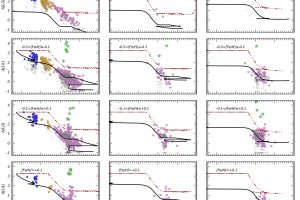
La figura (cliccare qui per visualizzare l’immagine interamente) mostra grafici dell’abbondanza di litio (A(Li)) in funzione della temperatura efficace delle stelle. I pannelli suddividono le stelle in intervalli di massa e metallicità. Stelle al turn-off della sequenza principale sono disegnate in blue, le sub-giganti in arancione, le giganti in rosa. Gli upper limits sono disegnati con triangoli grigi. Le curve mostrano i valori predetti da modelli teorici. I modelli includono una trattazione standard dei processi di mescolamento interno (linee tratteggiata) o una trattazione accurata dei processi indotti da rotazione ed instabilità (linee continue).

Mario Giuseppe Guarcello ( segui mguarce) ( youtube)
Iscriviti al canale Youtube dell’Osservatorio Astronomico di Palermo[:en]The chemical history of Lithium abundance in the Universe is very complex. This chemical element has been first produced during the Big Bang, even if in very small quantities compared with hydrogen and helium. Since then, lithium is continuously created and destroyed by several processes occurring in stellar interior. This means that the lithium abundances we observe in stars today does not reflect the primordial abundance of this element. Besides, with the only exception of very young (a few million years old) pre-main sequence stars, stellar lithium abundances are not related to the star-forming environment. Despite this, the study of lithium abundance in stars can shed an important light on the processes occurring inside the stars and on their evolution.
Lithium is in fact destroyed inside stars at a temperature of about 2.5 million degrees by proton-capture processes. During the main sequence, several phenomena occurring inside stars are responsible for carrying lithium from stellar surface to the interior where the temperature is high enough to trigger the destruction of this element. In the following evolutionary stages (such as sub-giant and giant phases), lithium in the stellar surface is even more diluted because of the processes that carry elements produced in stellar interior onto the surface.
All these phenomena can be studied with extensive measurements of lithium abundance in large sample of stars with different age, mass, and metallicity (which is the abundance of heavy elements compared with hydrogen), and then comparing the results with values predicted by models describing stellar internal structure accounting for different phenomena. This is the strategy adopted by the team of researchers led by L. Magrini (INAF – Astrophysical Observatory of Arcetri) in the study described in the paper “The Gaia-ESO survey: Mixing processes in low-mass stars traced by lithium abundance in cluster and field stars“, recently appeared in the journal Astronomy & Astrophysics. This research is based on measurements of lithium abundance obtained in the framework of the Gaia-ESO Survey for stars in 57 stellar clusters with an age between 130 million of years and 7 billion of years and field stars. The measurements of lithium abundance in stars with different age, mass and metallicity obtained by the team do not agree with the values predicted by classic models of stellar structure. A better agreement is instead observed using models that account for the internal mixing due to stellar rotation and instabilities. This demonstrate that it is important to account for these internal processes in order to reproduce the observed stellar abundances of lithium in stars with different properties and evolutive stages. The astronomers L. Prisinzano and F. Damiani of INAF – Astronomical Observatory of Palermo are among the coauthors of the paper.
The figure (click here to visualize the entire image) shows diagrams of lithium abundance (A(Li)) as a function of the stellar effective temperature. In each panel stars are sampled as a function of mass and metallicity. Stars at the main sequence turn-off are marked in blue, sub-giants in orange, and giants in pink. Upper limits are marked with gray triangles. The curves show the values predicted by theoretical models. Models including a standard description of the internal mixing processes are marked with dashed lines, models adopting accurate descriptions of the effects of rotation and instabilities with solid lines.
Mario Giuseppe Guarcello ( follow mguarce) ( youtube)
Subscribe the Youtube channel of the Astronomical Observatory of Palermo[:]