
[:it]La frazione di binarie delle Cefeidi rivelata da osservazioni ai raggi X. L’articolo: “X-Rays in Cepheids: Identifying Low-mass Companions of Intermediate-mass Stars” di N. R. Evans (SAO) pubblicato su ApJ [:en]The binary fraction in Cepheids revealed by X-ray observations. The paper: “X-Rays in Cepheids: Identifying Low-mass Companions of Intermediate-mass Stars” of N. R. Evans (SAO) recently appeared on ApJ [:]

[:it]Le Cefeidi sono stelle di grande importanza per la ben nota relazione tra periodo delle pulsazioni e luminosità. Si tratta infatti di stelle caratterizzate da pulsazioni regolari, che producono una variabilità periodica della loro luminosità, con un periodo che cresce linearmente con la magnitudine assoluta di queste stelle. Le Cefeidi hanno una massa di circa 5 masse solari, per cui provengono da stelle di classe spettrale B durante la fase di sequenza principale. Il loro percorso evolutivo può comunque essere fortemente influenzato dalla presenza di compagne.
Compagne di stelle cefeidi vengono spesso osservate a caratterizzate attraverso osservazioni spettroscopiche in ultravioletto. In questa banda, infatti, è più facile distinguere il segnale proveniente dalla stella cefeide da quello proveniente dalla stella compagna. Qusto però è strettamente vero quando la compagna è una stella calda (classi spettrali OBA). Per caratterizzare compagne più fredde (classi spettrali FGKM), possono rivelarsi particolarmente utili osservazioni ai raggi X. Le cefeidi sono infatti poco luminose ai raggi X, mentre stellle di piccola massa tendono ad essere molto più luminose.
Per studiare la binarietà delle cefeidi, 20 stelle di questa classe sono state recentemente osservate ai raggi X. L’articolo: “X-Rays in Cepheids: Identifying Low-mass Companions of Intermediate-mass Stars” di N. R. Evans (Smithsonian Astrophysical Observatory) presenta le osservazioni di due stelle di questo campione (la stella Polare e l Carinae) ottenute con il satellite della NASA Chandra, e l’analisi delle osservazioni di tutto il campione. Come atteso, le due stelle non sono particolarmente brillanti ai raggi X. La luminosità X di Polaris è leggermente superiore a quella del Sole durante il massimo di attività (circa 6×1028 erg/s), l Car è meno luminosa, ed in entrambi i casi la luminosità ai raggi X non aumenta in corrispondenza del picco di emissione in ottico. Da questa campagna osservativa risulta che circa il 28% delle cefeidi ha una compagna di piccola massa. Confrontando questa stima con quella riguardo compagne più massicce (57%), si può in principio dedurre il processo dominante che porta alla formazione di questi sistemi, che da questo studio risulta essere una combinazione di frammentazione di un comune disco circumbinario e cattura di una stella formatasi indipendentemente. Tra i coautori dello studio, l’astronomo I. Pillitteri dell’INAF – Osservatorio Astronomico di Palermo.
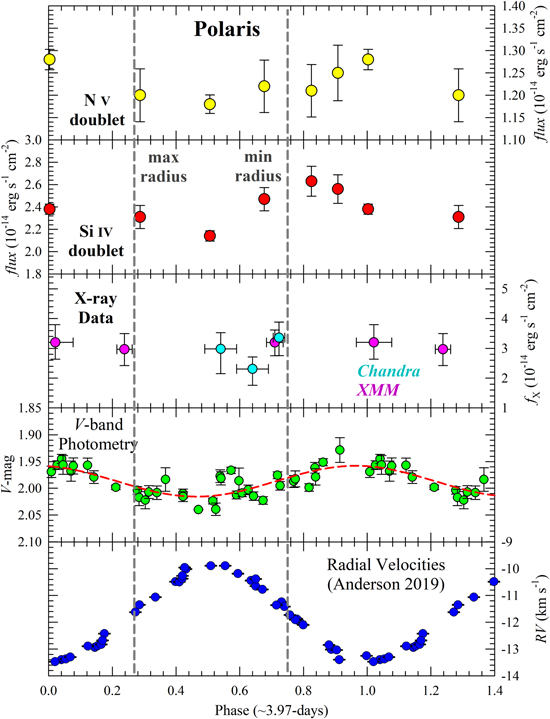
La figura (cliccare qui per visualizzare l’immagine interamente) mostra la variabilità di Polaris in funzione della fase in diverse lunghezze d’onda: l’intensità delle righe di emissione N v e Si iv, ai raggi X, in banda V, ed in velocità radiale (oscillazioni dei centroidi delle righe nello spettro della stella a causa dell’effetto Doppler).
Mario Giuseppe Guarcello ( segui mguarce) ( youtube)
Segui la pagina Facebook dell’Osservatorio Astronomico di Palermo
Iscriviti al canale Youtube dell’Osservatorio Astronomico di Palermo
[:en]Cepheids are important stars for the well-known relation between the period of their pulsations and their intrinsic luminosities. These stars are in fact characterized by regular pulsations whose period increases linearly with their absolute magnitude. Cepheids have a mass of about 5 solar masses, thus their progenitors are B stars in Main Sequence. However, their evolutionary path can be affected by binarity.
Companions of cepheids are often characterized by means of spectroscopic observations in the UV. In this band, in fact, it is easier to distinguish the spectrum of the cepheids from that of their companions. However, this is strickly true when the companion is a hot star, with spectral class OBA. X-ray observations can be useful, instead, to characterize low-mass companions (spectral classes FGKM). Cepheids are in fact quite faint X-ray sources, while low mass stars can be a few orders of magnitude brighter.
In order to study the binarity in cepheids, 20 stars have recently been observed in X-rays. The paper: “X-Rays in Cepheids: Identifying Low-mass Companions of Intermediate-mass Stars” of N. R. Evans (Smithsonian Astrophysical Observatory) presents the observations of two stars of this class (Polaris and l Carinae), recently obtained with the NASA satellite Chandra, and the analysis of the whole sample. As expected, these two stars are not particularly bright in X-rays. The X-ray luminosity of Polaris is slightly higher than that of the Sun during the peak of its activity (about 6×1028 erg/s), while l Car is fainter. Besides, non of these stars is brighter in X-ray during the peak of their optical pulsation. From this survey, results that about 28% of the cepheids have a low-mass companion. Comparing this estimate with that of more massive companions (57%), it is possible to estimate the driving formation process for these systems, which in this case seems to be a combination of formation by fragmentation of a common circumbinary disk and capture of an indipendently-formed star. Among the coauthors, the astronomer I. Pillitteri of INAF – Astronomical Observatory of Palermo.
The figure (click here to visualize the entire image) shows the variability of Polaris in various optical bands: the intensity of the emission lines N v and Si iv, in X-rays, in the V band, and in radial velocity (periodic oscillations of the centroids of spectral lines due to Doppler effect).
Mario Giuseppe Guarcello ( follow mguarce) ( youtube)
Follow the Astronomical Observatory of Palermo on Facebok
Subscribe the Youtube channel of the Astronomical Observatory of Palermo[:]