
[:it]Il superammasso Westerlund 1 ai raggi X. L’articolo: “EWOCS-I: The catalog of X-ray sources in Westerlund 1 from the Extended Westerlund 1 and 2 Open Clusters Survey” di M. G. Guarcello (INAF-OAPA) pubblicato su A&A[:en]The super star cluster Westerlund 1 observed in X-rays. The study: “EWOCS-I: The catalog of X-ray sources in Westerlund 1 from the Extended Westerlund 1 and 2 Open Clusters Survey” of M. G. Guarcello (INAF-OAPA) recently appeared on A&A[:]
[:it]Gli ammassi stellari sono oggetti di grande interesse nello studio di vari aspetti dell’evoluzione stellare e, nel caso degli ammassi più giovani, per la ricerca sui prodotti del processo di formazione stellare e planetaria. La nostra Galassia ospita una ricca popolazione di ammassi stellari giovani, i quali tipicamente presentano una massa di alcune centinaia di masse solari. Nell’intorno solare, ad esempio, si trovano solo pochi ammassi stellari giovani con una massa di alcune migliaia di masse solari, come il Trapezio nella Nebulosa di Orione o NGC2264 nella Nebulosa Cono.
Quali sono gli ammassi stellari giovani più massicci nella Via Lattea? Attualmente, la nostra Galassia ospita davvero pochi ammassi con una massa superiore a alcune decine di migliaia di masse solari, come ad esempio gli ammassi stellari Westerlund 1 e 2, NGC3603, o l’Arches ed il Quintuplet Cluster, questi ultimi situati vicino al centro della Via Lattea. Questi rari “ammassi stellari supermassicci” costituiscono, in realtà, oggetti di notevole interesse scientifico. Essi infatti rappresentano un ambiente di formazione stellare estremo, caratterizzato da intensi campi di radiazione ultravioletta e raggi X, nonché da particelle relativistiche, prodotti da ricche e compatte popolazioni di stelle di grande massa. Questa radiazione influisce su tutti gli aspetti del processo di formazione stellare e planetaria, che quindi si svolge negli ambienti supermassicci in modo diverso rispetto agli ambienti di piccola massa. Inoltre, gli ammassi stellari supermassicci sono comunemente osservati nelle galassie che attraversano epoche di intensa formazione stellare, come le galassie interagenti e quelle dell’Universo primordiale. Perfino nella Via Lattea, durante i principali episodi di fusione con le galassie nane circostanti, la formazione stellare in ambienti supermassicci era più frequente rispetto alla situazione attuale.
L’ammasso stellare giovane più massiccio nella Via Lattea è proprio Westerlund 1, con una massa attuale superiore alle centinaia di migliaia di masse solari, una distanza di circa 14000 anni luce da noi (il più vicino ammasso supermassiccio al Sole), ed un’età inferiore ai 10 milioni di anni. Grazie a queste caratteristiche, Westerlund 1 rappresenta l’oggetto ideale per studiare i risultati del processo di formazione stellare e planetaria in ambienti di formazione stellare supermassiccia. Inoltre, Westerlund 1 ospita la più ricca popolazione di stelle di grande massa mai osservata in un ammasso stellare della Via Lattea, e alcuni oggetti compatti generati dall’esplosione delle stelle più massicce formate nell’ammasso.
Questo ha motivato il progetto EWOCS (Extended Westerlund 1 and 2 Open Clusters Survey), guidato dall’astrofisico M. G. Guarcello (INAF – Osservatorio Astronomico di Palermo) e mirato a studiare i due superammassi stellari Westerlund 1 e 2. Il progetto si basa principalmente su osservazioni in infrarosso ottenute dal James Webb Space Telescope e su una lunga osservazione ai raggi X (311 ore) ottenuta con Chandra/ACIS di Westerlund 1. L’osservazione ai raggi X è necessaria per selezionare le stelle giovani associate all’ammasso stellare, grazie all’elevato livello di emissione di raggi X tipico delle stelle di pochi milioni di anni di età, e per studiare i processi ad alta energia che avvengono in queste stelle, nelle stelle di grande massa, negli oggetti compatti e all’interno dell’ammasso. Il primo studio prodotto dal progetto EWOCS, intitolato “EWOCS-I: The catalog of X-ray sources in Westerlund 1 from the Extended Westerlund 1 and 2 Open Clusters Survey“, guidato da M. G. Guarcello e pubblicato su Astronomy & Astrophysics, presenta l’analisi delle osservazioni ai raggi X di Westerlund 1 e l’identificazione di 5963 sorgenti di raggi X, per lo più stelle dell’ammasso. La sorgente più luminosa ai raggi X in Westerlund 1 è la pulsar CXO J164710.20-455217, una stella a neutroni generata da una supernova avvenuta circa 700000 anni fa. La pulsar è seguita da alcune stelle di grande massa e stelle di Wolf-Rayet in sistemi binari, dove i raggi X sono prodotti principalmente nella regione in cui i venti delle stelle massicce collidono a centinaia di km/s, riscaldandosi a milioni di gradi. Il catalogo sarà utilizzato nella maggior parte degli studi futuri associati al progetto EWOCS.
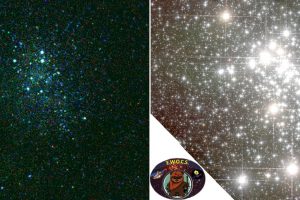
La figura (cliccare qui per visualizzarla interamente) mostra due immagini RGB di Westerlund 1: una ai raggi X ottenuta dalle osservazioni di Chandra/ACIS ed una in infrarosso ottenuta con l’Hubble Space Telescope.

Mario Giuseppe Guarcello ( segui mariospiegacose) ( mariospiegacose)( follow mariospiegacose)
Segui la pagina Facebook e Instagram dell’Osservatorio Astronomico di Palermo
Iscriviti al canale Youtube dell’Osservatorio Astronomico di Palermo
[:en]Stellar clusters are important targets for studying stellar evolution and, in the case of the youngest star clusters, the products of the star and planet formation processes. Our galaxy hosts a rich population of young stellar clusters, typically with masses of a few hundred solar masses. In the solar neighborhood, for instance, there are only a few young clusters with a mass of a few thousand solar masses, such as the Trapezium in Orion and NGC2264 in the Cone Nebula.
What are the most massive young clusters in the Milky Way? Currently, our Galaxy hosts only a few young star clusters with a mass exceeding ten thousand solar masses, such as the star clusters Westerlund 1 and 2, NGC3603, or the Arches and the Quintuplet Clusters, which are located near the center of our Galaxy. These rare “supermassive star clusters” are actually targets of great importance, as they represent the most extreme star-forming environments, characterized by intense fields of UV and X-ray radiation, and relativistic particles, produced by the compact and rich populations of massive stars in these clusters. Since this energetic radiation impacts every aspect of the star and planet formation process, stars and planets form differently in such massive star-forming environments compared to low-mass ones. Additionally, supermassive star clusters are common in galaxies experiencing intense epochs of star formation, such as interacting galaxies or in the early Universe. Even in the Milky Way, during major merging events, star formation typically occurred in supermassive star-forming environments.
The most massive young stellar cluster known in the Milky Way is Westerlund 1, with an actual mass exceeding 100000 solar masses, a distance from us of about 14000 light years (being the closest supermassive star cluster to the Sun), and an age of less than 10 million years. Given its characteristics, Westerlund 1 is the best target to study the products of star and planet formation processes in supermassive star-forming environments. Additionally, Westerlund 1 hosts the richest population of massive stars known in the Milky Way, along with some compact objects produced by past supernova explosions that occurred in the cluster.
This has motivated the project EWOCS (Extended Westerlund 1 and 2 Open Clusters Survey), led by the astronomer M. G. Guarcello (INAF – Astronomical Observatory of Palermo), which aims to study the two supermassive star clusters Westerlund 1 and 2. The project is primarily based on infrared observations with the Hubble Space Telescope and the James Webb Space Telescope, along with long X-ray observations (311 hours) using Chandra/ACIS. The X-ray observation is crucial for selecting the young stars in Westerlund 1, thanks to the high level of X-ray emission typical of young stars, and for studying the energetic phenomena occurring in these young stars, massive stars, compact objects, and within the cluster. The first study produced in the framework of EWOCS is titled “EWOCS-I: The catalog of X-ray sources in Westerlund 1 from the Extended Westerlund 1 and 2 Open Clusters Survey“, led by M. G. Guarcello and recently published in Astronomy & Astrophysics. The paper presents the analysis of the X-ray observations of Westerlund 1, as well as the selection and validation of 5963 X-ray sources, primarily stars within the cluster. The brightest X-ray source in Westerlund 1 is the pulsar CXO J164710.20-455217, a neutron star produced by a supernova explosion that occurred about 700000 years ago. The pulsar is followed by some massive stars and Wolf-Rayet stars in binary systems, where most of the X-rays are produced in the region where the winds of the massive stars collide at velocities of several hundred km per hour, reaching temperatures of millions of degrees. The catalog will be used in most of the upcoming EWOCS studies.
The figure (click here to view it in its entirety) displays two RGB images of Westerlund 1: one in X-ray produced with the Chandra/ACIS observations, and one in infrared produced with the Hubble Space Telescope (HST) observations.
Mario Giuseppe Guarcello ( follow mariospiegacose) ( mariospiegacose) ( follow mariospiegacose)
Follow the Astronomical Observatory of Palermo on Facebok and on Instagram
Subscribe the Youtube channel of the Astronomical Observatory of Palermo[:]