
[:it]Formazione stellare nell’associazione del Cane Maggiore. Pubblicato su A&A “Star formation history of Canis Major OB1” di T. Santos-Silva[:en]Star formation history in Canis Major. Recently published by A&A “Star formation history of Canis Major OB1” of T. Santos-Silva[:]

[:it]
di Mario Giuseppe Guarcello ( segui mguarce)
Sempre più spesso vengono osservate regioni di formazione stellare le cui stelle non hanno una singola età ben definita. Questo supporta l’idea che la formazione stellare in una nube molecolare sia un processo lento che si può propagare attraverso la nube in milioni di anni (come indicato, ad esempio, dallo studio di Palla & Stahler 2000). Questa ipotesi si contrappone a quella di un processo di formazione stellare tipicamente rapido e ben definito nel tempo (ad esempio supportato dallo studio di Dib e collaboratori del 2010).
Lo studio di questo processo richiede una conoscenza profonda delle stelle giovani in regioni di formazione stellare, della loro età, e della loro dinamica, cosa spesso alquanto complicata. Ciò nonostante, comunque, abbiamo compreso che esistono vari fenomeni che possono indurre e propagare il processo di formazione stellare in una nube: la radiazione UV emessa da popolazioni stellari ricche di stelle massive, esplosioni di supernovae, o la dinamica delle nubi stesse.
Lo studio “Star formation history of Canis Major OB1. II. A bimodal X-ray population revealed by XMM-Newton” di T. Santos-Silva (Università di San Paolo ed Istituto di Astrofisica di Parigi), pubblicato recentemente su Astronomy & Astrophysics, quantifica ed analizza la cronologia del processo di formazione stellare nell’associazione OB “Canis Major OB1”. Avvalendosi di osservazioni ai raggi X con il telescopio XMM-Newton, e del fatto che le stelle di presequenza sono alcuni ordini di grandezza più brillanti ai raggi X delle stelle di sequenza principale e giganti, gli autori dello studio hanno identificato circa 300 stelle di presequenza formate in questa regione. L’età di queste stelle è stata quantificata usando fotometria in infrarosso (bande JHK dal catalogo 2MASS). Il risultato è che l’80% dei candidati membri di Canis Major OB1 presenta un’età di circa 5 milioni di anni o circa 10 milioni di anni, mentre il restante 20% un’età compresa tra questi due valori. Questa distribuzione bimodale di età indica quindi che la regione sia stata interessata da due episodi principali di formazione stellare separati da circa 5 milioni di anni. Allo studio ha collaborato l’astronoma Beate Stelzer dell’Osservatorio Astronomico di Palermo.
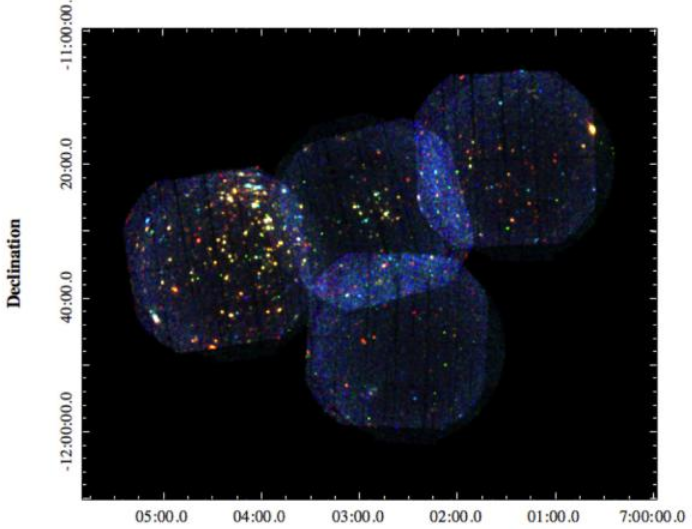
L’immagine in figura (link) mostra il mosaico di osservazioni XMM-Newton su cui si basa lo studio.[:en]Stars in several star forming regions are observed with a spread in age. This support the idea that star formation is a “slow” process which can propagate across a molecular cloud over million of years (as suggested, for instance, by the Palla & Stahler 2000 study), while several authors have instead suggested that star formation is a “fast” process (e.g. Dib et al. 2010).
The study of the star formation history in a molecular cloud requires a precise identification of stars formed into the cloud, and determination of their age and motion. Even if this is typically very difficult to achieve, we have understood that several processes can induce and propagate star formation across a cloud, such as the UV radiation emitted by large population of massive stars, supernovae explosions, or the dynamic of clouds themselves.
The study “Star formation history of Canis Major OB1. II. A bimodal X-ray population revealed by XMM-Newton” of T. Santos-Silva (Universidade de São Paulo and Institut d’Astrophysique de Paris) have analyzed the star formation process in the OB association “Canis Major OB1”. Thanks to recent X-ray observations from XMM/Newton and the fact that young pre-main sequence stars are order of magnitudes brighter in X-rays than old main sequence and giant stars, the authors of this study have identified more than 300 stars formed in this region. Their age has been determined using infrared photometry in JHK bands from 2MASS. With this approach, they have found that 80% of the candidate members of Canis Major OB1 have an age of 5 Myrs or 10 Myrs, while the remainder 20% has an age between these two values. This bimodal age distribution suggests that star formation occurred in Canis Major OB1 in two major events, 5 and 10 Myrs ago. The astronomer Beate Stelzer of the Astronomical Observatory of Palermo is coauthor of this study.
The figure (link) shows the XMM-Newton observations analyzed in this study.[:]