[:it]La morfologia del resto di supernova ricco di ossigeno N132D. Lo studio: “Three-dimensional Kinematic Reconstruction of the Optically Emitting, High-velocity, Oxygen-rich Ejecta of Supernova Remnant N132D” di C. J. Law (CfA) pubblicato su ApJ[:en]The morphology of the oxygen-rich supernova remnant N132D. The study: “Three-dimensional Kinematic Reconstruction of the Optically Emitting, High-velocity, Oxygen-rich Ejecta of Supernova Remnant N132D” of C. J. Law (CfA) recently appeared on ApJ[:]

[:it]Le supernove sono quasi unicamente osservate in galassie lontane, a distanze tali da non poter risolvere spazialmente i materiali espulsi e la loro interazione con il mezzo inter- e circumstellare. Con la sola eccezione di SN 1987 A, nella Via Lattea e nelle galassie vicine (principalmente le Nubi di Magellano) non abbiamo osservato in tempi recenti esplosioni di supernova, ma possiamo studiare i resti di supernova in grande dettaglio, e da questi risalire alle proprietà dell’esplosione e delle stelle progenitrici.


N132D è il resto di supernova più luminoso ai raggi X e γ della Grande Nube di Magellano (alla distanza di circa 163 mila anni luce dal Sole). Inoltre, i suoi ejecta (ossia il materiale stellare espulso dalla supernova a velocità di diverse migliaia di km/sec) sono ricchi di ossigeno e poveri di idrogeno. Questa importante proprietà suggerisce che la stella progenitrice abbia perso gli strati esterni (ricchi di idrogeno) nelle ultime fasi della sua evoluzione, prima dell’esplosione. A differenza dei resti di supernova ricchi di idrogeno, quindi, la morfologia e la dinamica degli ejecta in N132D può svelare dettagli importanti dei processi fisici coinvolti nell’esplosione nelle zone più interne della stella (infatti le stelle giganti sintetizzano elementi via via più pesanti nelle loro regioni più interne, per cui le regioni ricche di ossigeno nelle stelle supergiganti sono più in profondità di quelle ricche di idrogeno ed elio).


Il team guidato dall’astrofisico C. J. Law (Harvard-Smithsonian Center for Astrophysics), a cui partecipa anche l’astrofisico S. Orlando (INAF – Osservatorio Astronomico di Palermo), ha analizzato nuovi dati di N132D ottenuti con il telescopio Magellan, allo scopo di studiare morfologia e dinamica dei suoi ejecta ricchi di ossigeno. Le osservazioni hanno rivelato che questi ejecta sono principalmente disposti lungo un “toro” (superficie a forma di ciambella) incompleto lungo la sua circonferenza, dal raggio di 14.5 anni luce, ed inclinato rispetto la linea di vista di circa 28 gradi. La velocità media di espansione degli ejecta è di circa 1750 km/sec, che, supponendo un’espansione omologa del resto di supernova (ossia un’espansione in cui la geometria non cambia a meno di un fattore di scala), corrisponde ad un’età del resto di supernova di 2450±195 anni. Inoltre, gli autori hanno individuato un addensamento di materia (knot) ricco di silicio, che si muove in direzione pressoché perpendicolare al toro con una velocità di 3650 km/sec. L’abbondanza di silicio e la direzione del moto di questo knot fa supporre che sia stato lanciato da regioni interne della stella durante l’esplosione di supernova. Lo studio è descritto nell’articolo: “Three-dimensional Kinematic Reconstruction of the Optically Emitting, High-velocity, Oxygen-rich Ejecta of Supernova Remnant N132D“, pubblicato su The Astrophysical Journal.


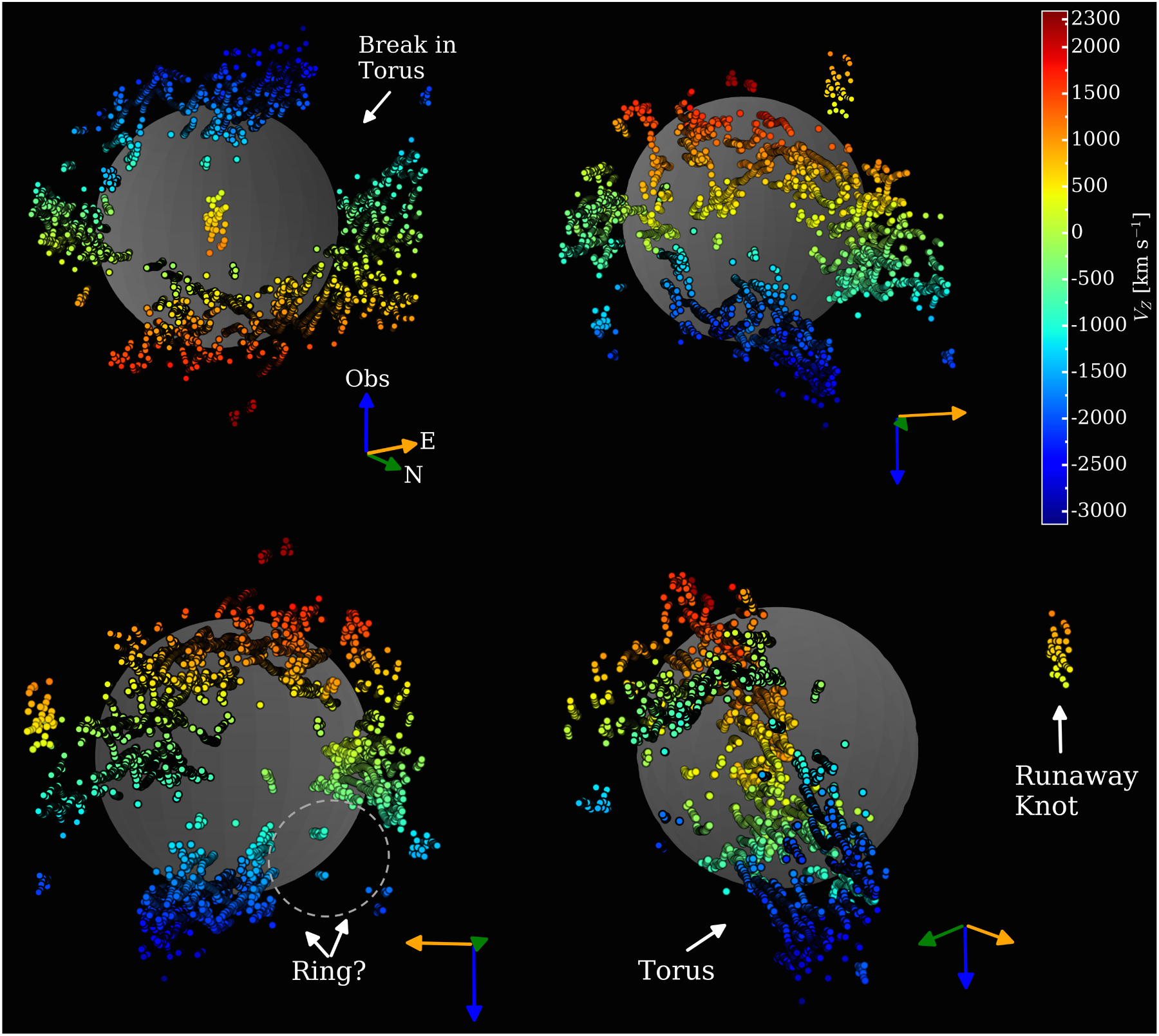
La figura (cliccare qui per visualizzare l’immagine intera) mostra una ricostruzione Doppler 3D degli ejecta ricchi di ossigeno di N132D. I vari pannelli mostrano la struttura in diverse inclinazioni. La sfera serve solamente a distinguere tra il materiale posto davanti e dietro rispetto la linea di vista.
 

Mario Giuseppe Guarcello  ( segui mguarce)[:en]Supernove explosions are repeatedly observed in distant galaxies, which lie at such large distances that it is impossible for us to resolve the geometry of the ejected material and its interaction with the surrounding interstellar and circumstellar clouds. With the only exception of SN 1978A, in the Milky Way and in the nearby galaxies (namely the Magellanic Clouds), we did not observed supernove during the telescopes era, but we can study their remnants with high spatial resolution their remnant in order to derive crucial information on the physics involved in supernova explosions and the properties of their progenitor stars.


N132D is the brightest supernova remnant in X and γ rays in the Large Magellanic Cloud, at a distance of about 163000 light years from us. Its ejecta (e.g. the stellar material ejected during the explosion at velocities of several thousands km/sec) are rich in oxygen and with low concentration of hydrogen. This suggests that the progenitor star lost its outer envelops (hydrogen-rich) during its late evolution, before the supernova explosion. Thus, while in hydrogen-rich supernova remnants the morphology and dynamics of the ejecta probe the explosion in the stellar outer layer, in the oxygen-rich remnants such as N132D, they probe the explosion in the deep layers of the star (supergiant stars synthesize heavy elements into deep layers, which means that while the outer layers of these stars are rich in hydrogen and helium, the deeper layers are rich in heavier elements such as oxygen).


The international team of astronomers led by C. J. Law (Harvard-Smithsonian Center for Astrophysics), counting also the astronomer S. Orlando (INAF – Astronomical Observatory of Palermo), has analyzed new observations of the oxygen-rich ejecta of N132D acquired with the Magellan Telescope, with the aim of studying their morphology and dynamics. The team has shown that the oxygen-rich ejecta mainly lie in a torus which is incomplete along its circumference, inclined about 28 degrees with respect to the line of sight, and with a radius of about 14.5 light years. The average expansion velocity of the ejecta is 1750 km/sec, which, with the hypothesis of a homologous expansion (e.g. without changing its shape except for a scaling factor) suggests that the remnant is 2450±195 years old. Besides, the authors have identified a silicon-rich knot of ejected material moving at about 3650 km/sec in a direction almost perpendicular to the torus. Both its chemical composition and motion suggest that this knot was ejected from deep inside the progenitor star during the supernova explosion. The study is described in the paper: “Three-dimensional Kinematic Reconstruction of the Optically Emitting, High-velocity, Oxygen-rich Ejecta of Supernova Remnant N132D“, which recently appeared on The Astrophysical Journal.


The image (click here to visualize the entire figure) shows a 3D Doppler reconstruction of the oxygen-rich ejecta of N132D. The different panels show the ejecta at different inclinations. The sphere helps discerning between ejecta in the front and in the back with respect the line of sight.


Mario Giuseppe Guarcello  ( follow mguarce)[:]