
[:it]Scoperto il primo sistema esoplanetario con pianeti in orbite sia polari che equatoriali. Lo studio: “The Rossiter-McLaughlin effect revolutions: an ultra-short period planet and a warm mini-Neptune on perpendicular orbits” di V. Bourrier (Observatoire Astronomique de l’Université de Genève) pubblicato da A&A[:en]Discovered the first planetary system with planets both in equatorial and polar orbits revealed by the study: “The Rossiter-McLaughlin effect revolutions: an ultra-short period planet and a warm mini-Neptune on perpendicular orbits” of V. Bourrier (Observatoire Astronomique de l’Université de Genève), appeared on A&A[:]

[:it]Lo studio delle architetture dei sistemi esoplanetari, ed in particolare dell’angolo spin-orbita (ossia l’inclinazione dell’orbita dei pianeti rispetto all’asse di rotazione della stella) può svelare importanti dettagli sull’evoluzione dinamica di un sistema planetario. In particolare, frequentemente i pianeti giovani possono migrare radialmente, cambiando la propria distanza dalla stella ed interagendo con gli altri corpi del sistema planetario. Questo processo può anche influenzare l’inclinazione dell’angolo spin-orbita. Questo può avvenire sia se il disco di gas e polveri da cui i pianeti stessi si stanno formando (il disco protoplanetario) è deformato o inclinato, che come conseguenza dell’interazione gravitazionale tra il sistema esoplanetario e stelle vicine o tra i pianeti stessi durante i processi di migrazione.
Uno strumento efficace per derivare l’inclinazione dell’orbita di esopianeti transitanti (ossia pianeti che transitano davanti alla propria stella rispetto alla nostra linea di vista durante la loro orbita) è lo studio dell’effetto Rossiter-McLaughlin. Quando un pianeta occulta la propria stella, che nel frattempo sta ruotando attorno al proprio asse, le righe in assorbimento osservabili nello spettro della stella presentano un profilo deformato proprio in funzione dell’inclinazione tra orbita del pianeta ed asse di rotazione della stella. Lo studio di questo effetto, quindi, permette di comprendere la geometria di un sistema esoplanetario con pianeti transitanti.
Il team di ricercatori guidato da V. Bourrier (Observatoire Astronomique de l’Université de Genève) ha presentato un nuovo approccio per studiare l’effetto Rossiter-McLaughlin in sistemi con più pianeti. Questo metodo consiste nell’analizzare contemporaneamente i profili delle righe osservate dalle regioni della fotosfera stellare occultate d a tutti gli esopianeti transitanti del sistema, possibilmente combinando osservazioni dei vari transiti ottenuti con strumenti diversi. Allo scopo di testarne la validità, i ricercatori hanno applicato il metodo all’analisi di osservazioni del sistema HD 3167, situato a circa 155 anni luce di distanza dalla Terra, che ospita ben tre pianeti: HD 3167b è una super-Terra di circa 5 masse terrestri, con un periodo orbitale di appena 0.96 giorni; HD 3167c è un mini-Nettuno di 9.8 masse terrestri, con un periodo orbitale di circa 30 giorni; HD 3167d ha una massa di circa 7 masse terrestri e non è un pianeta transitante. Le osservazioni sono state ottenute con lo spettrografo ESPRESSO per HD 3167b, strumento montato al Very Large Telescope dell’European Southern Observatory e realizzato anche grazie ad una grande partecipazione della comunità scientifica italiana, e con HARPS-N al Telescopio Nazionale Galileo dell’Istituto Nazionale di Astrofisica per HD 3167c. Lo studio ha rivelato un’architettura di questo sistema esoplanetario alquanto complessa: HD 3167b ha infatti un’orbita equatoriale, mentre HD 3167c si trova su un’orbita praticamente polare, inclinata rispetto la prima di circa novanta gradi. Questa complessa geometria, osservata per la prima volta in un sistema esoplanetario, è conseguenza di una diversa evoluzione dinamica dei due pianeti, con HD 3167b che conserva l’orbita primordiale del disco protoplanetario da cui si è formato, avendo subito poche interazioni durante la sua evoluzione, mentre l’orbita di HD 3167c è stata perturbata da interazioni gravitazionali. Lo studio è descritto nell’articolo: “The Rossiter-McLaughlin effect revolutions: an ultra-short period planet and a warm mini-Neptune on perpendicular orbits“, recentemente pubblicato su Astronomy & Astrophysics con la collaborazione di G. Micela dell’INAF – Osservatorio Astronomico di Palermo.
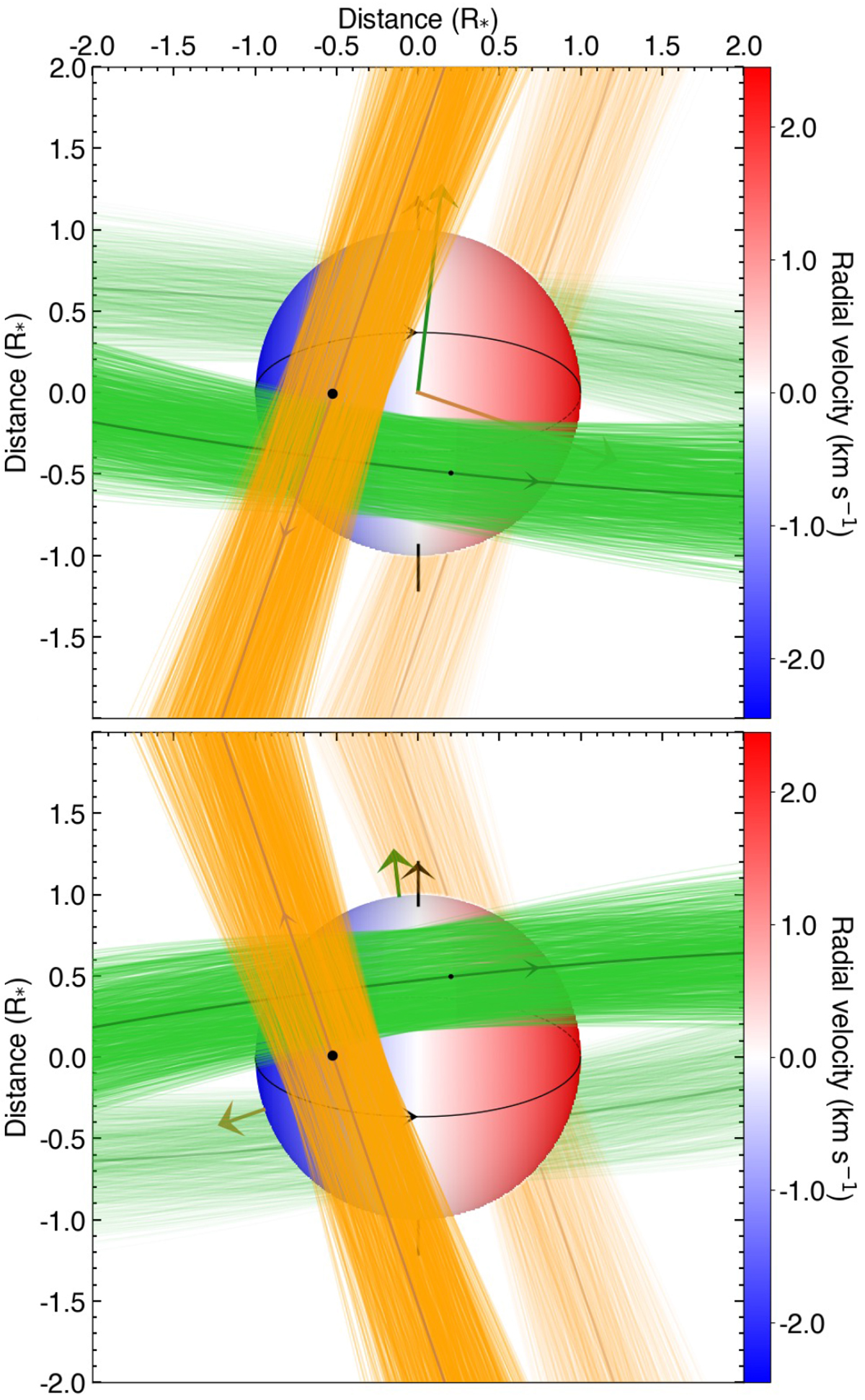
La figura (cliccare qui per visualizzare l’immagine interamente) mostra la soluzione orbitale per il sistema HD 3167. Le freccie nere indicano l’asse di rotazione della stella, la cui superficie è colorata indicando il segnale di velocità radiale dovuto alla rotazione (blu in rotazione verso l’osservatore, rosso in rotazione nella direzione opposta). L’equatore della stella è indicato con una linea nera. Le possibili orbite di HD 3167b e HD 3167c sono indicate con linee verdi e marroni, rispettivamente.
Mario Giuseppe Guarcello ( segui mguarce) ( youtube)
Iscriviti al canale Youtube dell’Osservatorio Astronomico di Palermo[:en]The study of the architecture of planetary systems, and in particular that of the spin-orbit angle (which is the inclination of the planetary orbit with respect to the stellar rotation axis) can unveil important details on the dynamical evolution of planetary systems. In particular, young planets typically migrate radially, changing their distance to the host star and interacting with the other bodies of their planetary systems. This process can also affect the spin-orbit angle of the planets. This may occur because the disc of gas and dust from which the planet is forming (the protoplanetary disc) is itself deformed or inclined, or as a consequence of the gravitational interaction between the planetary system and a nearby star, or among the planets of the system itself during the radial migration.
A powerful method to derive the inclination of the orbit of transiting exoplanets (which are planets that, during their orbit, pass in front of their star along our line of sight) is by studying the Rossiter-McLaughlin effect. This effect consists in a deformation of the profile of absorption lines in stellar spectra due to the transit of the planets across the rotating stellar surface. From the analysis of this effect it is thus possible to derive the geometry of a planetary system with transiting exoplanets.
The team of researchers led by V. Bourrier (Observatoire Astronomique de l’Université de Genève) recently presented a new method aimed at analyzing the Rossiter-McLaughlin effect in planetary systems hosting more than one exoplanet. This method consists in the simultaneous fit of the local lines from regions of the stellar surface occulted by all transiting exoplanets in a system, possibly combining data acquired with different spectrographs for each planet. As a test, the authors have applied their method to the system orbiting around the star HD 3167, at a distance of about 155 light years from Earth. The system hosts three planets: HD 3167b is a super-Earth with a mass of about 5 Earth masses and with an orbital period of just 0.96 days; HD 3167c is a mini-Neptune with a mass of about 9.8 Earth masses and an orbital period of about 30 days; HD 3167d has a mass of about 7 Earth masses and it is not a transiting exoplanet. The observations were obtained from ESPRESSO, mounted on the Very Large Telescope of the European Southern Observatory, for HD 3167b, and with HARPS-N, mounted on the Telescopio Nazionale Galileo of the Italian Institute for Astrophysics, for HD 3167c. The study has revealed that the planetary system of HD 3167 has a complicated architecture, with HD 3167b being on an equatorial orbit, while HD 3167c on a polar orbit. This complex geometry, observed for the first time in an exoplanetary system, is a consequence of the different dynamical evolution of the two planets, with HD 3167b still keeping its primordial orbit, which coincides with that of the protoplanetary disc, while the orbit of HD 3167c has been inclined by the secular gravitational interaction with other objects. The study is described in the paper: “The Rossiter-McLaughlin effect revolutions: an ultra-short period planet and a warm mini-Neptune on perpendicular orbits“, recently appeared on Astronomy & Astrophysics, with the collaboration, among the others, of G. Micela (INAF – Astronomical Observatory of Palermo)
The figure (click here to visualize the entire image) shows the orbital solution for the planets in the HD 3167 system. The rotation axis of the star is marked with a black arrows, while the stellar surface is colored according the radial velocity signal due to rotation (with the blue part moving toward the observer and the red part moving away). The stellar equator is marked with a black line. The possible orbits of HD 3167b and HD 3167c are marked with green and brown lines, respectively.
Mario Giuseppe Guarcello ( follow mguarce) ( youtube)
Subscribe the Youtube channel of the Astronomical Observatory of Palermo[:]