
[:it]Un sistema binario in via di sincronizzazione. Lo studio: “The GAPS programme at TNG. XLIII. A massive brown dwarf orbiting the active M dwarf TOI-5375” di J. Maldonado (INAF – OAPA) pubblicato su A&A[:en]A binary system in orbital synchronization. The study: “The GAPS programme at TNG. XLIII. A massive brown dwarf orbiting the active M dwarf TOI-5375” of J. Maldonado (INAF – OAPA) appeared on A&A[:]
[:it]Esiste un limite inferiore per la massa di una stella: negli oggetti con una massa inferiore a 0.07-0.08 masse solari, infatti, non è possibile avviare le reazioni termonucleari che alimentano le stelle di massa maggiore. Al di sotto di questa soglia, si entra nel dominio delle “nane brune“, oggetti con una massa troppo piccola per essere considerati stelle, ma allo stesso tempo troppo grande per essere classificati come pianeti.
Il meccanismo di formazione delle nane brune è ancora oggetto di studio. Oggetti di questo genere potrebbero formarsi attraverso un processo simile a quello delle stelle, ovvero tramite la contrazione gravitazionale di nubi di gas e polveri, oppure in modo più simile al processo di formazione dei pianeti. Nel secondo caso, potrebbero formarsi all’interno dei dischi protoplanetari che orbitano attorno a stelle giovani, accumulando gas su un nucleo roccioso massiccio, oppure attraverso la frammentazione gravitazionale del disco. L’analisi delle nane brune all’interno di sistemi binari potrebbe fornire importanti indizi per comprendere quale processo di formazione risulti più efficace.
TOI-5375 è una stella di classe spettrale M0.5 (che corrisponde a una temperatura efficace di circa 3700 gradi Kelvin) situata a una distanza di circa 400 anni luce dal Sole. Essendo nota per avere un compagno transitante di piccola massa, questa stella è stata inclusa nell’elenco dei target del progetto GAPS (Global Architecture of Planetary Systems), il cui scopo è caratterizzare esopianeti conosciuti. Il team di ricercatori guidato dall’astronomo J. Maldonado (INAF – Osservatorio Astronomico di Palermo) ha analizzato lunghe serie temporali di osservazioni fotometriche ottenute tramite il telescopio TESS della NASA, e spettroscopiche ottenute con lo spettrografo HARPS-N montato sul Telescopio Nazionale Galileo. L’analisi di questi dati ha confermato che l’oggetto che orbita attorno a TOI-5375 (denominato TOI-5375 b) possiede una massa molto piccola, pari a 77 masse gioviane. L’approfondita analisi delle serie temporali condotta dal team di ricercatori ha inoltre consentito di misurare un ritardo nell’orbita del compagno di TOI-5375 di circa 20 secondi accumulato in circa 10 anni. Questo fenomeno indica che la stella sta sincronizzando la sua rotazione attorno al proprio asse con il periodo orbitale del compagno a causa degli effetti mareali presenti nel sistema. Lo studio è descritto nell’articolo intitolato “The GAPS programme at TNG. XLIII. A massive brown dwarf orbiting the active M dwarf TOI-5375“, il quale è stato di recente pubblicato sulla rivista Astronomy & Astrophysics.
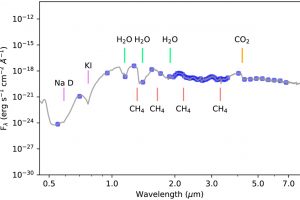
I ricercatori hanno simulato osservazioni di TOI-5375 b realizate con il satellite ARIEL dell’Agenzia Spaziale Europea, il cui lancio è previsto nel 2029. Nello spettro simulato (accessibile a questo link), sono chiaramente visibili i segnali generati da diverse molecole che presumibilmente popolano l’atmosfera di TOI-5375 b, tra cui acqua, anidride carbonica e metano.

Mario Giuseppe Guarcello ( segui mariospiegacose) ( mariospiegacose)( follow mariospiegacose)
Segui la pagina Facebook e Instagram dell’Osservatorio Astronomico di Palermo
Iscriviti al canale Youtube dell’Osservatorio Astronomico di Palermo
[:en]Nature sets a lower limit on stellar masses: objects less massive than 0.07-0.08 solar masses are incapable of initiating the thermonuclear reactions that power more massive stars. Below this threshold lies the realm of brown dwarfs, objects whose mass is too small to qualify as stars, yet too large to be categorized as planets.
The mechanism responsible for the formation of the brown dwarfs is still under analysis. Such small objects can form as normal stars—via the gravitational collapse of gas and dust clouds—or similar to the formation of planets. In the latter scenario, brown dwarfs might form within protoplanetary disks orbiting around young stars, accumulating gas onto massive rocky cores, or arising from the gravitational fragmentation of these disks. The investigation of brown dwarfs within binary systems could provide astronomers with insights into the primary formation mechanism of brown dwarfs.
TOI-5375 is an M0.5 star, characterized by an effective temperature of approximately 3700 K, located at a distance of around 400 light years from the Sun. It is recognized for hosting a low mass companion, prompting observations of this star within the context of the GAPS (Global Architecture of Planetary Systems) project. The team headed by the astronomer J. Maldonado (INAF – Astronomical Observatory of Palermo) has examined an extensive series of photometric observations gathered using the NASA satellite TESS, as well as spectroscopic observations acquired using the HARPS-N spectrograph mounted on the Telescopio Nazionale Galileo. This analysis has confirmed the companion’s low mass (designated as TOI-5375 b), which corresponds to 77 Jupiter masses. Furthermore, astronomers have determined that the orbital period of TOI-5375 b has experienced a delay of approximately 20 seconds over the course of 10 years. This suggests that the star is synchronizing its rotation period with the orbital period of the low-mass companion due to tidal effects. The findings of this study are described in the paper titled: “The GAPS programme at TNG. XLIII. A massive brown dwarf orbiting the active M dwarf TOI-5375“, recently published in the journal Astronomy & Astrophysics.
The researchers have also simulated future observations of TOI-5375 b with the ESA satellite ARIEL, scheduled for launch in 2029. The simulated spectrum (accessible through this link) displays characteristics of molecules that are expected to exist in the atmosphere of this low-mass object, including water, carbon dioxide, and methane.
Mario Giuseppe Guarcello ( follow mariospiegacose) ( mariospiegacose) ( follow mariospiegacose)
Follow the Astronomical Observatory of Palermo on Facebok and on Instagram
Subscribe the Youtube channel of the Astronomical Observatory of Palermo[:]