
[:it]TESS osserva un esopianeta attorno una stella di 40 milioni di anni. Pubblicato su A&A lo studio: “A possibly inflated planet around the bright young star DS Tucanae A” di S. Benatti (INAF-OAPA/INAF-Padova)[:en]TESS finds an exoplanets around a 40 million years old star. The study: “A possibly inflated planet around the bright young star DS Tucanae A” of S. Benatti (INAF-OAPA/INAF-Padova) recently appeared on A&A[:]

[:it]L’architettura finale di un sistema esoplanetario è il risultato di una combinazione di processi complicati, quali la dispersione del disco protoplanetario da cui si è formato il sistema planetario e l’interazione gravitazionale tra gli esopianeti. Questi processi possono anche essere fortemente influenzati dall’ambiente esterno e dalla stella centrale. Uno dei processi più importanti in tal senso è la migrazione dei pianeti dall’orbita dove si sono formati alla loro orbita finale.
Un tipo di migrazione avviene durante la dispersione del disco protoplanetario, per interazione tra il pianeta ed il materiale (gas e polveri) nel disco. Questa migrazione avviene su tempi scala rapidi, dato che i dischi protoplanetari normalmente si disperdono in meno di 10 milioni di anni. Altri meccanismi di migrazione che agiscono su tempi scala del miliardo di anni sono causati dall’interazione gravitazionale tra i pianeti. Diversi meccanismi di migrazione risultano in orbite dalle caratteristiche diverse, come ad esempio eccentricità ed allineamento tra rotazione planetaria ed orbita. Questo offre l’opportunità di distinguere il tipo di migrazione che ha plasmato l’architettura di un dato sistema planetario dalle proprietà orbitali dei pianeti.
In questo contesto è quindi necessario individuare un campione statisticamente ricco di esopianeti con orbite diverse, per poter analizzare l’importanza dei diversi tipi di migrazione e la loro relazione con le proprietà di stelle e pianeti. Questo è uno degli obiettivi della missione della NASA Transiting Exoplanet Survey Satellite (TESS), che scandaglierà più dell’85% del cielo alla ricerca di esopianeti identificati con la tecnica dei transiti (ossia analizzando la variabilità della luminosità delle stelle alla ricerca di diminuzioni periodiche dovute al passaggio del pianeta di fronte al disco stellare). Il team di ricercatori guidato dall’astronoma S. Benatti dell’INAF-Osservatorio Astronomico di Palermo ed Osservatorio Astronomico di Padova, ha analizzato le osservazioni ottenute da TESS del sistema binario DS Tuc, sospettato di ospitare un candidato pianeta attorno alla componente principale DS Tuc A, una stella giovane (40 milioni di anni) di tipo spettrale G6V. Grazie a un’analisi indipendente della curva di luce (ossia la variazione temporale dell’intensità della radiazione stellare osservata) TESS in combinazione con dati di archivio sia spettroscopici che di fotometria ad alta precisione, è stata confermata la presenza di un esopianeta con un periodo orbitale di 8.14 giorni ed un raggio pari alla metà del raggio di Giove. Si tratta del primo esopianeta confermato attorno una stella così giovane. Data la sua età e l’orbita stretta, la massa presunta di questo pianeta è probabilmente inferiore a 20 masse terrestri, indice di un’atmosfera molto estesa che la rende particolarmente adatta all’analisi spettroscopica della sua composizione e struttura.
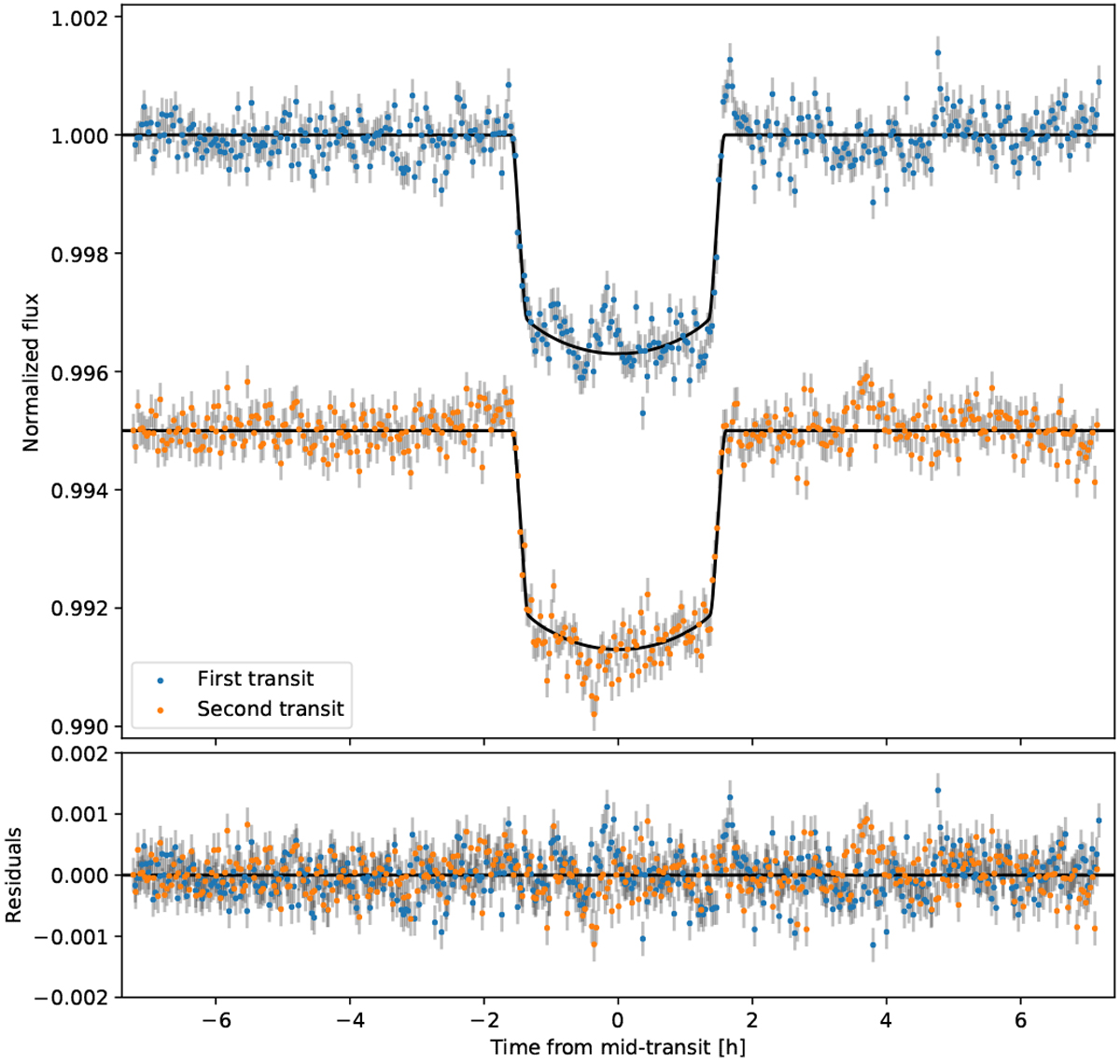
L’immagine (link) mostra la curva di luce di DS Tuc A ottenuta da TESS durante il transito dell’esopianeta.
di Mario Giuseppe Guarcello ( segui mguarce)[:en]The final architecture of a planetary system is the result of a complex interplay between several processes, such as the dispersion of the protoplanetary disk from which the planetary system formed, and the gravitational interaction between the newborn planets. Besides, these processes can be affected by the environment and by their central star. One of the most important process dictating the final architecture of a planetary system is the migration of planets from the orbits where they formed to their final orbits.
One type of migration occurs over rapid timescale during the dispersion of the protoplanetary disk (occurring in less than 10 million years) as a result of the interaction between the planets and the material in the disk (gas and dust). Other migration mechanisms work over longer timescale (about 1 billion years), and they result from the gravitational interaction between planets. Different migration mechanisms result in orbits characterized by different properties, namely their eccentricity and the alignment between planetary spin and orbit. This offers the opportunity to understand the main migration mechanism that acted on a given planetary system.
In order to study planetary migration and its connection with the properties of planets and stars, it is necessary to build a statistically rich sample of planets with different properties. This is one of the tasks of the NASA mission Transiting Exoplanets Survey Satellite (TESS), that will observe more than 85% of the sky searching for exoplanets with the technique of the transits (e.g., by detecting periodic dimming of stellar radiation due to the transit of their planets over the stellar disk). The team of astronomers led by S. Benatti (INAF-Astronomical Observatories of Palermo and Padua) analyzed the data acquired by TESS of the binary system DS Tus, with a candidate exoplanet orbiting around the principal component DS Tuc A, a G6V star 40 million years old. By studying the TESS light curve (e.g.: the variability of the source brightness with the time) together with archival spectroscopic and photometric data, the team has confirmed the presence of the exoplanet, calculating an orbital period of 8.14 days and a radius equal to half Jupiter radius. This is the first time an exoplanet is found in such a young star. From its age and orbit, the mass of the exoplanet is likely about 20 Earth masses, with a very extended atmosphere that can be easily characterized in future by spectroscopic observations.
The figure (link) shows the light curve of DS Tuc A obtained with TESS during the transit of the exoplanet.
by Mario Giuseppe Guarcello ( follow mguarce)[:]