
[:it]Simulazioni MHD dell’emissione radio da un arco magnetico in una T Tauri. L’articolo: “Predicting the time variation of radio emission from MHD simulations of a flaring T-Tauri star” di Waterfall C. O. G. (Jodrell Bank Centre for Astrophysics) pubblicato su MNRAS[:en]MHD simulations of the radio emission from a flaring T Tauri star. The study: “Predicting the time variation of radio emission from MHD simulations of a flaring T-Tauri star” of Waterfall C. O. G. (Jodrell Bank Centre for Astrophysics) recently appeared on MNRAS[:]
[:it]Le T Tauri sono stelle giovani (tipicamente più giovani di 5 milioni di anni), di piccola massa, circondate da un disco di polveri e gas chiamato disco protoplanetario. Il disco non raggiunge la superficie della stella attorno cui orbita: le polveri sublimano in prossimità della stella per le alte temperature raggiunte dal disco interno (oltre i 1500 gradi), mentre il disco di gas è troncato dal campo magnetico della stella. Le linee di campo magnetico che connettono stella e disco possono essere responsabili dell’accrescimento di gas dal disco alla stella: il gas dal disco viene incanalato nelle arcate magnetiche che connettono stella e disco, per poi precipitare in caduta libera a velocità di alcune centinaia di km al secondo sulla stella.
Il ruolo fondamentale del campo magnetico nel mediare il processo di accrescimento di gas dal disco alla stella è stato studiato in dettaglio con simulazioni magneto-idrodinamiche (MHD), molte delle quali prodotte da ricercatori dell’INAF – Osservatorio Astronomico di Palermo. In particolare, queste simulazioni dimostrano come il plasma imprigionato nei canali magnetici possa emettere significativamente radiazione ai raggi X una volta riscaldato da fenomeni di riconnessione magnetica, in analogia con quanto osservato su scale spaziali più piccole nei brillamenti solari.
Le recenti simulazioni descritte nell’articolo: “Predicting the time variation of radio emission from MHD simulations of a flaring T-Tauri star” di Waterfall C. O. G. (Jodrell Bank Centre for Astrophysics, The University of Manchester), pubblicato sulla rivista Monthly Notices of the Royal Astronomical Society, analizzano i meccanismi che risultano anche in una significativa emissione di onde radio da questi eventi. In questi modelli, viene considerata l’evoluzione di un plasma non termico (ossia elettroni non in equilibrio termodinamico) all’interno delle arcate magnetiche, la cui esistenza era stata provata in simulazioni precedenti. Per la prima volta gli autori hanno osservato come questi elettroni emettano significativamente onde radio polarizzate circolarmente con una frequenza distribuita tra 1 e 1000 GHz. Allo studio hanno partecipato anche gli astrofisici S. Orlando (INAF – Osservatorio Astronomico di Palermo) e F. Reale (INAF – Osservatorio Astronomico di Palermo ed Università degli Studi di Palermo).
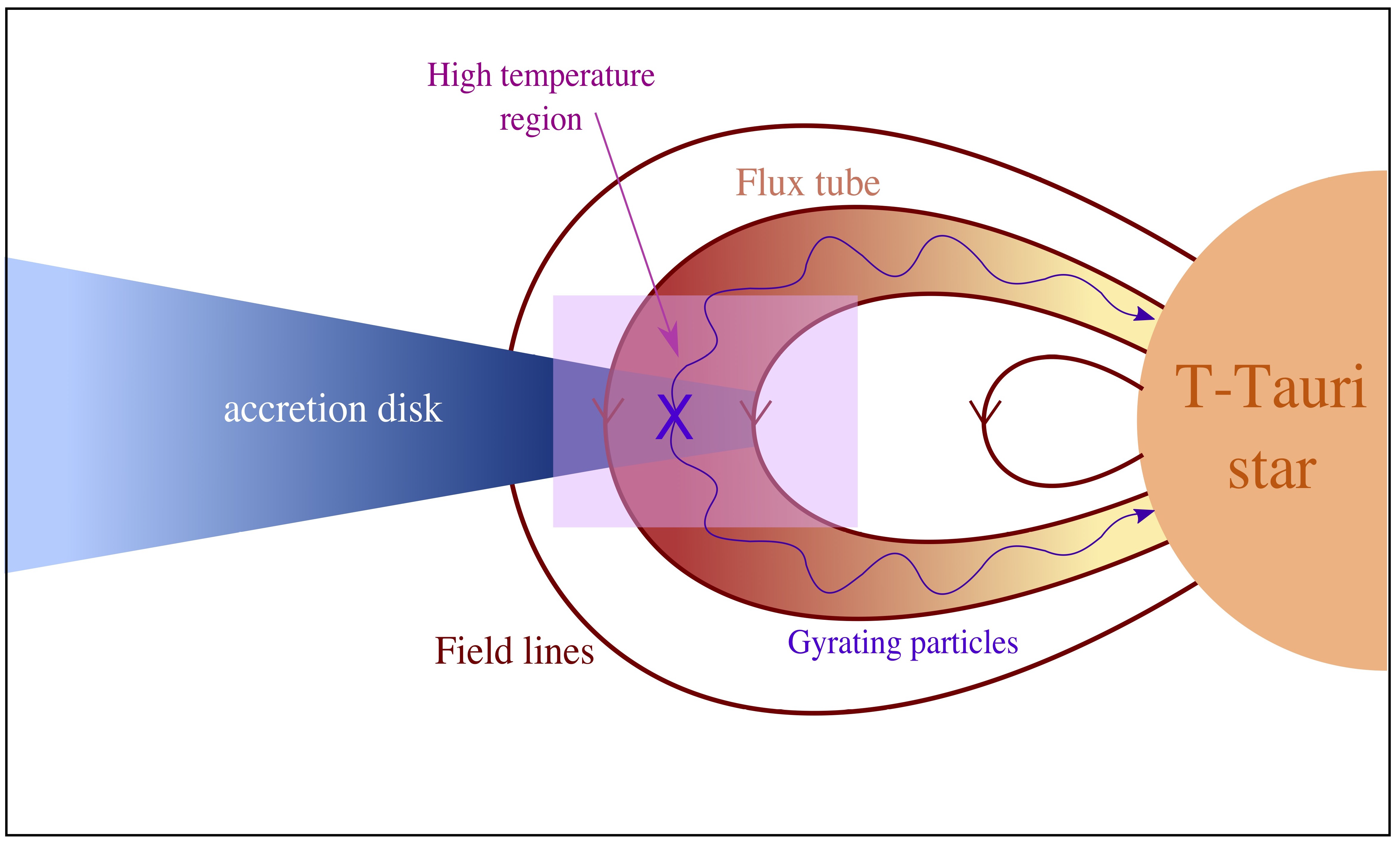
L’immagine (cliccare qui per visualizzare la figura interamente) mostra uno schema di una stella T Tauri e del suo disco protoplanetario, connessi da archi magnetici dove si muovono particelle ad alta energia.
Mario Giuseppe Guarcello ( segui mguarce)[:en]T Tauri stars are young low-mass stars (typically younger than 5 million of years), which are surrounded by a protoplanetary disk, e.g. a disk of gas and dust orbiting around the star. The disk material does not reach the central star: the dust component sublimates in the inner disk, where the temperature exceeds 1500 degrees, while the gas disk is truncated by the stellar magnetic field. The magnetic field also regulates the accretion of gas from the disk onto the star. In fact, the gas in the disk can be funneled by the magnetic loops connecting star and disk, and then it falls at the free-fall velocity of several hundreds km/sec onto the stellar surface.
In the past years several magneto-hydrodynamic (MHD) models describing the accretion from the disk onto the star driven by the magnetic field were presented, a large number of which produced by astronomers of INAF – Astronomical Observatory of Palermo. In particular, these simulations show that the plasma trapped in the magnetic loops connecting star and disk may irradiate in X-rays once it is heated up by the energy released in magnetic reconnection events, similar to what happens on smaller scales in the Solar corona.
The recent simulations presented in the study: “Predicting the time variation of radio emission from MHD simulations of a flaring T-Tauri star” of Waterfall C. O. G. (Jodrell Bank Centre for Astrophysics, The University of Manchester), appeared on the journal Monthly Notices of the Royal Astronomical Society, focuses on the mechanisms producing radio emission from flaring magnetic channels. This model, in fact, accounts for the evolution of non-thermal plasma (e.g., electrons not in thermodynamic equilibrium) inside the magnetic loops connecting star and disk. The presence of this population of non-thermal electrons was considered by previous more simple models from some of the authors. In this paper it is predicted for the first time the intensity and circular polarisation of the radio emission in a frequency ranging between 1 and 1000 from the non-thermal plasma of a flaring T-Tauri star. The flare model developed by the Palermo astronomers allows to predict the detailed evolution of the radio spectrum during the flare. The astronomers S. Orlando (INAF – Astronomical Observatory of Palermo) and F. Reale (INAF – Astronomical Observatory of Palermo and University of Palermo) are coauthors of this study.
The figure (click here to visualize the entire image) shows a scheme of a T Tauri star and its disk, connected by magnetic loops filled with high-energy particles.
Mario Giuseppe Guarcello ( follow mguarce)[:]