
[:it]Otto campagne osservative per WEAVE. L’articolo: “The wide-field, multiplexed, spectroscopic facility WEAVE: Survey design, overview, and simulated implementation” di S. Jin (University of Oxford) pubblicato su MNRAS[:en]Eight surveys for WEAVE. The paper: “The wide-field, multiplexed, spectroscopic facility WEAVE: Survey design, overview, and simulated implementation” of S. Jin (University of Oxford) appeared on MNRAS[:]

[:it]Circa tredici anni fa, nel mese di gennaio 2010, si tenne presso l’Isaac Newton Group of telescopes (ING) il meeting “Science with the William Herschel Telescope 2010-2020”. Durante tale incontro si discusse dell’importanza di campagne osservative spettroscopiche a media ed alta risoluzione per ricerche in diversi campi dell’astronomia considerati strategici, dall’astronomia galattica a quella extragalattica. Quasi contemporaneamente, la Comunità Astronomica Europea, attraverso il programma ASTRONET finanziato dalla Commissione Europea, presentò in un documento la necessità di un’infrastruttura per la spettroscopia a media ed alta risoluzione su un telescopio di 2-4 metri, al fine di completare la campagna osservativa condotta dal satellite Gaia, effettuare esperimenti di cosmologia e condurre studi sulla morfologia e la chimica della Via Lattea. Anni dopo, tali raccomandazioni presero forma nel WHT Enhanced Area Velocity Explorer (WEAVE).
WEAVE è uno strumento per osservazioni spettroscopiche a grande campo (2 gradi di campo visivo) equipaggiato con un sistema di poco meno di 1000 fibre ottiche, che trasferiscono il segnale a uno spettroscopio in grado di produrre spettri a media risoluzione (R=5000) in due ampie finestre dello spettro ottico (λ=3660-6060 Å per il canale blu, 5790-9590 Å per il canale rosso), e spettri ad alta risoluzione (R=20000) in tre finestre spettrali più strette. Inoltre, WEAVE offre 20 unità di campo integrale (IFUs) con un campo piccolo (11×12 arcosecondi) più uno con un campo largo pari a 1.3×1.5 arcominuti (IFU è l’abbreviazione di Integral Field Unit, uno strumento che genera spettri per ogni pixel di un’immagine). WEAVE ha avuto la sua prima luce nel dicembre 2022 (link) ed è ora pronto per la fase di “science verification”, durante la quale verrà testata la capacità dello strumento nel rispondere alle diverse domande scientifiche alle quali è chiamato a rispondere. Da quel momento, WEAVE inizierà la sua campagna osservativa che si protrarrà per almeno 5 anni, generando 30 milioni di spettri per 10 milioni di oggetti astronomici diversi.
Le operazioni di WEAVE saranno suddivise in 8 campagne osservative, coinvolgendo oltre 500 astronomi provenienti da 11 nazioni diverse:
- La campagna “WEAVE Galactic Archaeology” misurerà la metallicità (cioè l’abbondanza di elementi chimici pesanti rispetto all’idrogeno) in circa 3 milioni di stelle che stanno evolvendo dalla sequenza principale e giganti rosse, oltre alle abbondanze chimiche di 1.5 milioni di oggetti raggruppati in quattro programmi diversi.
- La campagna “Stellar, Circumstellar, and Interstellar Physics” osserverà un vasto campione di stelle giovani, stelle di grande massa e formazioni nebulari lungo il piano galattico, al fine di ottenere una visione completa del processo di formazione stellare nella nostra Galassia.
- La campagna “White Dwarfs Survey” osserverà circa 50.000 nane bianche.
- La campagna “WEAVE-Apertif Survey” produrrà spettri a bassa risoluzione per circa 400 galassie e ad alta risoluzione per circa 100 galassie.
- La campagna “WEAVE Galaxy Cluster” si concentrerà sugli ammassi di galassie per studiare le popolazioni stellari, le proprietà del gas ionizzato e la dinamica di gas e stelle delle galassie all’interno degli ammassi.
- La campagna “Stellar Population at Intermediate Redshift Survey” mira a studiare le proprietà e la dinamica delle stelle in circa 25.000 galassie con redshift compreso tra 0.3 e 0.7.
- La campagna “WEAVE-LOFAR Survey” otterrà spettri di circa un milione di sorgenti extragalattiche selezionate in base alla loro attività dalla campagna osservativa LOFAR Two-metre Sky Survey (LoTSS).
- La campagna “WEAVE-QSO” studierà il mezzo intergalattico a redshift z>2.1 attraverso l’osservazione di spettri di circa 40.000 quasar.
L’articolo “The wide-field, multiplexed, spectroscopic facility weave: Survey design, overview, and simulated implementation” di S. Jin (Oxford Astrophysics, Università di Oxford), recentemente pubblicato sulla rivista “The Monthly Notices of the Royal Academic Society”, presenta una descrizione dettagliata di WEAVE e delle otto campagne osservative, la procedura automatica (pipeline) per la riduzione e l’analisi degli spettri, le strategie per l’organizzazione delle osservazioni e il simulatore delle osservazioni usato durant ela lunga fase preparativa. Lo studio è stato firmato anche dall’astrofisico M. G. Guarcello dell’INAF – Osservatorio Astronomico di Palermo, membro della campagna “Stellar, Circumstellar, and Interstellar Physics”.
La figura (clicca qui per visualizzare l’immagine interamente) mostra:
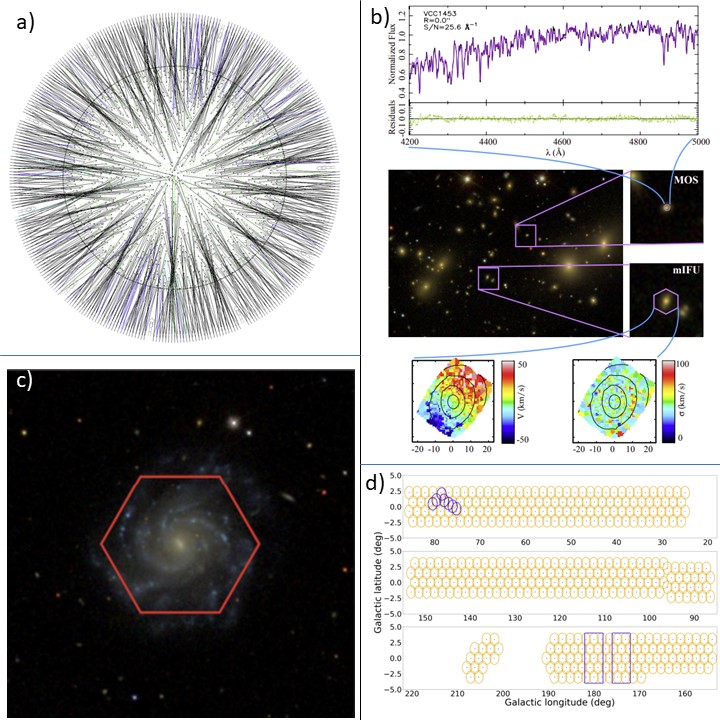
- a) il posizionamento delle fibre ottiche nel campo visivo di WEAVE.
- b) Un esempio di osservazioni per la campagna “WEAVE Nearby Clusters”: osservazioni con l’unità di campo integrale (IFU) e con fibre delle galassie nane dell’ammasso di galassie A2152. Esempi di osservazioni non ottenute con WEAVE, che forniscono rispettivamente una mappa di dinamica delle galassie e spettri, sono mostrati rispettivamente nei pannelli in basso ed in alto.
- c) Un esempio di osservazione della campagna “WEAVE-Apertif Survey” della galassia UGC 9837 con l’IFU a campo largo.
- d) La suddivisione del piano galattico nei campi che verranno osservati per la campagna “Stellar, Circumstellar, and Interstellar Physics” a bassa risoluzione (giallo) e ad alta risoluzione (blu).
Mario Giuseppe Guarcello ( segui mariospiegacose) ( mariospiegacose)( follow mariospiegacose)
Segui la pagina Facebook dell’Osservatorio Astronomico di Palermo
Iscriviti al canale Youtube dell’Osservatorio Astronomico di Palermo
[:en]About thirteen years ago, in January 2010, the meeting “Science with the William Herschel Telescope 2010-2020” took place at the Isaac Newton Group of telescopes (ING). During that meeting, the importance of spectroscopic surveys at medium and high resolution for various strategic fields in both galactic and extragalactic astronomy was discussed. In the same year, a document endorsed by the European Astronomical Society, as part of the ASTRONET program funded by the European Commission, outlined the necessity for a spectroscopic infrastructure capable of medium and high-resolution spectroscopy, to be installed on telescopes in the 2-4 meter class. This infrastructure was intended for complementing the Gaia science mission, conducting cosmological experiments, and studying the morphology and chemical properties of the Milky Way. After 13 years, these recommendations have taken shape in the form of the WHT Enhanced Area Velocity Explorer (WEAVE).
WEAVE is an instrument designed for spectroscopic observations across a wide field of view, covering 2 degrees. It is equipped with a system capable of deploying slightly less than 1000 optical fibers within the field of view. These fibers direct the light to a spectrograph, enabling observations at medium resolution (R=5000) in two broad ranges of the optical spectrum (λ=3660-6060 Å for the blue channel, 5790-9590 Å for the red channel), as well as high-resolution spectra (R=20000) in three narrower spectral windows. Additionally, WEAVE offers 20 small (1112 arcseconds) field Integral Field Units (IFUs) and one large IFU with a field of view of 1.3×1.5 arcminutes. An Integral Field Unit is an instrument that can produce a low-resolution spectrum for each pixel of an image. Following its first light in December 2022 (link), WEAVE is now entering the “science verification” phase. During this phase, the instrument’s capabilities will be tested to ensure its ability to address the scientific questions it was designed for. Once this phase is complete, WEAVE will commence its observational campaign, which is expected to span at least five years. Over this period, it will provide over 30 million spectra for more than 10 million astronomical objects.
WEAVE operations are divided into eight surveys, involving more than 500 astronomers from 11 different countries:
- The “WEAVE Galactic Archaeology” survey aims to measure the metallicity (the abundance of heavy elements compared to hydrogen) of 3 million stars in the Main Sequence turn-off and red giants, as well as detailed chemical abundances of 1.5 million objects divided into four sub-surveys.
- The “Stellar, Circumstellar, and Interstellar Physics” survey focuses on observing young stars, massive stars, and nebulae along the Galactic plane to gain a comprehensive understanding of the star formation process in our Galaxy.
- The “White Dwarfs Survey” is dedicated to studying a sample of 50,000 white dwarfs.
- The “WEAVE-Apertif Survey” will provide low-resolution spectra for 400 galaxies and high-resolution spectra for an additional 100 galaxies.
- The “WEAVE Galaxy Cluster Survey” will concentrate on galaxy clusters to investigate stellar populations, properties of ionized gas, and the dynamics of stars and gas within galaxies in clusters.
- The “Stellar Population at Intermediate Redshift Survey” aims to study the properties and dynamics of approximately 25,000 galaxies with redshifts between 0.3 and 0.7.
- The “WEAVE-LOFAR Survey” will obtain spectra for around one million extragalactic sources selected based on activity diagnostics provided by the LOFAR Two-metre Sky Survey (LoTSS).
- The “WEAVE-QSO” survey will explore the intergalactic medium at redshifts z > 2.1 through observations of a sample of 40,000 quasars.
The paper “The wide-field, multiplexed, spectroscopic facility WEAVE: Survey design, overview, and simulated implementation” by S. Jin (Oxford Astrophysics, University of Oxford), recently published in the journal “Monthly Notices of the Royal Astronomical Society,” provides a detailed description of WEAVE and the eight surveys, the data reduction pipeline, the observing strategy, and the simulator used during the extensive mission preparation phase. Among the long list of coauthors of this paper is the astronomer M. G. Guarcello from INAF – Astronomical Observatory of Palermo, who is associated with the “Stellar, Circumstellar, and Interstellar Physics” survey.
The figure (click here to view the entire image) illustrates:
- Panel a) A diagram depicting the deployment of fibers across the field of view.
- Panel b) An example of observations of the WEAVE Nearby Clusters survey: observations made using the IFU and fibers targeting dwarf galaxies in the galaxy cluster A2152. Examples of non WEAVE data providing dynamics maps and spectra of the galaxies are shown in the bottom and top panels, respectively.
- Panel c) An example of a typical galaxy that will be observed by the WEAVE-Apertif survey, which is the galaxy UGC9837 observed with the large field IFU.
- Panel d) The footprint of the observations of the Galactic plane for the “Stellar, Circumstellar, and Interstellar Physics” survey. Fields marked in yellow will be observed at medium resolution, while those in blue will be observed at high resolution.
Mario Giuseppe Guarcello ( follow mariospiegacose) ( mariospiegacose) ( follow mariospiegacose)
Follow the Astronomical Observatory of Palermo on Facebok
Subscribe the Youtube channel of the Astronomical Observatory of Palermo[:]