
[:it]Nessuna relazione tra metallicità ed età delle stelle nell’intorno solare. Lo studio: “Constraining the solar neighbourhood age-metallicity relation from white dwarf-main sequence binaries” di A. Rebassa-Mansergas (Universitat Politècnica de Catalunya) pubblicato su MNRAS [:en]There is no relation between age and metallicity of the stars in the Solar neighbourhood. The study: “Constraining the solar neighbourhood age-metallicity relation from white dwarf-main sequence binaries” of A. Rebassa-Mansergas (Universitat Politècnica de Catalunya) recently appeared on MNRAS [:]
[:it]I primi elementi chimici presenti nell’Universo dopo il Big Bang sono stati idrogeno, elio, e, in percentuali estremamente basse, litio. Da quel momento, sono state le stelle, soprattutto quelle di grande massa, le principali responsabili dell’arricchimento chimico dell’Universo. Le stelle, infatti, producono energia nei loro nuclei sintetizzando elementi chimici, che quindi vengono ridistribuiti nel mezzo interstellare quando queste terminano la loro evoluzione. Ne consegue che le prime stelle che hanno popolato l’Universo si sono formate da un mezzo popolato quasi unicamente da idrogeno ed elio, mentre le stelle che si sono formate in epoche successive contengono percentuali crescenti di elementi più pesanti. E’ intuitivo quindi aspettarsi una relazione tra l’età delle stelle e la percentuale di elementi pesanti che le caratterizza, chiamata “metallicità”.
Una simile relazione offre un’opportunità importante per stimare l’età delle stelle, impresa spesso molto ardua. Tipicamente l’età di stelle non appartenenti ad ammassi stellari è stimata dall’analisi della loro attività magnetica o confrontando magnitudini e colori osservati con quelli previsti da modelli stellari evolutivi. Da entrambi i metodi, però, si ottengono stime di età spesso imprecise. Solo recentemente stime di età più precise possono essere ottenute da una tecnica chiamata “asterosismologia”, che consiste nello studiare i modi di oscillazione interni delle stelle. Questa tecnica, però, può essere applicata solo a poche stelle luminose per cui sono disponibili lunghe osservazioni fotometriche continuative.
Per studiare la validità della relazione tra metallicità ed età delle stelle, il team di ricercatori guidato dall’astronomo A. Rebassa-Mansergas (Departament de Física, Universitat Politècnica de Catalunya) ha studiato un campione di sistemi binari non stretti composti da una nana bianca ed una stella di sequenza principale. Questi particolari sistemi, infatti, si prestano a stime accurate sia di metallicità che di età. L’età del sistema può essere ottenuta sommando l’età della nana bianca e la durata dell’evoluzione della sua progenitrice (ossia la stella che terminando la sua evoluzione ha formato la nana bianca). L’età della nana bianca viene stimata dalla sua luminosità, assumendo delle ben note relazioni tra età e luminosità delle nane bianche che derivano dalla conoscenza dei processi di raffreddamento di questi oggetti. L’età della progenitrice può essere invece stimata dalla massa della nana bianca, dalla quale si deduce la massa della stella progenitrice, che a sua volta vincola il tempo di vita della stella. La metallicità del sistema è invece misurata direttamente da osservazioni spettroscopiche della componente del sistema binario in sequenza principale, assumendo che essa sia rappresentativa dell’intero sistema e che non ci siano stati trasferimenti di massa durante l’evoluzione del sistema binario (da qui la necessità di non includere nel campione studiato sistemi in orbite strette). Il team di ricercatori ha selezionato 135 sistemi binari dai cataloghi dello Sloan Digital Sky Survey (SDSS) e dal secondo data-release del satellite dell’ESA Gaia. Osservazioni spettroscopiche sono quindi state ottenute utilizzando vari telescopi. Il confronto tra età e metallicità misurata in questi sistemi non supporta l’esistenza di una relazione tra la metallicità delle stelle e la loro età: la distribuzione metallicità vs. età ottenuta dai ricercatori è infatti pressocchè piatta e centrata sullo 0, con una dispersione in metallicità di quasi un ordine di grandezza. Lo studio è descritto nell’articolo: “Constraining the solar neighbourhood age-metallicity relation from white dwarf-main sequence binaries“, recentemente pubblicato sulla rivista Monthly Notices of the Royal Astronomical Society. L’astronomo J. Maldonado dell’Osservatorio Astronomico di Palermo è tra i coautori dello studio.
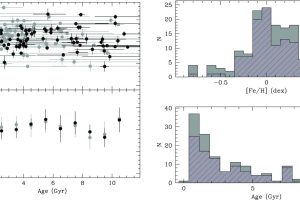
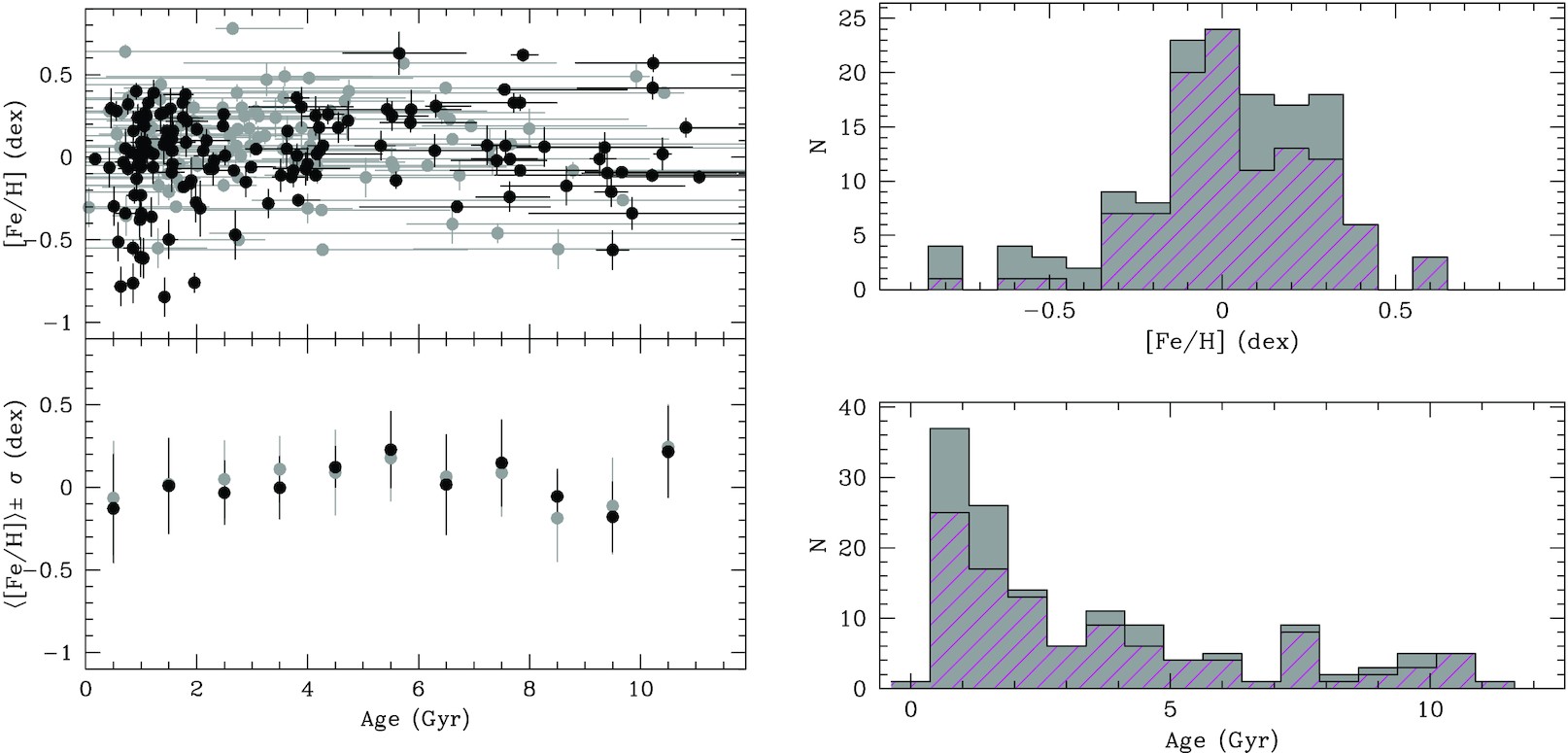
L’immagine (clicca qui per visualizzare la figura interamente) mostra la relazione tra età e metallicità ottenuta dagli autori dello studio. I punti neri indicano l’età ottenute con incertezze minori del 30%. Nel pannello in basso a sinistra l’età delle stelle è campionata in intervalli di un miliardo di anni. Nei pannelli a destra sono confrontate a destra le distribuzioni di età e metallicità ottenute dai due campioni, con quelle ottenute dai sistemi selezionati dal catalogo di Gaia segnate in magenta.
Mario Giuseppe Guarcello ( segui mguarce) ( youtube)
Iscriviti al canale Youtube dell’Osservatorio Astronomico di Palermo[:en]After the Big Bang, the Universe contained only hydrogen, helium, and a very small fraction of lithium. After that, stars, mainly the most massive ones, were responsible for the chemical enrichment of the Universe. In fact, stars produce energy by synthetizing chemical elements in their cores. These elements are then redistributed in the interstellar medium when stars end their evolution. As a consequence, the first stars formed in the Universe from a medium of hydrogen and helium, while stars formed later are richer of heavy elements. It is intuitive, then, that it can exist a relation between the age of the stars and their content of heavy elements, called “metallicity”.
Such a relation may offer a great opportunity to measure stellar ages, which is often a very hard task. The age of stars not belonging to stellar clusters is often deduced from the intensity of their magnetic activity or from the comparison between observed colors and magnitudes with values predicted by stellar evolutionary models. Both methods, however, often result in very large uncertainties. More recently, a technique called “asterosysmology”, which consists in measuring stellar internal oscillations, offers more precise age measurements. This technique, however, can only be applied to bright stars for which there exist long and mostly not interrupted photometric monitoring.
In order to verify the validity of the age-metallicity relation, a team of researchers led by the astronomer A. Rebassa-Mansergas (Departament de Física, Universitat Politècnica de Catalunya) have studied a sample of binary systems formed by a white dwarf and a main sequence star. In these systems, in fact, it is possible to obtain reliable estimates of both age and metallicity. The age of the system can be deduced by summing the age of the white dwarf and the evolutionary time of its progenitor (which is the star from which the white dwarf formed). The age of the white dwarf is estimated from its luminosity, by assuming a well-known relation between age and luminosity in these objects which is deduced from their cooling processes. The evolutionary time of the progenitor is instead deduced from its mass, which is estimated from the mass of the white dwarf. Metallicity is instead measured directly from spectroscopic observations of the main sequence star in the system, assuming that it is representative of the system and that no mass transfer occurred during the evolution of the binary system. For the latter assumption, no close binaries were analyzed in this study. The final sample counts 135 systems selected from the Sloan Digital Sky Survey (SDSS) and the second Gaia data release. Spectroscopic observations of these systems were then obtained with different telescopes. The study does not support the existence of a relation between the age and the metallicity of the systems. In the metallicity vs. age plane, in fact, the metallicity distribution obtained by the authors is almost flat and centered on 0, with a one order of magnitude spread. The study is described in the paper: “Constraining the solar neighbourhood age-metallicity relation from white dwarf-main sequence binaries“, recently appeared on the journal Monthly Notices of the Royal Astronomical Society. The astronomer J. Maldonado of the Astronomical Observatory of Palermo is one of the coauthors of the study.
The image (click here to visualize the entire figure) shows the age-metallicity relation obtained in this study. Black points include only age estimates with an uncertainty smaller than 30%. No relation between age and metallicity is observed. In the bottom-left panel ages are sampled in 1 Gyr bins. The right panels show the distributions of both age and metallicity separately, with the distribution obtained from the systems selected from Gaia marked in magenta.
Mario Giuseppe Guarcello ( follow mguarce) ( youtube)
Subscribe the Youtube channel of the Astronomical Observatory of Palermo[:]