
[:it]JWST, transiti esoplanetari e macchie fotosferiche. L’articolo:”Hiding in plain sight: observing planet-starspot crossings with the James Webb Space Telescope” di G. Bruno (INAF – OA Catania) pubblicato su MNRAS[:en]JWST, explanetary transits and starspots. The paper:”Hiding in plain sight: observing planet-starspot crossings with the James Webb Space Telescope” of G. Bruno (INAF – OA Catania) appeared on MNRAS[:]

[:it]Sulla fotosfera, cromosfera e corona del Sole è facile osservare fenomeni di natura magnetica, quali ad esempio macchie fotosferiche, faculae, protuberanze e brillamenti. Questi fenomeni sono il frutto dell’interazione tra il campo magnetico solare ed il plasma, ossia il gas ad alta temperatura (da 5600 gradi in fotosfera fino ad alcuni milioni di gradi in corona) ed alto tasso di ionizzazione. In particolare, le macchie fotosferiche si presentano come delle macchie scure nella fotosfera brillante del Sole, e corrispondono a regioni depresse e fredde (3000-4500 gradi), caratterizzate da un intenso campo magnetico. Data la grande distanza delle altre stelle, non è possibile risolvere i dettagli della loro fotosfera come facciamo nel Sole, e quindi osservare direttamente la presenza di macchie. Ciò nonostante, possiamo rivelarne la presenza in altre stelle grazie a varie tecniche, principalmente studi di variabilità dell’intensità della radiazione osservata. Durante la rotazione della stella, infatti, se gruppi di macchie compaiono nella faccia della stella rivolta verso di noi, si osserva una piccola e periodica diminuzione della luminosità della stella.
Una variabilità simile può essere osservata anche quando una stella ospita un pianeta “transitante”, ossia un pianeta che, durante la sua orbita, passa davanti al disco della stella, occultandone una piccola parte. La tecnica dei transiti, che ad oggi (Dicembre 2021) ha permesso la scoperta del 76.8% di esopianeti noti (fonte exoplanets.nasa.gov), consiste proprio nel misurare le periodiche riduzioni di luminosità delle stelle dovute al transito dei loro pianeti. E’ importante, però, tenere conto dell’eventuale presenza di macchie in fotosfera durante il transito. La presenza di macchie fotosferiche durante il passaggio del pianeta, infatti, può influenzare le misure del transito, e quindi la nostra capacità di derivare alcune proprietà dei pianeti, come il loro raggio rispetto al raggio stellare. D’altro canto, l’osservazione di transiti esoplanetari durante i quali il pianeta occulta un sistema di macchie può permetterci di derivare importanti proprietà delle macchie stesse, quali ad esempio la loro temperatura.
Il team di ricercatori guidato dall’astrofisico G. Bruno, dell’INAF – Osservatorio Astrofisico di Catania, ha prodotto delle simulazioni di transiti di esopianeti attorno stelle di classe spettrale M e K, mentre nella fotosfera della stella sono presenti macchie che vengono occultate dal pianeta. Le simulazioni hanno permesso di sintetizzare delle osservazioni del fenomeno con il telescopio James Webb Space Telescope (JWST) in specifiche bande infrarosse di due suoi strumenti (NIRspec e NIRCAM). Secondo lo studio, descritto nell’articolo: “Hiding in plain sight: observing planet-starspot crossings with the James Webb Space Telescope“, nei casi di stelle sufficientemente brillanti ed elevata differenza di
temperatura tra la macchia e la fotosfera stellare, le osservazioni di JWST permetteranno di misurare la temperatura delle macchie occultate dal pianeta con un’incertezza di poche centinaia di gradi, confrontabile con la precisione ottenuta in banda ottica dall’Hubble
Space Telescope. Dato il gran numero di transiti esoplanetari che verranno osservati con JWST, questi risultati dimostrano che sarà possibile ottenere misure di temperatura delle macchie di un gran numero di stelle, permettendo studi statistici sui fenomeni magnetici in queste stelle. Allo studio, recentemente pubblicato sulla rivista Monthly Notices of the Royal Astronomical Society, hanno partecipato anche G. Micela, dell’INAF – Osservatorio Astronomico di Palermo, e G. Cracchiolo (Università degli Studi di Palermo ed INAF – OAPA).
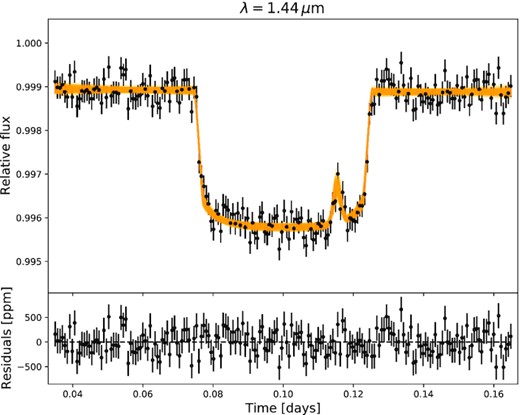
La figura (cliccare qui per visualizzare l’immagine interamente) mostra la curva di luce simulata (ossia la variazione temporale del flusso di radiazione osservato) che sarà ottenuta da osservazioni NIRspec di una stella di classe spettrale K durante un transito. Il pianeta transitante ha un raggio di 0.25 raggi Gioviani, ed occulta un sistema di macchie con una temperatura di 2900 gradi. La diminuzione di luminosità è dovuta al transito del pianeta, mentre il debole picco di emissione osservato durante il transito è dovuto all’occultamento del sistema di macchie.
Mario Giuseppe Guarcello ( segui mguarce) ( youtube)
Iscriviti al canale Youtube dell’Osservatorio Astronomico di Palermo[:en]We typically observe phenomena due to the interaction between the magnetic field of Sun and its plasma, which is the hot (from 5600 K in photosphere to million degrees in the corona) gas with a high level of ionization, on the photosphere, chromosphere, and corona of our star. Some of these magnetic phenomena are starspots, faculae, prominences, and flares. In particular, solar spots can be seen as dark features in the bright photosphere, and they correspond to regions with intense local magnetic fields, which are colder (3000-4500 K) and deeper than the surrounding photosphere. Given their typical large distances from us, we can not observe directly spots in other stars. However, we can infer their presence with other techniques, such as time-resolved measurements of stellar luminosity. During the rotation of the stars, in fact, if spots emerge in their surface, we can observe faint but periodic dimming of their luminosity.
A similar variability can also be observed in stars hosting transiting exoplanets. These are planets that move across the surface of their stars along our line of sight during their orbit, occulting a tiny fraction of their stars. The technique of the transits consists in detecting the periodic small dimming of stellar luminosity during the passages of their planets along our line of sight, and it has permitted to date (December 2021) to discover 76.8% of known exoplanets (exoplanets.nasa.gov). However, it is important to account for the presence of starspots during the transit of the exoplanets. Occulted spots, in fact, can alter the profile of the transit and affect our capability of deriving the properties of the exoplanets, such as their radius. However, observations of transits, during which the spots are occulted, allow astronomers to derive important information on the spots, such as their temperature.
The team of researchers led by the astronomer G. Bruno (INAF – Astrophysical Observatory of Catania) recently presented simulations of transits of exoplanets orbiting around K and M stars, while their photospheres were populated by starspots. The astronomers have also synthetized from these simulations infrared observations of the phenomenon with the instruments NIRCAM and NIRspec on board of the James Webb Space Telescope (JWST). As described in the paper: “Hiding in plain sight: observing planet-starspot crossings with the James Webb Space Telescope“, JWST observations will allow astronomers to derive the temperature of occulted spots in stars which are bright enough, with a precision which is comparable to the precision achievable with observations in the optical band with the Hubble Space Telescope. Given the large number of transiting exoplanets that will be observed by JWST, these measurements will allow astronomers to perform studies of the properties of starspots in an unprecedently rich sample of stars. The paper has recently appeared on the journal Monthly Notices of the Royal Astronomical Society, with the collaboration of G. Micela, INAF – Astronomical Observatory of Palermo, and G. Cracchiolo (University and Observatory of Palermo).
The figure (click here to visualize the entire image) shows a simulated light curve (which is the time variation of stellar luminosity) that will be obtained from NIRspec observations of a K star during a transit. The transiting exoplanet has a radius of 0.25 Jupiter radii, and it is occulting a system of starspots with a temperature of 2900 K. The dimming is due to the transit of the exoplanet, while the faint bump during the transit is due to the occultation of the starspots.
Mario Giuseppe Guarcello ( follow mguarce) ( youtube)
Subscribe the Youtube channel of the Astronomical Observatory of Palermo[:]