
[:it]Scoperto un ciclo di attività coronale in una stella di 400 milioni di anni. L’articolo: “An X-ray activity cycle on the young solar-like star ɛ Eridani” di M. Coffaro (Eberhard-Karls Universität Tübingen) pubblicato su A&A[:en]Discovered an X-ray cycle in a 400 million years old star. The study: “An X-ray activity cycle on the young solar-like star ɛ Eridani” of M. Coffaro (Eberhard-Karls Universität Tübingen) appeared on A&A[:]
[:it]L’intensità dell’attività magnetica del Sole e di tutti i fenomeni ad essa connessi (come le macchie solari ed i brillamenti) si manifesta con un ciclo dal periodo medio di 11 anni. Per comprendere se tale ciclicità sia comune anche nelle altre stelle, dal 1966 l’Osservatorio di Monte Wilson in California porta avanti un progetto di monitoraggio dell’attività stellare attraverso osservazioni spettroscopiche di righe legate all’attività cromosferica (in particolare, la riga H+K del calcio ionizzato, CaII). Da questo progetto, è emerso che circa il 60% delle stelle osservate mostra un ciclo di attività cromosferica con periodi che vanno da 2 a 20 anni.
Nel Sole, durante il ciclo varia sia l’intensità dei fenomeni cromosferici che di quelli coronali. E’ così anche per le altre stelle? Rispondere a questa domanda è complicato, data la rarità di osservazioni di stelle ai raggi X (la radiazione emessa dal plasma in corona), lunghe un periodo di tempo adeguato per rivelare un eventuale ciclo. Fino ad oggi, gli astronomi hanno scoperto cicli di emissione di raggi X, grazie ad osservazioni del satellite ESA XMM-Newton, in 5 stelle: 61 Cyg A, α Cen A e α Cen B, HD 81809 (con una serie di studi realizzati, tra gli altri, dagli astrofisici di INAF-OAPA S. Orlando e G. Micela), e ι Horologii (studio condotto dall’astrofisica di INAF-OAPA B. Stelzer). La scoperta, avvenuta nel 2013, di un ciclo di attività coronale in quest’ultima stella ha suscitato particolare interesse, essendo infatti l’unica tra queste stelle ad essere relativamente giovane (600 milioni di anni) e con il ciclo dal periodo più breve rispetto le altre quattro (1.6 anni). Questa scoperta ha sollevato quindi la seguente domanda: a che età nelle stelle di tipo solare comincia a manifestarsi un ciclo di attività coronale, e quando diventa stabile? Data la stretta connessione tra l’attività coronale stellare, la produzione e le proprietà del campo magnetico, e la struttura interna delle stelle, questa domanda ha importanti conseguenze sulla nostra conoscenza dell’evoluzione stellare.
Per rispondere a questa domanda, l’astrofisica M. Coffaro (Institut für Astronomie und Astrophysik Tübingen (IAAT), Eberhard-Karls Universität Tübingen), in collaborazione anche con gli astrofisici B. Stelzer e S.Orlando (INAF – Osservatorio Astronomico di Palermo) ha analizzato una lunga serie temporale di osservazioni della riga CaII H+K, realizzate dall’Osservatorio di Mt. Wilson, ed ai raggi X, ottenute da XMM/Newton, della stella ɛ Eridani, una stella K2V a circa 6.6 anni luce di distanza dal Sole e con un’età di 440 milioni di anni (più giovane di ι Horologii), scoprendo un ciclo di attività coronale con un periodo di 2.92 anni, consistente con il ciclo di attività cromosferica. Dall’analisi spettrale dell’emissione X di ɛ Eridani, usando come riferimento il modello di emissione coronale solare che tiene conto delle proprietà delle regioni attive (le regioni della corona brillanti ai raggi X, dove si manifestano maggiormente i fenomeni magnetici) e dei brillamenti, è risultato che la copertura della corona di ɛ Eridani da parte delle regioni attive varia da circa il 60% a circa il 90% durante il ciclo. Lo studio è descritto nell’articolo: “An X-ray activity cycle on the young solar-like star ɛ Eridani“, pubblicato sulla rivista Astronomy & Astrophysics.
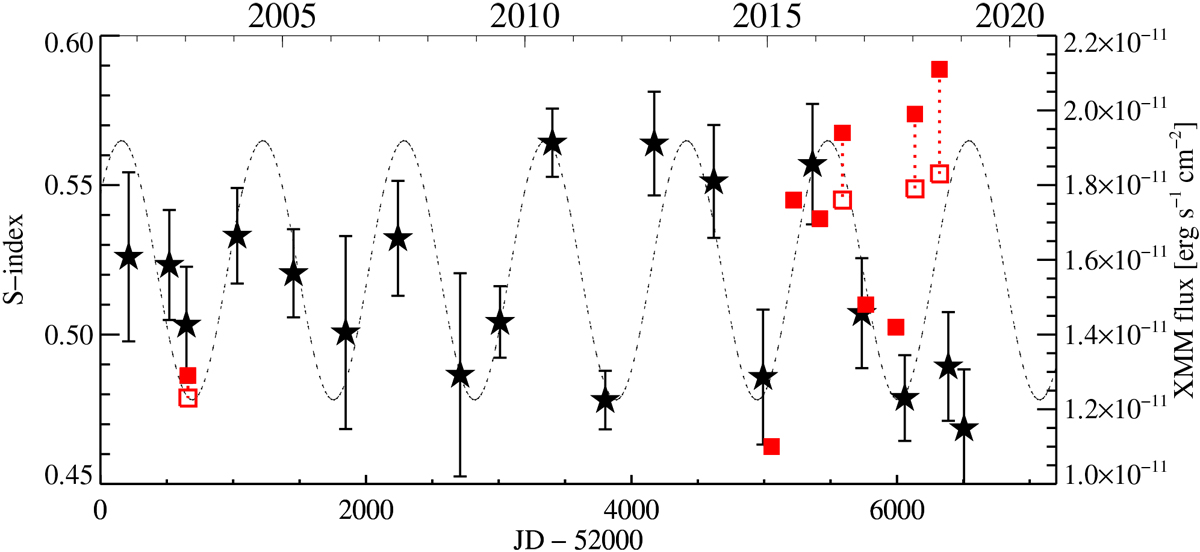
La figura (clicca qui per visualizzare l’immagine intera) mostra la curva di luce (ossia la variazione temporale della luminosità della sorgente) ai raggi X di ɛ Eridani (quadrati), insieme alla variabilità di un indice spettroscopico di attività coronale basato sulla riga CaII H+K (simboli a stella). La modulazione temporale di entrambi i segnali dovute al ciclo della stella è ben evidente.
Mario Giuseppe Guarcello ( segui mguarce)[:en]The intensity of Solar magnetic activity and of the related phenomena (such as sunspots and flares) varies with an 11-years cycle. In order to understand whether such an activity cycle is common among solar-type stars, since 1966 a project based on the Observatory of Mt. Wilson is collecting measurements of the cromospheric activity of a large sample of low-mass stars based on spectroscopic observations of lines that probe such activity, such as the H+K line of ionized Calcium (CaII). One of the main results of this project is that more than 60% of observed stars show an activity cycle with a period ranging from 2 to 20 years.
In the Sun, during the cycle change both the cromospheric and the coronal activity. What about the other stars? The search for a coronal activity cycle in the other stars is complicated by the paucity of observations of stars in X-rays (the emission from the coronal plasma) covering a period long enough to detect any cycle. To date, observations performed with the ESA satellite XMM-Newton has allowed astronomers to detect an X-ray cycle only in 5 stars: 61 Cyg A, α Cen A and α Cen B, HD 81809 (studied in a series of papers led, among the others, by the INAF-OAPA astronomers S. Orlando and G. Micela), and ι Horologii (study led by the INAF-OAPA astronomer B. Stelzer). The discovery of an X-ray cycle in the latter star was particularly interesting. It is in fact the youngest star (600 million years old) and that with the shortest period cycle compared with the other four stars. This discovery rise an important question: at what age solar-type stars develop an activity cycle, and when it becomes stable? The importance of such a question is dictated by the connection between the stellar magnetic activity, the properties of their magnetic fields, and stellar internal structure.
To answer this question, the team led by the astronomer M. Coffaro (Institut für Astronomie und Astrophysik Tübingen (IAAT), Eberhard-Karls Universität Tübingen), in collaboration with the astronomers B. Stelzer e S. Orlando (INAF – Osservatorio Astronomico di Palermo), has analyzed long time series of spectroscopic observations of the CaII H+K line (from the Observatory of Mt. Wilson catalog), and X-ray observations, performed with XMM-Newton, of the star ɛ Eridani. This is a K2V star at a distance of 6.6 light years from the Sun, and with an age of 440 million years, being thus younger than ι Horologii. The analysis has allowed the team to discover an X-ray cycle with a period of 2.92 years, consistent with the stellar cromospheric cycle. By analyzing the X-ray spectrum of the star across the cycle, adopting as template a model of the Solar corona which accounts for the presence of coronal active regions (the X-ray bright coronal regions where the magnetic phenomena are more intense) and flares, the team has estimated that the coverage of the corona by active regions varies from 60% to 90% through the cycle. The study is described in the paper: “An X-ray activity cycle on the young solar-like star ɛ Eridani“, recently appeared on Astronomy & Astrophysics.
The figure (click here to visualize the entire image) shows the X-ray light curve (e.g. the time variability of the stellar luminosity, marked with squares) of ɛ Eridani, together with the time variability of a spectroscopic index of cromospheric activity based on the CaII H+K line (marked with the stars symbols). The modulation of the two signals due to the activity cycle of the star is evident.
Mario Giuseppe Guarcello ( follow mguarce)[:]