
[:it]Gaia ESO Survey e Gaia Data Release 1 insieme per stimare le età delle stelle. Pubblicato su A&A “The Gaia-ESO Survey: open clusters in Gaia-DR1. A way forward to stellar age calibration” di S. Randich (INAF-Firenze)[:en]The Gaia ESO Survey and Gaia satellite join their forces to determine clusters age. Published by A&A the study “The Gaia-ESO Survey: open clusters in Gaia-DR1. A way forward to stellar age calibration” of S. Randich (INAF-Firenze)[:]

[:it]
di Mario Giuseppe Guarcello ( segui mguarce)
Gli ammassi stellari sono dei preziosi laboratori per lo studio, sia teorico che osservativo, dell’evoluzione delle stelle. Infatti, ogni ammasso costituisce un campione di stelle, talvolta anche piuttosto ricco arrivando a contare migliaia di membri, con un’età ben precisa ed uno spettro di massa ampio. Sfortunatamente, però, determinare l’età di un ammasso stellare può non essere semplice. Il metodo più usato consiste nel confronto delle magnitudini e colori delle stelle associate ad un dato ammasso con quelle stimate usando modelli teorici di evoluzione e struttura delle stelle. Questo metodo soffre però di incertezze significative, dovute alle difficoltà nello stimare l’effetto del materiale interstellare fra le stelle e l’osservatore, ovvero l’assorbimento interstellare, all’affidabilità dell’identificazione delle stelle associate agli ammassi, ed all’accuratezza dei modelli teorici. Un ulteriore metodo efficace per gli ammassi più giovani consiste nella misura dell’abbondanza di Litio nelle stelle associate ad un dato ammasso. Questo elemento chimico, infatti, viene consumato rapidamente all’interno delle stelle e la sua abbondanza diventa quindi un’efficace test di giovinezza delle stelle. L’abbondanza di Litio in stelle di una data massa dipende quindi dalla loro età, fornendo un metodo che però dipende comunque dai modelli evolutivi.
La determinazione dell’età degli ammassi stellari è quindi una sfida piuttosto complicata. In questi anni i risultati ottenuti con alcuni grandi progetti possono però migliorare la nostra capacità nello stimare l’età delle stelle associate ad ammassi. Due di questi sono il satellite Gaia e la Gaia-ESO Survey. Gaia è un satellite dell’European Space Agency che durante la sua missione fornirà misure astrometriche di altissima precisione per circa un miliardo di stelle della nostra Galassia, permettendo di calcolare accuratamente il loro moto proprio e distanza. La Gaia-ESO Survey nasce invece dalla necessità di completare le osservazioni di Gaia di stelle in ammassi stellari fornendo ulteriori diagnostiche per identificare le stelle associate agli ammassi e calcolare le loro proprietà fisiche e velocità radiali tramite spettroscopia ad alta risoluzione con lo spettroscopio FLAMES dell’European Southern Observatory.
Nello studio “The Gaia-ESO Survey: open clusters in Gaia-DR1. A way forward to stellar age calibration” di s. Randich (INAF – Osservatorio Astrofisico di Arcetri), pubblicato su Astronomy & Astrophysics in collaborazione con astronomi dell’Osservatorio Astronomico di Palermo, le osservazioni ottenute da Gaia e dalla Gaia-ESO Survey sono analizzate insieme per ottenere un’accurata identificazione delle stelle associate in 8 ammassi stellari e quindi stimarne l’età tramite il confronto con tre modelli stellari (PROSECCO, PARSEC e MIST). Per la prima volta, quindi, è stato possibile porre questi ammassi su una scala temporale autoconsistente, un risultato che è di grande importanza per porre dei vincoli agli studi sulll’evoluzione stellare e che in futuro sarà ripetuto per un numero maggiore di ammassi osservati con Gaia.
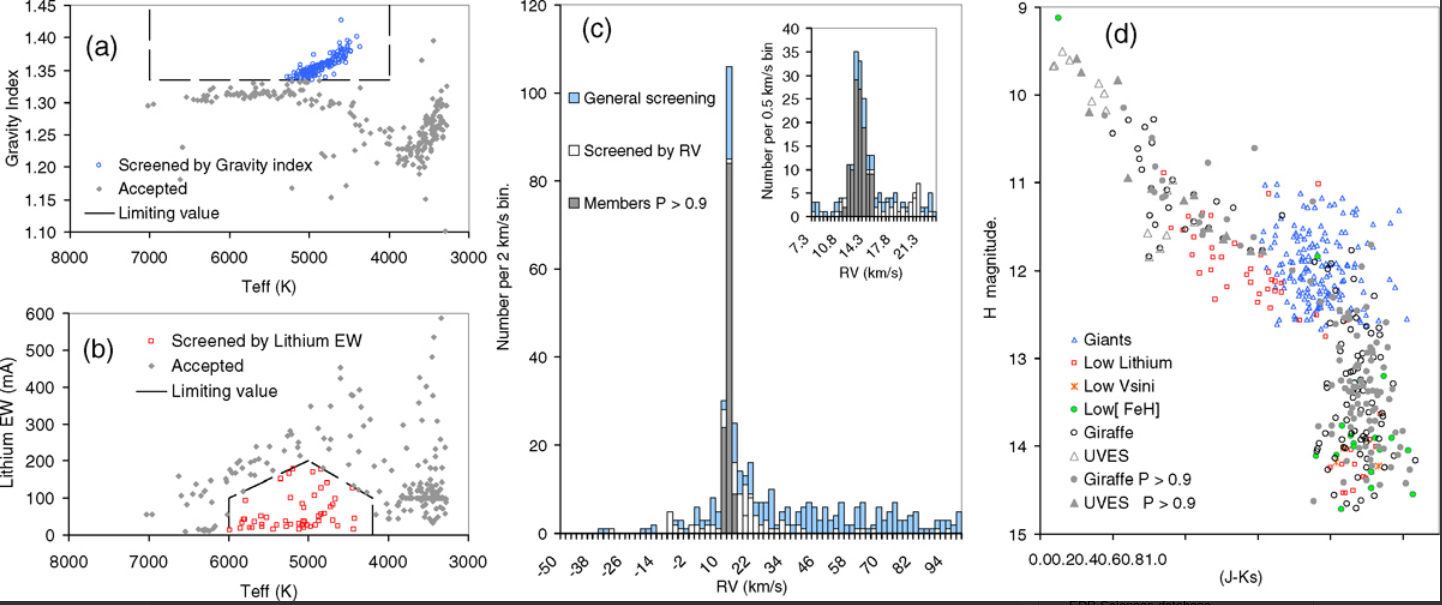
L’immagine (link) mostra le diagnostiche usate per identificare le stelle associate a NGC 2547.[:en]Stellar clusters are important targets for the study of stellar evolution, since their members constitute a sample of stars, sometime even richer than few thousands, with similar age but covering a wide range of masses. The most widely used method to determine clusters age consists in comparing magnitudes and colors of their stars with those predicted by stellar evolutionary models. This method, however, suffers strong uncertainties, due, for instance, to the precision of the photometric measures, the reliability of cluster members identification, and the accuracy of used stellar models. Another important method consists in calculating Lithium abundance in cluster members. Lithium is in fact quickly consumed in stellar interior and thus its presence is a test for stellar youth. Besides, the efficiency at which Lithium has been depleted in stars with given mass is a function of stellar age. However, also this method is model dependent.
The determination of clusters age is thus a challenge. In the past years, however, several projects will improve the accuracy of how the age of stellar clusters is obtained. Two of these projects are the Gaia mission and the Gaia-ESO Survey. Gaia is a European Space Agency mission which will provide precise astrometric measurements for more than one billion stars, allowing the determination of their proper motion and distance with unprecedented precision. The Gaia-ESO Survey aims at completing the information provided by Gaia for stellar clusters, providing accurate membership and estimate of stellar parameters and radial velocity by means of high resolution optical spectroscopy with FLAMES of the European Southern Observatory.
In the study “The Gaia-ESO Survey: open clusters in Gaia-DR1. A way forward to stellar age calibration” of s. Randich (INAF – Osservatorio Astrofisico di Arcetri), recently published by Astronomy & Astrophysics with the collaboration of INAF-OAPA astronomers, data from Gaia and the Gaia-ESO Survey are analyzed together in order to derive membership and age of 8 open clusters. As a result, for the first time it has been possible to define a consistent age scale where these open clusters have been included. This is an important step for the study of stellar evolution and this method will be exploited for a larger number of clusters during Gaia mission.
The figure (link) shows the membership diagnostics used for the open cluster NGC 2547.[:]