
[:it]Formazione stellare nella Vela. Pubblicato su A&A lo studio: “Low-mass star formation and subclustering in the H II regions RCW 32, 33, and 27 of the Vela Molecular Ridge. A photometric diagnostics for identifying M-type stars” di L. Prisinzano (INAF-OAPA)[:en]Star formation in the Vela. Published on A&A the study: “Low-mass star formation and subclustering in the H II regions RCW 32, 33, and 27 of the Vela Molecular Ridge. A photometric diagnostics for identifying M-type stars” of L. Prisinzano (INAF-OAPA)[:]
[:it]
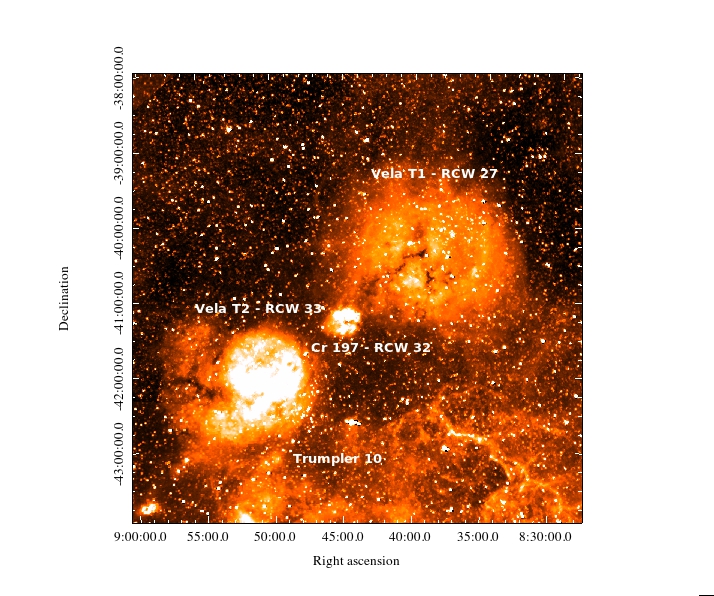
La figura (link) mostra un’immagine dal Southern H-Alpha Sky Survey Atlas (Gaustad et al., 2001) di 6°×6° centrata sulle tre regioni oggetto di questo studio.
di Mario Giuseppe Guarcello ( segui mguarce)[:en]In the Milky Way one of the main modes of star formation is in stellar clusters, which remain associated with their parental cloud for about 5-10 million years. This makes the star forming regions complex targets, characterised by rich stellar populations packed into small regions, sometime even with massive stars, and clouds whose morphology and properties are affected by the radiation of the stars formed in them. Star forming regions are thus intriguing targets where occur several important physical phenomena of great interest for modern astrophysics.
One of the major challenges in studying star forming regions is the identification and characterisation of their young stars. It is in fact often difficult to observe the low mass members which may be hidden by the surrounding clouds, and it is not always trivial to separate the stars associated with star forming regions with unrelated sources falling in the same line of sight but being at different distances.
The study: “Low-mass star formation and subclustering in the H II regions RCW 32, 33, and 27 of the Vela Molecular Ridge. A photometric diagnostics for identifying M-type stars” of L. Prisinzano (INAF – Osservatorio Astronomico di Palermo), recently published on Astronomy & Astrophysics, is focused on the young stellar population and the star formation process in the three young clusters RCW 27, RCW32, and RCW 37, part of the Vela Molecular Ridge. Their population of young stars with protoplanetary disks (disks of gas and dust orbiting around young stars for 5-15 million of years, and from which planetary systems can form), counting 559 stars, is selected thanks to the IR emission from their disks or the UV and Hα emission due to the accretion of gas from the disks onto the central stars. A total of 1200 candidate young M stars associated with the three clusters were also identified adopting a photometric selection procedure developed by the astronomers of the Astronomical Observatory of Palermo. Thanks to this rich sample of young stars associated with this region, the authors could estimate the distance of the clusters (about 2500 light years from the Sun) and their age (0.5-13 million of years). They also have been able to acquire a complete picture of the star formation process in this cloud, with a decreasing star formation rate in RCW 33 and star formation in RCW 27 and RCW 32 likely been triggered by the interaction between the molecular cloud and the radiation from the first generation of stars formed.
The figure (link) shows a 6°×6° Southern H-Alpha Sky Survey Atlas (Gaustad et al., 2001) image centred on the three clusters subject of this study.
of Mario Giuseppe Guarcello ( follow mguarce)[:]