
[:it]Due Nettuniani caldi per una stella giovane. L’articolo: “The GAPS Programme at TNG XXVIII. A pair of hot-Neptunes orbiting the young star TOI-942” di I. Carleo (Wesleyan University/INAF-OAPd) pubblicato su A&A)[:en]Two Neptunians for a young star. The study: “The GAPS Programme at TNG XXVIII. A pair of hot-Neptunes orbiting the young star TOI-942” of I. Carleo (Wesleyan University/INAF-OAPd) recently appeared on su A&A)[:]

[:it]I sistemi esoplanetari scoperti fino ad oggi (3212 sistemi per un totale di 4331 esopianeti confermati, dato aggiornato al 26 Gennaio 2021, fonte: https://exoplanets.nasa.gov/) presentano architetture talvolta molto diverse da quella del Sistema Solare. Questa varietà di sistemi esoplanetari costituisce una sfida per la comprensione dei fenomeni di formazione planetaria e delle interazioni tra i pianeti e l’ambiente circostante, che plasmano le proprietà e la configurazione finale dei sistemi planetari.
In questo contesto, è di grande importanza la scoperta di esopianeti attorno a stelle giovani (ad esempio, più giovani di 100 milioni di anni). Queste stelle permettono infatti di studiare sistemi planetari che sono da poco emersi dal disco protoplanetario (la nebulosa a forma di disco da cui si formano i pianeti), e possono ancora presentare fenomeni di migrazione, ossia spostamenti radiali dovuti prima all’interazione tra pianeti e disco protoplanetario, e poi tra pianeti stessi. Inoltre, le stelle giovani sono sorgenti brillanti ai raggi X ed UV, prodotti dall’attività magnetica delle stelle stesse. Questa radiazione ha un impatto profondo sulla chimica degli esopianeti e sulle loro atmosfere. Ad oggi, però, il numero di esopianeti confermati attorno a stelle giovani è piuttosto basso: 5 pianeti scoperti dal satellite della NASA TESS (Transiting Exoplanet Survey Satellite), a cui si aggiungono un sistema di 4 esopianeti attorno a una stella di 23 milioni di anni ed un’esopianeta orbitante attorno a una stella di 5-10 milioni di anni, entrambi scoperti dalla missione Kepler/K2.
Grazie alla ricerca realizzata dal team guidato dall’astrofisica I. Carleo (Astronomy Department and Van Vleck Observatory, Wesleyan University e INAF – Osservatorio Astronomico di Padova), la famiglia degli esopianeti noti orbitanti attorno a stelle giovani si arricchisce di due Nettuniani. I pianeti sono stati scoperti attorno alla stella TOI-942, classificata dagli autori dello studio come una stella di classe spettrale K2.5V con un’età compresa tra 30 e 80 milioni di anni. Data la sua giovane età, TOI-942 ha un periodo di rotazione di appena 3.4 giorni ed un’intensa attività magnetica. Questo causa un’emissione importante di radiazione energetica che induce una significativa perdita di massa dalle atmosfere dei due pianeti. Inoltre, dall’analisi delle curve di luce (ossia la misura della variazione di luminosità di una sorgente in funzione del tempo) ottenute da TESS, insieme ad osservazioni ottenute con SuperWASP (un telescopio progettato per la ricerca di esopianeti), con il telescopio REM (Rapid Eye Mount) dell’European Southern Observatory, e con lo spettrografo HARPS-N montato al Telescopio Nazionale Galileo, il team di ricercatori ha confermato la presenza dei due esopianeti attorno a TOI-942, stimando un limite superiore della loro massa di 16 e 37 masse terrestri, un raggio di 4.2 e 4.8 raggi terrestri, e un periodo orbitale di 4.3 e 10.2 giorni. Il sistema planetario di TOI-942 è quindi al momento il sistema più giovane scoperto usando TESS. Lo studio è descritto nell’articolo: “The GAPS Programme at TNG XXVIII. A pair of hot-Neptunes orbiting the young star TOI-942“, recentemente pubblicato sulla rivista Astronomy & Astrophysics. Allo studio hanno partecipato anche gli astrofisici D. Locci, G. Micela, L. Affer, S. Benatti, A. Maggio e J. Maldonado dell’INAF – Osservatorio Astronomico di Palermo.
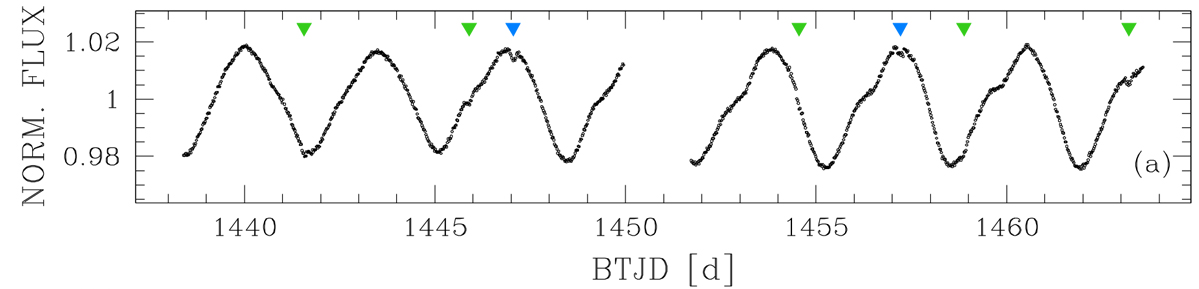
La figura (cliccare qua per visualizzare l’immagine interamente) mostra la curva di luce di TOI-942 misurata da TESS. Le frecce verdi e blu indicano i transiti dovuti al passaggio dei due esopianeti TOI-942b e TOI-942c.
Mario Giuseppe Guarcello ( segui mguarce) ( youtube)
Iscriviti al canale Youtube dell’Osservatorio Astronomico di Palermo[:en]The exoplanetary systems discovered so far (3212 systems with a total of 4331 exoplanets, as reported by https://exoplanets.nasa.gov/ on January 21st 2021) show a great variety of systems architecture, with some configurations which are completely different than that of our Solar System. This variety of architectures is a challenge for studies of the planetary formation process and all mechanisms that contribute in shaping the final configuration of planetary systems.
In this contest, it is very important to discover exoplanets orbiting around young stars (i.e. younger than 100 million years). Such systems, in fact, allow us to study exoplanets that only recently emerged from the protoplanetary disk in which they formed, and they can still undergo the process of radial migration, which is due first to interaction between the newborn planets and their disks, and then by the gravitational interaction between the planets of the same system. Besides, young stars are bright X-ray and UV sources. This radiation arises from the magnetic activity of these stars, and it can have important consequences on the chemical evolution of planets and their atmospheres. However, to date only a handle of planets orbiting around young stars are known: 5 planets discovered by TESS (Transiting Exoplanet Survey Satellite), together with a system hosting 4 exoplanets orbiting around a 23 million years old star and an exoplanet orbiting around a 5-10 million years star, both discovered by Kepler/K2.
Thanks to the research led by the astronomer I. Carleo (Astronomy Department and Van Vleck Observatory, Wesleyan University and INAF – Astronomical Observatory of Padua), the family of exoplanets orbiting around young stars now has two new members: two Neptunians orbiting around the star TOI-942, classified by the authors as a K2.5V star with an age between 30-80 million of years. Given its young age, TOI-942 as a short rotation period of only 3.4 days and an intense magnetic activity, producing energetic radiation inducing a significant mass loss from the planets atmospheres. From the analysis of the TESS light curves of TOI-942 (e.g., brightness variation with the time), together with observations obtained with SuperWASP (a telescope designed for the search of exoplanets), REM telescope (Rapid Eye Mount) of the European Southern Observatory, and the spectrograph HARPS-N mounted on the Telescopio Nazionale Galileo, the team led by I. Carleo has confirmed the presence of the two exoplanets orbiting around TOI-942. They have also estimated the upper limits of the mass of the two planets (16 and 37 Terrestrial masses), their radii (4.2 and 4.8 Terrestrial radii), and their orbital periods equal to 4.3 and 10.2 days. The planetary system of TOI-942 is thus the youngest system discovered with TESS so far. The study is described in the paper: “The GAPS Programme at TNG XXVIII. A pair of hot-Neptunes orbiting the young star TOI-942“, recently appeared on Astronomy & Astrophysics. Among the coauthors, the astronomers D. Locci, G. Micela, L. Affer, S. Benatti, A. Maggio e J. Maldonado of INAF – Astronomical Observatory of Palermo.
The figure (click here to visualize the entire image) shows the light curve of TOI-942 measured by TESS. The blue and green arrows show the transits due to the exoplanets TOI-942b e TOI-942c.
Mario Giuseppe Guarcello ( follow mguarce) ( youtube)
Subscribe the Youtube channel of the Astronomical Observatory of Palermo[:]