
[:it]Caratterizzati gli esopianeti orbitanti attorno alla stella K2-3. Pubblicato su A&A lo studio: “Eyes on K2-3: A system of three likely sub-Neptunes characterized with HARPS-N and HARPS” di M. Damasso (INAF-OA Torino)[:en]Mass determination of the three planets of K2-3. Published on A&A the study: “Eyes on K2-3: A system of three likely sub-Neptunes characterized with HARPS-N and HARPS” of M. Damasso (INAF-OA Torino)[:]

[:it]
di Mario Giuseppe Guarcello ( segui mguarce)
La ricerca di esopianeti che orbitano all’interno della fascia di abitabilità della propria stella (ossia la regione dove l’acqua può esistere su un pianeta allo stato liquido) riveste ovviamente un grande interesse. In particolare, vari progetti come MEarth (Irwin et al. 2015), APACHE (Sozzetti et al. 2013) e TRAPPIST (Gillon et al. 2017) sono dedicati alla ricerca di esopianeti attorno stelle di tipo spettrale M (con una temperatura efficace di 2400-3700 K ed una massa tra 0.08 e 0.6 masse solari). Queste stelle costituiscono più del 75% delle stelle nell’intorno solare, e i due metodi maggiormente usati per l’individuazione di esopianeti, il metodo dei transiti fotometrici (variazione della luce della stella quando questa è parzialmente occultata da un esopianeta che le passa davanti) e delle velocità radiali (individuazione delle periodiche oscillazioni della stella attorno al centro di massa del sistema stella-pianeta), sono particolarmente efficaci per trovare pianeti orbitanti nella zona di abitabilità.
La stella K2-3 e’ una stella M0 ad una distanza dal Sole di 147 anni luce, attorno alla quale il satellite Kepler (che ha recentemente terminato la sua lunga missione) ha individuato tre esopianeti grazie al metodo dei transiti: K2-3 b (raggio di 2 R⊕ e periodo orbitale di 10 giorni), K2-3 c (1.7 R⊕ e 24.6 giorni) e K2-3 d (1.6 R⊕ e 45.5 giorni). In particolare, K2-3 d orbita vicino al raggio interno della fascia di abitabilità di K2-3.
Date queste caratteristiche, era importante misurare le masse e quindi le densità di questi tre pianeti con un’adeguata precisione. Questo e’ stato lo scopo dello studio “Eyes on K2-3: A system of three likely sub-Neptunes characterized with HARPS-N and HARPS” di M. Damasso (INAF-Osservatorio Astronomico di Torino), recentemente pubblicato su Astronomy & Astrophysics. Analizzando un totale di 349 spettri ad alta risoluzione di K2-3, 138 ottenuti con lo spettroscopio HARPS e 211 con HARPS-N, alcuni dei quali nell’ambito del progetto GAPS (Global Architecture of Planetary Systems), gli autori di questo studio hanno misurato la massa di due dei tre pianeti dopo aver rimosso dal segnale delle velocità radiali la componente dominante dovuta all’attività magnetica della stella. Le masse risultanti sono di 6.6 ± 1.1 M⊕ per il pianeta b e 3.1−1.2+1.3 M⊕ per il pianeta c. La massa del pianeta d non e’ stata misurata direttamente ma stimata, attraverso delle simulazioni, pari a 2.7−0.8+1.2 M⊕. Secondo questi risultati, quindi, si tratta di 3 pianeti di tipo sub-Nettuniano. Allo studio hanno partecipato gli astronomi J. Maldonado, L. Affer, E. Gonzalez-Alvarez, A. Maggio, S. Masiero e G. Micela dell’INAF-Osservatorio Astronomico di Palermo.
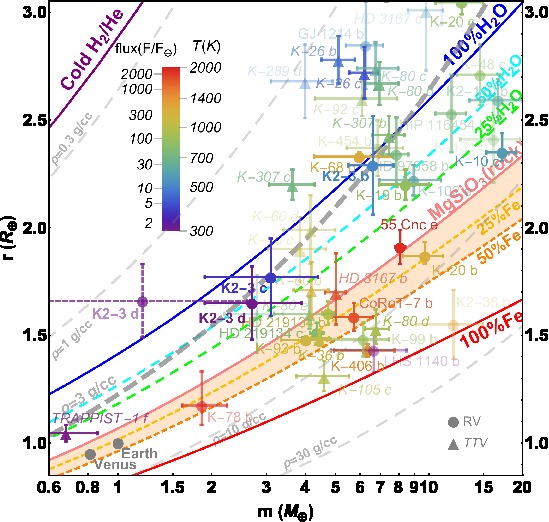
La figura (link) mostra il diagramma massa vs. raggio degli esopianeti noti e per cui queste due grandezze siano state determinate con incertezze minori del 30%. La posizione degli esopianeti di K2-3 è evidenziata. In grigio è evidenziata la curva corrispondente ad una densità di 3 g cm^-3, che interseca la posizione dei tre pianeti di K2-3.[:en]In the field of exoplanetary science, it is particularly important the study of exoplanets orbiting in the habitable zone, e. g. at a distance from their stars which allows water to be in liquid state at the surface of rocky planets. In particular, several projects such as MEarth (Irwin et al. 2015), APACHE (Sozzetti et al. 2013), and TRAPPIST (Gillon et al. 2017) focused on the search of exoplanets around M stars (with effective temperature between 2400K and 3700K and with a mass ranging from 0.08 and 0.6 solar masses). In M stars, in fact, the two techniques mainly used to detect exoplanets, the method of transits (which consists in detecting the fading of emission from the stars during the transit of exoplanets across stellar disc), and the method of radial velocity (which consists in detecting the periodic oscillations of stars around the common center of mass of the star-planets system), are more effective in detecting planets in the habitable zone.
The star K2-3 is a M0 star at a distance of 147 light years from the Sun. The satellite Kepler (which has recently finished its fuel completing its long and successful mission) has detected three planets around this star: K2-3 b (with a radius of 2 R⊕ and an orbital period of 10 days), K2-3 c (1.7 R⊕ and 24.6 days), and K2-3 d (1.6 R⊕ and 45.5 days). In particular, K2-3 d orbits close to the inner edge of the habitable zone of K2-3.
Given these properties, it was important to obtain an accurate determination of the masses and thus the bulk densities of these three planets. This was the purpose of the study “Eyes on K2-3: A system of three likely sub-Neptunes characterized with HARPS-N and HARPS” of M. Damasso (INAF-Astronomical Observatory of Turin), recently published by Astronomy & Astrophysics. By analysing a total of 349 high resolution spectra, 138 acquired with HARPS and 211 with HARPS-N, some of which as part of the program GAPS (Global Architecture of Planetary Systems) the authors have measured the mass of two of these three planets after removing the principal component in the radial velocity signal due to stellar activity. The resulting mass fo K2-3 b is 6.6 ± 1.1 M⊕, while for K2-3 c is 3.1−1.2+1.3 M⊕. The mass of planet d has not been measured directly, since its signal was very low, and it was estimated by simulations as equal to 2.7−0.8+1.2 M⊕. According to these results, these three planets are of the sub-Neptune class. The study has been published with the collaboration of the astronomers J. Maldonado, L. After, E. Gonzalez-Alvarez, A. Maggio, S. Masiero, and G. Micela of INAF – Astronomical Observatory of Palermo.
The figure (link) shows the mass-radius diagram for exoplanets for which the mass and radius have been both measured with a relative error better than 30$\%$. The location of the K2-3 planets is emphasized. The curve for bulk density 3 g cm-3 is shown in grey passing through the three positions occupied by the K2-3 planets. The planetary data are taken from the NASA exoplanet archive and updated to 30th August 2017.
[:]