
[:it]Attività stellare ed età. L’articolo: “The GAPS programme at TNG XXXIV. Activity-rotation, flux–flux relationships, and active-region evolution through stellar age” di J. Maldonado (INAF-OAPA) recentemente pubblicato su A&A[:en]Stellar age and magnetic activity. The study: “The GAPS programme at TNG XXXIV. Activity-rotation, flux–flux relationships, and active-region evolution through stellar age” of J. Maldonado (INAF-OAPA) recently appeared on A&A[:]

[:it]Quasi tutte le stelle generano un campo magnetico al loro interno tramite un processo di dinamo, in cui sono coinvolti la rotazione della stella ed i moti convettivi del plasma al suo interno. In generale, i campi magnetici agiscono e sono influenzati da particelle cariche elettricamente, cosa di cui è composto il plasma nelle stelle. Di conseguenza, nelle stelle campo magnetico e plasma interagiscono, dando vita ad una famiglia di fenomeni transienti che osserviamo in fotosfera, cromosfera e corona solare, chiamati “attività stellare“. In questa classe di fenomeni rientrano, ad esempio: le macchie fotosferiche, i brillamenti coronali e le protuberanze.
L’attività stellare è più intensa in quelle regioni della stella, sia in superifcie che in atmosfera, dove il campo magnetico è localmente più intenso. Queste regioni transienti sono chiamate “regioni attive“, e sono dominate da fenomeni come macchie e protuberanze. Nel corso degli anni diversi studi hanno analizzato come i fenomeni magnetici nelle stelle variano in funzione dei parametri stellari (come la massa) e della loro età. Tali studi sono di grande importanza per due motivi: sia perchè attraverso l’analisi dell’attività magnetica è possibile esplorare la struttura interna della stella, sia perchè questi fenomeni, e la conseguente emissione di radiazione energetica (raggi UV e X), può avere conseguenze importanti sull’ambiente circumstellare ed eventuali sistemi esoplanetari.
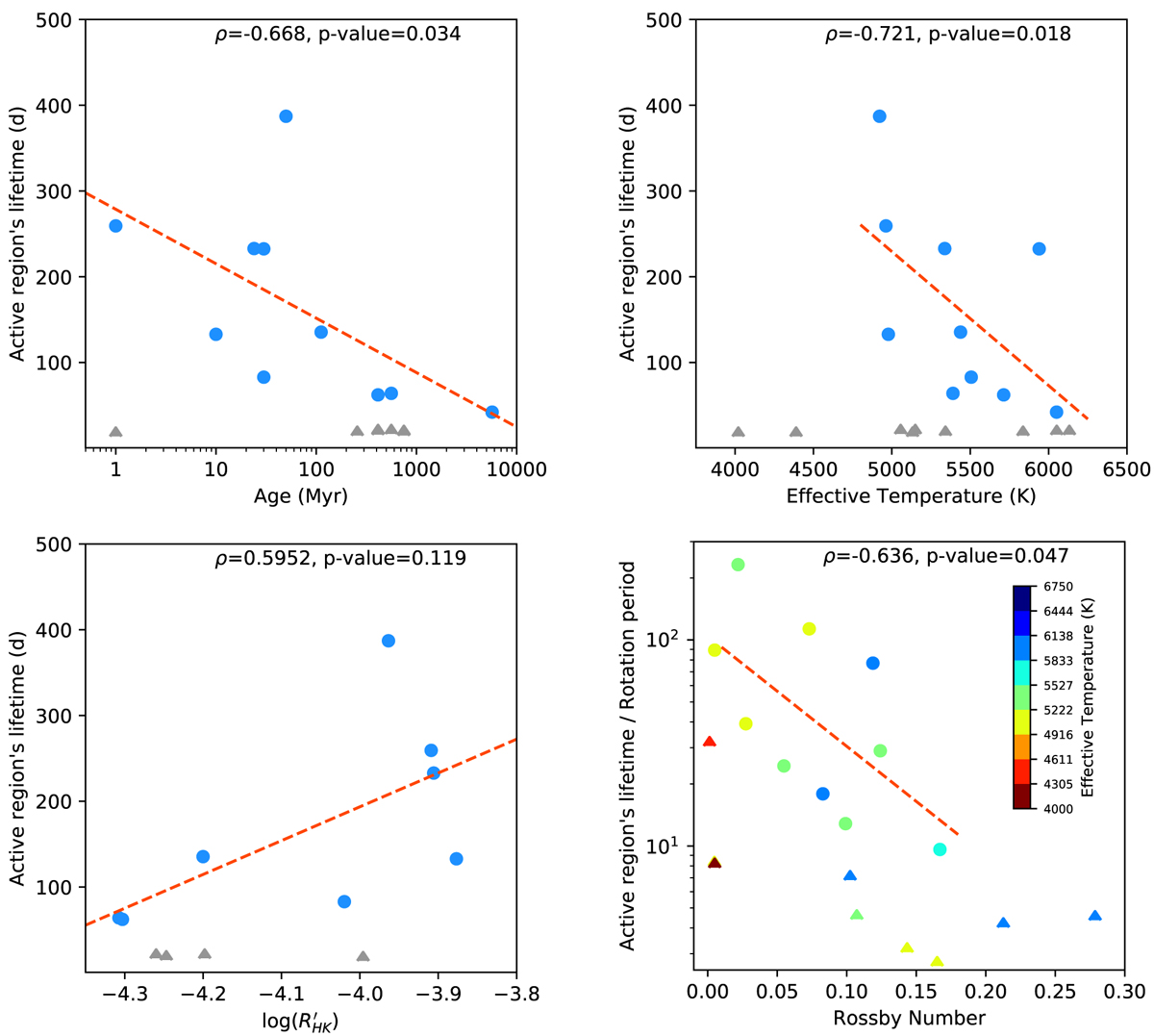
In tutti questi studi si osserva come le diagnostiche legate ai fenomeni di natura magnetica diminuiscano con l’età delle stelle. Questo in generale è conseguenza dell’evoluzione del campo magnetico stellare, a sua volta conseguenza di un’evoluzione della dinamo stellare che risente, ad esempio, della rotazione via via più lenta e dell’evoluzione della struttura interna. Questo declino vale anche per il tempo di vita medio delle regioni attive? Per rispondere a questa domanda, il team guidato dall’astrofisico J. Maldonado (INAF – Osservatorio Astronomico di Palermo) ha studiato un campione di 130 stelle in ammassi stellari ed associazioni la cui età è ben definita, da alcune giovanissime stelle dell’Associazione del Toro (1-2 milioni di anni), ad una dozzina di stelle associate all’ammasso NGC752, con 1.3 miliardi di anni. Tutte queste stelle sono state osservate con lo spettrografo HARPS-N del Telescopio Nazionale Galileo come parte del programma GAPS (Global Architecture of Planetary Systems). Da queste osservazioni è possibile misurare diversi indici di attività stellare, che hanno permesso agli autori di confermare il declino dell’attività magnetica in funzione dell’età delle stelle, e di evidenziare come tale declino sia più lento per le stelle di massa minore. Per un campione più piccolo di stelle, il team ha potuto anche ottenere il tempo di vita medio delle regioni attive dall’analisi delle curve di luce (ossia misure della variazione di luminosità delle stelle in funzione del tempo) ottenute dal satellite della NASA TESS (Transiting Exoplanet Survey Satellite). Nonostante le poche stelle per cui questa analisi sia stata possibile, è evidente un declino co l’età del tempo di vita medio delle regioni attive, che va da alcune centinaia di giorni per le stelle più giovani (1-2 milioni di anni) a pochi giorni per quelle più vecchie (circa 1 miliardo di anni). Lo studio è descritto nell’articolo: “The GAPS programme at TNG. XXXIV. Activity-rotation, flux-flux relationships, and active-region evolution through stellar age“, recentemente pubblicato sulla rivista Astronomy & Astrophysics. Il team conta 20 astronomi di diversi istituti, tra cui S. Colombo, A. Petralia, S. Benatti, G. Micela, A. Maggio e L. Affer dell’INAF – Osservatorio Astronomico di Palermo.
La figura (cliccare qui per visualizzare l’immagine interamente) mostra l’andamento del tempo di vita medio delle regioni attive in funzione dell’età delle stelle (in alto a sinistra), temperatura (alto a destra), uno degli indici di attività cromosferica, denominato RHK (basso a sinistra), ed il numero di Rossby, una quantità che dipende da rotazione e convezione nella stella (basso a destra).
Mario Giuseppe Guarcello ( segui mguarce) ( youtube)
Segui la pagina Facebook dell’Osservatorio Astronomico di Palermo
Iscriviti al canale Youtube dell’Osservatorio Astronomico di Palermo[:en]Almost all stars in the Universe produce their own magnetic field with a process called stellar dynamo, whose basic ingredients are stellar rotation and convection. In general, magnetic fields are produced and are affected by charged particles, which is what stellar plasma is made of. In stars the magnetic field and plasma thus interact, producing a class of transient phenomena that we can observe in the Solar photosphere, chromosphere and corona, which are classified as “stellar activity“. In this class we can find phenomena such as spots, flares, and prominences.
Stellar activity is more intense in those regions of the stellar surface and atmosphere where the magnetic field intensity is larger. These transient regions are called “active regions“, and they are dominated by spots, prominences and other magnetic phenomena. In the last decades, several studies have analyzed how stellar magnetic activity varies as a function of stellar parameters, such as mass, and stellar age. These studies are of particular importance for two reasons. First, magnetic activity allows astronomers to probe the stellar internal structure and its evolution. Second, these phenomena and their energetic (UV and X-rays) radiation can strongly impact the surrounding environment and planetary systems.
All these studies conclude that all the diagnostics probing stellar magnetic activity decline with age. In general, this is a consequence of the evolution of the stellar magnetic field, which results from the evolution of stellar dynamo mainly due to stellar spin-down and changes in their internal structure. Does this decline occur also for the mean lifetime of active regions? To answer this question, the team of researchers led by the astronomer J. Maldonado (INAF – Astronomical Observatory of Palermo) have studied a sample of 130 stars in star clusters or associations, which allow astronomers to constrain with precision their ages. The age of these stars ranges from a few very young stars associated with the Taurus Association (1-2 million of years old) to a dozen of stars in the cluster NGC 752 (more than 1 billion years old). All these stars were observed with the spectrograph HARPS-N mounted at the Telescopio Nazionale Galileo, in the framework of the GAPS (Global Architecture of Planetary Systems) program. From these observations, it is possible to measure a few indices of stellar activity, which allowed the team to confirm the decline with age of stellar activity, and to verify that such a decline is slower for low-mass stars. For a subsample of stars, the researchers could also measure the mean lifetime of active regions from the light curves (e.g.: measurements of stellar luminosity as a function of time) obtained with the NASA satellite TESS (Transiting Exoplanet Survey Satellite). Despite the small number of stars, from this analysis it is evident the decline with stellar age of the mean lifetime of active regions, which goes from a few hundreds days in the youngest stars in the sample (1-2 million of years) to a few days in the oldest ones (about 1 billion of years old). The study is described in the paper:”The GAPS programme at TNG. XXXIV. Activity-rotation, flux-flux relationships, and active-region evolution through stellar age“, recently appeared on the journal Astronomy & Astrophysics. The team counts 21 astronomers of several institutions, among whom S. Colombo, A. Petralia, S. Benatti, G. Micela, A. Maggio and L. Affer of INAF – Astronomical Observatory of Palermo.
The figure (click here to visualize the entire image) shows how the mean lifetime of active regions varies as a function of: stellar age (upper left panel), temperature (upper right panel), one of the most widely used indices of chromospheric activity, the RHK index (bottom left panel), and the Rossby number, which is a quantity which depends on star rotation period and convection (bottom right panel).
Mario Giuseppe Guarcello ( follow mguarce) ( youtube)
Follow the Astronomical Observatory of Palermo on Facebok
Subscribe the Youtube channel of the Astronomical Observatory of Palermo[:]