
[:it]Completate le osservazioni Chandra/ACIS-I dell’ammasso stellare Westerlund-1 per il progetto Extended Westerlund One Chandra Survey (EWOCS) [:en]Completed the Chandra/ACIS-I observations of the starburst cluster Westerlund 1 as part of the EWOCS (Extended Westerlund One Chandra Survey) project.[:]
[:it]Durante il processo di formazione stellare, la quantità di gas che viene convertito in stelle dipende del tasso di formazione stellare. Ad esempio, nella Via Lattea ogni anno vengono convertite in media da 0.7 a 1.5 masse solari di gas in stelle. Questo valore è ovviamente una media su tutta la Galassia, ma localmente possono verificarsi episodi di formazione stellare molto più rapidi e violenti. Le regioni più estreme vengono chiamate “regioni starburst”, e gli ammassi stellari formati da questi eventi “ammassi stellari starburst”.
Gli eventi starburst sono molto comuni nelle galassie primordiali e nelle galassie interagenti, dove l’interazione gravitazionale tra le galassie coinvolte induce tassi di formazione stellare decine o centinaia di volte maggiori del valore medio della Via Lattea. Un esempio molto noto di questo tipo di fenomeno è costituito dalle Galassie Antenne.
Nella nostra Galassia oggi solo pochi ammassi e regioni di formazione stellare rientrano in questa categoria, mentre certamente erano più comuni in epoche passate caratterizzate da intensi tassi di formazione stellare. La regione starburst più vicina a noi è l’ammasso stellare Westerlund 1. Con una massa iniziale di circa 52000 masse solari, ed una massa attuale stimata tra 2000 masse solari e 45000 masse solari, Westerlund 1 è quindi il target migliore per studiare come i processi di formazione stellare e planetaria, e l’evoluzione iniziale delle stelle, avvengano in un ambiente starburst. Westerlund 1 inoltre è caratterizzato da una popolazione di stelle massicce estremamente ricca, che conta alcune delle stelle più massicce che conosciamo nella nostra Galassia ed alcune stelle in fasi evolutive transienti, e quindi molto rare. L’ammasso ha inoltre ospitato almeno un’esplosione di supernova, come è testimoniato dalla presenza della pulsar CXO J164710.20-455217, e costituisce l’ambiente adatto per la formazione di buchi neri di massa intermedia, mai osservati finora se non per l’emissione di onde gravitazionali durante episodi di coalescenza.
Per studiare questo ammasso stellare dalle proprietà uniche, l’astronomo Mario Giuseppe Guarcello dell’INAF – Osservatorio Astronomico di Palermo, ha recentemente ottenuto una lunga (1 milione di secondi) osservazione ai raggi X con il satellite della NASA Chandra ed un’osservazione nell’infrarosso con il James Webb Space Telescope di 19 ore, ed organizzato il progetto internazionale EWOCS (Extended Westerlund One Chandra Survey), che coinvolge 35 scienziati di 19 istituti europei, americani, e sud americani. Sebbene l’analisi dei dati sia iniziata da poco, si può già affermare con assoluta certezza che il progetto porterà ad un’importante produzione scientifica, impreziosita anche dalla multidisciplinarietà del team coinvolto nel progetto.
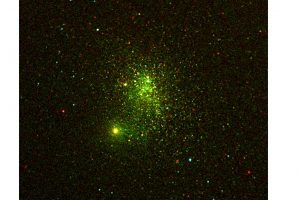
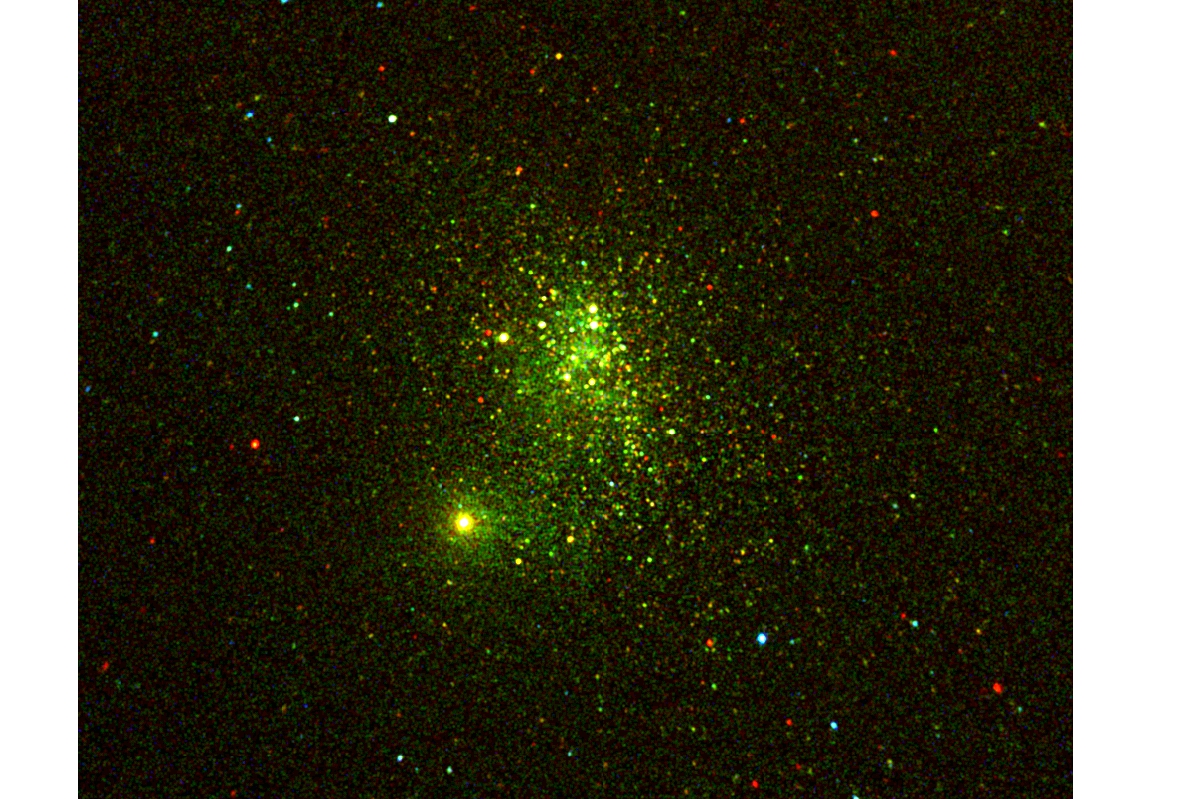
La lunga osservazione Chandra/ACIS-I (che può essere visualizzata per intero in questo link) dell’ammasso è stata completata in questi giorni. Nell’immagine, i raggi X più energetici (fotoni con un’energia compresa tra 2 e 7 keV) sono colorati in rosso, quelli meno energetici (0.5-1.2 keV) in blu, quelli intermedi in verde. L’energia dei raggi X osservati dipende dai processi fisici e della temperatura del plasma responsabili dell’emissione di raggi X, e della quantità di gas interstellare che assorbe la radiazione emessa (un’emissione osservata con raggi X di energia maggiore può corrispondere ad un maggiore assorbimento da parte del gas interstellare, che selettivamente assorbe raggi X di energia minore). Nell’immagine è evidente il centro dell’ammasso densamente popolato da sorgenti di varia luminosità, insieme alla pulsar molto brillante in basso a sinistra.
Mario Giuseppe Guarcello ( segui mguarce) ( youtube)
Iscriviti al canale Youtube dell’Osservatorio Astronomico di Palermo[:en]The amount of gas that is converted into stars by the star formation process is described by the star formation rate. For instance, in the Milky Way today between 0.7 and 1.5 solar masses of gas are converted into stars each year. However, this a mean value across our Galaxy, since locally clouds can start forming stars at higher rates than this value. The most extreme star forming regions are called “starburst regions”, and the resulting young stellar clusters “starburst clusters”.
Starburst events are common in the early Universe and in the interacting galaxies, where the gravitational interaction between the galaxies induces star formation rates tens or even hundreds times higher than that of the Milky Way. A typical example of such a phenomenon are the Antenna Galaxies.
In our Galaxy today only a handle of starburst clusters are known, while they were certainly more common in past epochs characterized by more intense star formation rates than today. The closest starburst region to the Sun is the young cluster Westerlund 1. With an initial mass of 52000 solar masses, and a current total mass between 20000 and 45000 solar masses, Westerlund 1 is thus the best target to study the products of star and planet formation processes, and the early stellar evolution in a starburst environment. Westerlund 1 is also characterized by an impressive population of massive stars, with some of the most massive stars known in the Galaxy, and several stars in transient evolutionary phases, which are very rare to be observed. The cluster also hosted at least one supernova explosion, as supported by the association with the cluster of the pulsar CXO J164710.20-455217, and it represents a typical environment where it is possible to form intermediate massive black holes, which have been observed to date only thanks to the emission of gravitational waves during coalescence events.
In order to unveil the properties of such an important cluster, the astronomer Mario Giuseppe Guarcello (INAF – Astronomical Observatory of Palermo) has recently obtained a long (1 million of seconds) observation with the NASA X-ray telescope Chandra, together with an infrared observation of 19 hours with the James Webb Space Telescope. These observations will be part of the project Extended Westerlund One Chandra Survey (EWOCS), in which 35 astronomers from 19 institutions are involved. Even if the team has started the data analysis only recently, it is clear that the project will produce important results, also thanks to the multidisciplinary skill of the team.
The long Chandra/ACIS-I observations (click here to visualize the entire image) of the cluster has been completed recently. In the image, the most energetic X-rays (photons with the energy between 2 and 7 keV) are colored in red, the less energetic (0.5-1.2 keV) in blue, while those with an intermediate energy in green. The energy of the observed X-ray photons depends on the physical processes and the temperature of the plasma responsible for the emission, together with the quantity of the intervening interstellar gas that absorbs the X-ray emission (the larger the interstellar absorption the more energetic the photons detected). In the image, the cluster with its dense core is in the center, while the pulsar is the bright source in the bottom left part of the image.
Mario Giuseppe Guarcello ( follow mguarce) ( youtube)
Subscribe the Youtube channel of the Astronomical Observatory of Palermo[:]