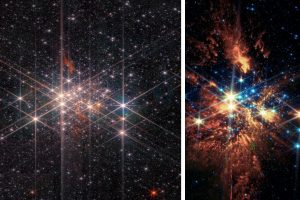
Berkeley 59: an expanding cluster described in the study: “Internal dynamics and structure of Cepheus OB4. The asymmetric expansion of Berkeley 59” of B. Wiesneth (Universität Leipzig/Universidade de Lisboa)

Berkeley 59 is a young stellar clusters, which is experiencing a rapid asymmetric expansion   Stars typically form in groups or stellar clusters containing from hundreds to thousands of members. Within these clusters, stars are not stationary but move along trajectories determined by the system’s overall gravity (that is, the gravitational potential of the cluster) and by their mutual interactions.

» Read more

(Italiano) Un superammasso stellare svelato dal James Webb Space Telescope. L’articolo: “EWOCS-III: JWST observations of the supermassive star cluster Westerlund 1” di M. G. Guarcello (INAF-OAPA) pubblicato su A&A

The star-forming regions can differ significantly from one another, particularly in terms of the population of massive stars (with masses exceeding about 10 solar masses) and stellar density (defined as the number of stars per unit volume). These aspects can vary drastically from one region to another. Such differences are extremely important, as massive stars create environments dominated by high-energy

» Read more

A large catalog of stars associated with stellar clusters recently compiled in the framework of the Gaia-ESO Survey.

Star clusters are a product of the star formation process. During their gravitational collapse, in fact, molecular clouds fragment forming hundreds or even thousands of stars. During the first few tens of million of years of their evolution, the young stars formed in a cloud are bound by the intense mutual gravitational attraction, forming a stellar cluster. Star clusters are important

» Read more