
[:it]Le abbondanze chimiche stellari possono non essere rappresentative di quelle del mezzo interstellare. Lo studio: “The Gaia-ESO Survey: Probing the lithium abundances in old metal-rich dwarf stars in the solar vicinity” di M. L. L. Dantas (Nicolaus Copernicus Astronomical Center) pubblicato su A&A [:en]Stellar lithium abundances may not be representative of the interstellar medium composition. The study: “The Gaia-ESO Survey: Probing the lithium abundances in old metal-rich dwarf stars in the solar vicinity” of M. L. L. Dantas (Nicolaus Copernicus Astronomical Center) appeared on A&A [:]

[:it]Lo studio delle abbondanze chimiche del mezzo interstellare e nelle stelle della nostra Galassia è un argomento di estremo interesse, in quanto è legato al processo di arricchimento chimico del mezzo interstellare da parte delle stelle di grande massa e all’evoluzione delle varie componenti stellari della Via Lattea. Il litio è uno degli elementi che spesso è oggetto di campagne osservative spettroscopiche e studi volti a determinarne l’abbondanza e a metterla in relazione con le proprietà stellari.
Per circa tre decenni si è ritenuto che la determinazione dell’inviluppo superiore delle abbondanze del litio in una popolazione stellare fosse rappresentativa delle abbondanze del mezzo interstellare locale. Per “inviluppo superiore” si intende il luogo definito dalle stelle con abbondanze più elevate in un diagramma che metta in relazione le abbondanze di litio e la temperatura delle stelle. Tuttavia, recentemente alcuni studi hanno evidenziato una diminuzione anomala dell’inviluppo superiore dell’abbondanza di litio in stelle ad alta metallicità (ossia l’abbondanza di elementi pesanti rispetto a quella dell’idrogeno). Studi recenti hanno attribuito questo risultato alla “contaminazione” dei campioni stellari da parte di vecchie stelle migrate radialmente dalle regioni interne della Galassia verso l’intorno solare.
La campagna osservativa denominata Gaia-ESO Survey (GES), che ha prodotto osservazioni spettroscopiche di più di 100000 stelle utilizzando lo spettrografo FLAMES montato al Very Large Telescope dell’European Southern Observatory, offre un’opportunità unica per determinare le abbondanze chimiche in un ampio e variegato campione di stelle. Il team guidato dall’astrofisica M. L. L. Dantas (Nicolaus Copernicus Astronomical Center, Varsavia) ha analizzato i dati GES di 1400 stelle nane con caratteristiche chimico-dinamiche che suggeriscono una migrazione dalle regioni interne della Galassia fino all’area vicina al Sole. L’analisi ha rivelato che queste stelle sono responsabili della diminuzione dell’inviluppo superiore dell’abbondanza di litio, supportando lo scenario che suggerisce che le abbondanze del mezzo interstellare non possono essere rappresentate da quelle misurate nelle stelle, senza tenere adeguatamente conto della loro metallicità e della loro storia (luogo di formazione e dinamica nella Galassia). Lo studio è descritto nella lettera intitolata “The Gaia-ESO Survey: Probing the lithium abundances in old metal-rich dwarf stars in the solar vicinity“, recentemente pubblicata nella rivista Astronomy & Astrophysics. Tra i coautori figura anche l’astrofisica L. Prisinzano dell’INAF – Osservatorio Astronomico di Palermo.
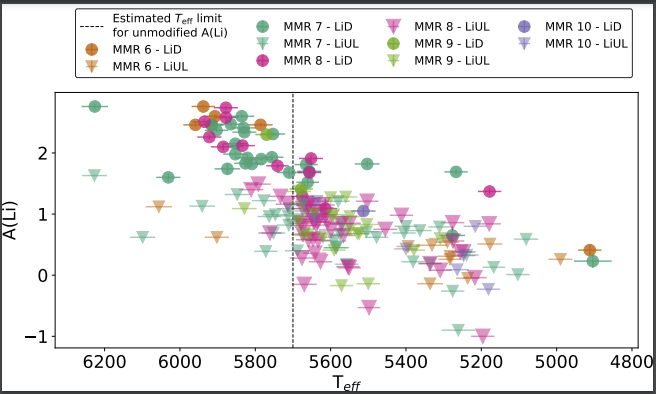
La figura (clicca qui per visualizzare l’immagine completa) mostra il diagramma dell’abbondanza di litio (A(Li)) in funzione della temperatura efficace (Teff) di tutte le stelle con alte abbondanze di metalli del campione analizzato in questo studio. Le stelle in cui il litio è stato misurato sono rappresentate da cerchi, mentre quelle per le quali sono disponibili limiti superiori sono rappresentate da triangoli. La linea verticale indica la temperatura di 5700 K.
Mario Giuseppe Guarcello ( segui mariospiegacose) ( mariospiegacose)( follow mariospiegacose)
Segui la pagina Facebook e Instagram dell’Osservatorio Astronomico di Palermo
Iscriviti al canale Youtube dell’Osservatorio Astronomico di Palermo
[:en]The study of chemical abundances in the interstellar medium and stars in our Galaxy is of utmost importance, as it provides insights into the chemical enrichment of the galactic interstellar medium by massive stars and the evolution of different components of the Milky Way. Lithium is frequently the subject of spectroscopic surveys and studies aimed at determining its abundance in stars and establishing its relationship with stellar properties.
For three decades, astronomers believed that determining the upper envelope of lithium abundances in a stellar population was representative of the abundances in the local interstellar medium. The term “upper envelope” refers to the region defined by stars with the highest lithium abundances in diagrams that plot abundances against stellar effective temperatures. However, recent observations have revealed an anomalous decline in the upper envelope of lithium abundance for stars with high metallicity (which indicates the abundance of heavy elements relative to hydrogen). Some studies have suggested that this decline may be attributed to the “contamination” of the observed stellar samples by old stars that migrated from the inner regions of the Galaxy to the Solar neighborhood.
The spectroscopic survey known as the Gaia-ESO Survey (GES), which conducted spectroscopic observations for over 100000 stars using the FLAMES spectrograph mounted on the Very Large Telescope of the European Southern Observatory, provides a unique opportunity to determine chemical abundances across a large and diverse sample of stars. The team led by astronomer M. L. L. Dantas, from the Nicolaus Copernicus Astronomical Center in Warsaw, analyzed GES data for approximately 1400 high-metallicity stars exhibiting chemical and dynamical characteristics indicating radial migration from the inner regions of the Galaxy to the vicinity of the Sun. The analysis unveiled that these stars are responsible for the decline of the upper limit of lithium abundances, supporting the scenario suggesting that the chemical abundances of the interstellar medium cannot be inferred solely from stellar measurements without properly accounting for stellar metallicity and history, including birthplace and dynamics. The study is described in the letter titled “The Gaia-ESO Survey: Probing the lithium abundances in old metal-rich dwarf stars in the solar vicinity” recently published in the journal Astronomy & Astrophysics. Among the co-authors is the astronomer L. Prisinzano from INAF – Astronomical Observatory of Palermo.
The figure (click here to view the complete image) illustrates the lithium abundances (A(Li)) as a function of effective temperature (Teff) for all the high-metallicity stars in the analyzed sample. Stars with detected lithium are represented by circles, while those with available upper limits are indicated by inverted triangles. The vertical line denotes an effective temperature of 5700K.
Mario Giuseppe Guarcello ( follow mariospiegacose) ( mariospiegacose) ( follow mariospiegacose)
Follow the Astronomical Observatory of Palermo on Facebok and on Instagram
Subscribe the Youtube channel of the Astronomical Observatory of Palermo[:]