
[:it]La cronologia della formazione stellare nella Lagoon Nebula. Pubblicato su A&A lo studio: “The Gaia-ESO Survey: Age spread in the star forming region NGC 6530 from the HR diagram and gravity indicators” di L. Prisinzano (INAF-OAPA)[:en]The chronology of star formation in the Lagoon.The study: “The Gaia-ESO Survey: Age spread in the star forming region NGC 6530 from the HR diagram and gravity indicators” of L. Prisinzano (INAF-OAPA) recently appeared on A&A[:]

[:it]Le stelle si formano dalla contrazione gravitazionale di enormi nubi di gas. Questo processo può avvenire in due modi diversi: la contrazione può infatti essere rapida, con tempi caratteristici dettati dalla velocità con cui il gas “precipita” verso le protostelle in formazione, o può essere più lento e sostenuto da turbolenze e dal campo magnetico locale. Nel primo caso, le stelle si formano in un periodo piuttosto breve, mentre nel secondo caso il processo di formazione stellare in una nube può durare diversi milioni di anni.
Per comprendere quali di questi due modi di formazione stellare sia dominante, gli astronomi devono osservare diverse regioni di formazione stellare, identificare le giovani stelle ancora associate ad esse, e datarle. Purtroppo, stimare l’età delle stelle in formazione è un’impresa complessa. Il metodo più diffuso consiste nel confrontare il diagramma Hertzsprung-Russell di queste stelle (diagrammi dove vengono tipicamente mostrati la luminosità della stella in funzione della temperatura efficace) con i modelli di evoluzione stellare. Grazie a questo metodo, molti autori hanno suggerito un processo di formazione stellare durato vari milioni di anni in alcune regioni di formazione stellare, come la Nebulosa di Orione. Questi risultati, però, possono essere inficiati dal fatto che i modelli usati non comprendono alcune proprietà e fenomeni che caratterizzano le stelle in formazione, come le conseguenze del processo di accrescimento di gas o differenze nei raggi stellari. L’analisi di osservazioni spettroscopiche può rivelarsi utile a questo scopo, permettendo una stima indipendente di molti parametri stellari, quali la gravità superficiale e la temperatura, e quindi portare ad una stima più accurata dell’età delle stelle.
Questo approccio è usato nello studio: “The Gaia-ESO Survey: Age spread in the star forming region NGC 6530 from the HR diagram and gravity indicators” di L. Prisinzano (INAF – Osservatorio Astronomico di Palermo) per analizzare la sequenza di formazione stellare nella regione NGC 6530 (la Nebulosa Laguna). Nello studio, pubblicato su Astronomy & Astrophysics e parte del progetto Gaia-ESO Survey, gli autori analizzano osservazioni spettroscopiche ottenute con FLAMES dell’European Southern Observatory di 2077 stelle della regione, insieme a dati fotometrici di archivio ed i dati di parallasse e moto proprio forniti dal satellite Gaia dell’European Space Agency. Tra le 652 stelle giovani selezionate come membri di NGC 6530, combinando i dati spettroscopici con quelli fotometrici, è stato possibile stimare l’età di 382 stelle. Queste stelle hanno mediamente un’età minore di 1 milione di anni, ma presentano una distribuzione di età significativamente piu’ larga di quella attesa per le incertezze statistiche, con i primi eventi di formazione stellare avvenuti ben 15 milioni di anni fa. Altri test indipendenti confermano l’eta delle stelle con meno di un milione di anni, quali la loro bassa gravità superficiale (tipica delle stelle più giovani in questa fase evolutiva). La popolazione stellare più giovane di NGC 6530 è concentrata principalmente attorno la stella 9 Sgr (un sistema binario composto da una stella O3.5 ed una stella O5.5) ed un filamento della nube a sud-est, dove le stelle sembrano avere una cinematica diversa rispetto il resto della regione. Secondo questi risultati, quindi, NGC 6530 è una delle regioni di formazione stellare caratterizzata da un processo di formazione stellare lento, che si è protratto per circa 15 milioni di anni. Per questo studio, L. Prisinzano ha guidato un team di ricercatori internazionale, di cui fanno parte anche gli astronomi F. Damiani, R. Bonito, G. Micela, M. G. Guarcello, e E. Flaccomio dell’INAF – Osservatorio Astronomico di Palermo.
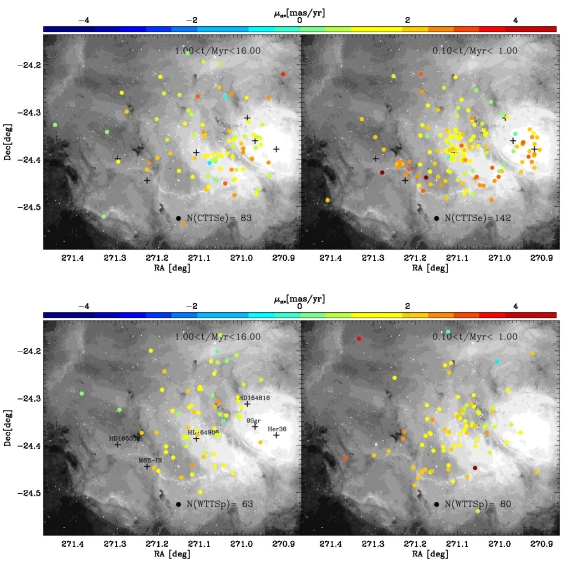
La figura (link per l’immagine intera) mostra la distribuzione spaziale delle stelle associate ad NGC 6530, divisi in due intervalli di età, e distinguendo le T Tauri Classiche (stelle giovani con associato un disco protoplanetario che accresce gas sulla stella centrale) dalle T Tauri Weak-line (stelle giovani senza fenomeni di accrescimento significativi).
di Mario Giuseppe Guarcello ( segui mguarce)[:en]Stars form from the gravitational contraction of large gas clouds. This process may occur in two different modes: It may be fast, with a characteristic timescale dictated by the free fall of gas onto the forming stars, or it may be slow, sustained by turbulence and magnetic field. In the former case stars form over a short period, while in the latter case the star formation process can occur over a time period of several million years.
In order to understand which is the dominant star formation mode, astronomers must observe several star forming regions, select the young stars associated to these regions, and estimate their age. This is not a trivial task. The most widely used method to estimate the age of stars is by comparing their observed photometry with that predicted by models of stellar evolution. With this method, the star formation has been dated in several star forming regions, and clues of a significant spread of stellar age suggested in some cases, such as in the Orion Nebula. These results, however, can be affected by important issues. For instance, they typically ignore some important properties or phenomena which characterize young stars, such as the gas accretion history or a spread in the distribution of stellar radii. An important help in this direction can be provided by stellar spectroscopy. By analyzing stellar spectra, in fact, it is possible to estimate stellar parameters such as temperature and surface gravity, obtaining a more reliable age estimate.
This is the approach adopted in the study: “The Gaia-ESO Survey: Age spread in the star forming region NGC 6530 from the HR diagram and gravity indicators” of L. Prisinzano (INAF – Astronomical Observatory of Palermo), to study the star formation chronology in NGC 6530 (the Lagoon Nebula). In this study, recently appeared on Astronomy & Astrophysics and part of the Gaia-ESO Survey, the authors have analyzed spectroscopic data of 2077 stars of this region obtained with FLAMES of the European Southern Observatory, together with archival photometric data and the parallaxes and proper motions provided by the Gaia satellite of the European Space Agency. Among the 652 stars associated as members of NGC 6530, it has been possible to estimate the age of 382 stars. This sample constitutes a very young population, with a median age younger than 1 million of years and a significant spread, with the oldest stars formed about 15 million years ago.The youth of the youngest stars in this sample has been confirmed by independent tests, such as the low surface gravity which is typical of the stars in their early evolutionary stage. Besides, the young stars are mainly clustered around the star 9 Sgr (a binary system with a O3.5 and a O5.5 stars) and in a filament of the cloud at south-east, where stars have a different cinematic than those in the rest of the cloud. NGC 6530 is thus one of the star forming regions characterized by a real age spread. L. Prisinzano led and international team of researchers, counting also the astronomers F. Damiani, R. Bonito, G. Micela, M. G. Guarcello, e E. Flaccomio of INAF – Astronomical Observatory of Palermo.
The figure (link to see the entire image) shows the spatial distribution of all the members of NGC 6530, split into two age bins, and separating the Classical T Tauri (stars associated with a protoplanetary disk still accreting gas) from the Weak line T Tauri (young stars which are not longer accreting from their disks).

by Mario Giuseppe Guarcello ( segui mguarce)[:]