
[:it]Molecole organiche formate nei ghiacci interstellari. Lo studio: “Synthesis of complex organic molecules in soft x-ray irradiated ices” di A. Ciaravella (INAF-OAPA) recentemente pubblicato su ApJ[:en]Organic molecules formed in interstellar grains. The study: “Synthesis of complex organic molecules in soft x-ray irradiated ices” of A. Ciaravella (INAF-OAPA) recently appeared on ApJ[:]
[:it]Negli ultimi anni, molte molecole organiche, alcune delle quali prebiotiche, sono state osservate in diversi ambienti astronomici. Ad esempio, l’acetonitrile CH3CN è stato osservato nella nube molecolare Sag B2 e nel disco protoplanetario attorno la protostella MWC480; la formammide (precursore, ad esempio, di nucleobasi) è stata osservata in alcune galassie e nella protostella SVS13-A (in questo caso insieme ad acetaldeide CH3CHO, metanolo CH3OH e formiato di metile HCOOCH3); l’isocianato di metile è stato osservato nella regione di formazione stellare della Nebulosa di Orione e in alcune comete.
Il processo di formazione di queste molecole organiche in ambienti astronomici così diversi tra loro, ed il modo con cui il mezzo interstellare, le nebulose ed i dischi protoplanetari possano arricchirsi di queste specie chimiche, è ovviamente un argomento di grande interesse per lo studio dello sviluppo della vita nell’Universo. Ad esempio, alcune di queste molecole si possano formare nei ghiacci depositati sui grani di polvere interstellare a seguito di irraggiamento di raggi X. Questo processo è particolarmente interessante dato che le protostelle, stelle giovani che possono formare un sistema planetario, sono in media sorgenti brillanti di raggi X e sono circondate dai dischi protoplanetari, dove i grani di polvere coaugolano formando planetesimali, ossia gli embrioni dei pianeti.
Per studiare la produzione di molecole organiche in ghiacci interstellari irradiati da raggi X, il team di ricercatori guidato dall’astronoma A. Ciaravella (INAF-Osservatorio Astronomico di Palermo), che conta anche gli astronomi INAF-OAPA Antonio Jiménez-Escobar e Cesare Cecchi-Pestellini, ha condotto degli esperimenti presso il National Synchrotron Radiation Research Center, a Hsinchu (Taiwan), utilizzando l’apparato Interstellar Photo-process System: una camera a ultra-alto vuoto capace di raggiungere una pressione di 1.3 × 10⁻¹⁰ mbar. In questa camera venivano disposti campioni di miscele di ghiaccio H2O:CO:NH3, irradiati da raggi X con energie comprese tra i 250 e 1250 eV, prodotti con lo Spherical Grating Monochromator beamline del National Synchrotron Radiation Research Center (NSRRC, Taiwan). Durante l’esperimento, gli scienziati hanno osservato tramite spettroscopia di massa la formazione di diverse molecole organiche, tra cui isocianato di metile e formammide. Sono state osservate anche altre tracce probabilmente associate a formiato di metile, ossammide e acido N-acetilaspartico. Molte di queste molecole sono prebiotiche, dimostrando che i mattoni fondamentali per la vita possono sintetizzarsi nei ghiacci depositati su grani di polvere interstellare e circumstellare. Lo studio è descritto nell’articolo: “Synthesis of complex organic molecules in soft x-ray irradiated ices“, recentemente pubblicato su The Astrophysical Journal.
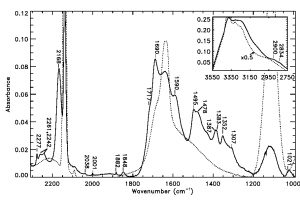
La figura (link) mostra lo spettro della miscela di ghiacci usato nell’esperimento, prima e dopo l’irraggiamento con raggi X.

di Mario Giuseppe Guarcello ( segui mguarce)[:en]In the last years, several organic molecules, some of which of prebiotic interest, have been observed in different astronomical environments. For instance, Acetonitrile CH3CN was detected in the molecular cloud Sag B2 and in the protostar MWC480; formamide (a building block for sugars and amino-acids) was detected in some outer galaxies and in the protostar SVS13-A (in this case together with acetaldehyde CH3CHO, methanol CH3OH and methyl formate HCOOCH3); methyl isocyanate was observed in the Orion Nebula and in comets.
In order to understand how life can develop in the Universe, it is crucial to understand how organic molecules can form in such a large variety of astronomical environments such as the interstellar medium, molecular clouds, and protoplanetary disks. Some of these molecules can be synthesized in the ices deposited on dust grains irradiated by X-ray photons. This possibility is particularly interesting since protostars, young stars which may form planetary systems, are intense sources of X-ray radiation and they are also typically surrounded by protoplanetary disks, where dust grains coagulate into planetesimals, which are the embryos of planets.
In order to study the formation of organic molecules on ices deposited onto interstellar dust grains, the team of researchers led by A. Ciaravella (INAF- Astronomical Observatory of Palermo), counting also the INAF-OAPA astronomers Antonio Jiménez-Escobar and Cesare Cecchi-Pestellini, has conducted experiments in the laboratory Interstellar Photo-process System of the National Synchrotron Radiation Research Center, in Hsinchu (Taiwan): an ultrahigh vacuum chamber of base pressure 1.3×10⁻¹⁰ mbar. During the experiment, a H2O:CO:NH3 ice mixture deposited in this chamber was irradiated by X-ray photons with energy between 250 e 1250 eV, produced with the Spherical Grating Monochromator beamline of the National Synchrotron Radiation Research Center (NSRRC, Taiwan). During the experiment, the team has observed using a mass spectrometer the formation of several organic molecules, such as methyl isocyanate and formamide. They also observed several features likely associated with methyl-formate, ethanediamide, and N-acetyl-L-aspartic acid. Most of these molecules are prebiotic, showing that the fundamental blocks for life can develop in the ices deposited onto interstellar and circumstellar grains. The study is described in the article: “Synthesis of complex organic molecules in soft x-ray irradiated ices“, recently appeared on The Astrophysical Journal.
The figure (link) shows the spectrum of the ice mixture before and after the irradiation with X-rays.
by Mario Giuseppe Guarcello ( follow mguarce)[:]