
[:it]Composizione chimica delle stelle e processo di formazione planetaria. Pubblicato su A&A lo studio “Connecting substellar and stellar formation. The role of the host star’s metallicity” di J. Maldonado (INAF-OAPA)[:en]Stellar chemical composition and planetary formation. The study “Connecting substellar and stellar formation. The role of the host star’s metallicity” of J. Maldonado (INAF-OAPA) recently appeared on A&A[:]

[:it]Ad oggi la famiglia degli esopianeti (pianeti che orbitano attorno stelle diverse dal Sole) conta circa 4000 pianeti confermati. Le stelle che ospitano gli esopianeti conosciuti coprono un’ampia gamma di parametri stellari e fasi evolutive. Diversi studi sono quindi stati realizzati per comprendere come le proprietà fisiche delle stelle possano determinare la probabilità che attorno ad esse si siano formati pianeti di tipo diverso (giganti gassosi, pianeti terrestri, etc..) o compagni di massa sub-stellare, come le nane brune.
In particolare, lo studio del legame tra la possibilità di formare pianeti gassosi e la metallicità delle stelle (ossia l’abbondanza di elementi pesanti quali il ferro rispetto l’idrogeno) può fornire prove importanti a favore delle varie teorie proposte sul meccanismo di formazione planetaria. Ad esempio, il modello del core-accretion (Pollack et al. 1996), secondo il quale i pianeti gassosi si formano dall’accrescimento di grandi quantità di gas dall’ambiente circostante su nuclei rocciosi massivi, suggerisce che la formazione di giganti gassosi sia favorita in ambienti circumstellari ad alta metallicità. Questo perchè la bassa metallicità comporta dei tempi più lunghi per la formazione del nucleo roccioso, che poi non avrebbe più il tempo necessario per accrescere la quantità di gas necessaria a formare un gigante gassoso. Molti studi hanno analizzato le possibilità di formare pianeti e compagni di massa sub-stellare attorno stelle di varia metallicità, concentrandosi però sempre su determinati prodotti del processo di formazione planetaria (ad esempio, giganti gassosi, pianeti di piccola massa, nane brune, dischi di polveri, etc..) o determinati tipi di stelle (giganti, stelle di piccola massa, etc..)
Il team guidato dall’astronomo J. Maldonado dell’INAF-Osservatorio Astronomico di Palermo, composto dall’astronoma G. Micela di INAF-OAPA ed astronomi dell’Univesità Autonoma di Madrid, ha analizzato in maniera omogenea un ampio campione di stelle con pianeti di vario tipo o con compagni di massa sub-stellare (59 stelle con nane brune, 208 con giganti gassosi e 78 con pianeti di piccola massa) allo scopo di determinare se la formazione di questi oggetti sia legata alla metallicità della stella ospite. Si tratta della prima volta che una simile indagine venga effettuata in maniera omogenea su un campione così vasto ed eterogeneo. Da questo studio, descritto nell’articolo “Connecting substellar and stellar formation. The role of the host star’s metallicity” pubblicato dalla rivista Astronomy & Astrophysics, risulta che stelle a metallicità minore tendono ad avere compagni di massa maggiore, suggerendo che oggetti di massa più grande potrebbero essersi formati con meccanismi diversi dal core-accretion. In particolare, questo meccanismo ha un’efficienza massima nel formare pianeti di tipo gioviano (con una massa compresa tra 0.2 e 2 masse gioviane). Pianeti di piccola massa in stelle a bassa metallicità potrebbero anche essersi formati tramite core-accretion, sebbene sia necessario un campione più ampio per poter confermare questa ipotesi.
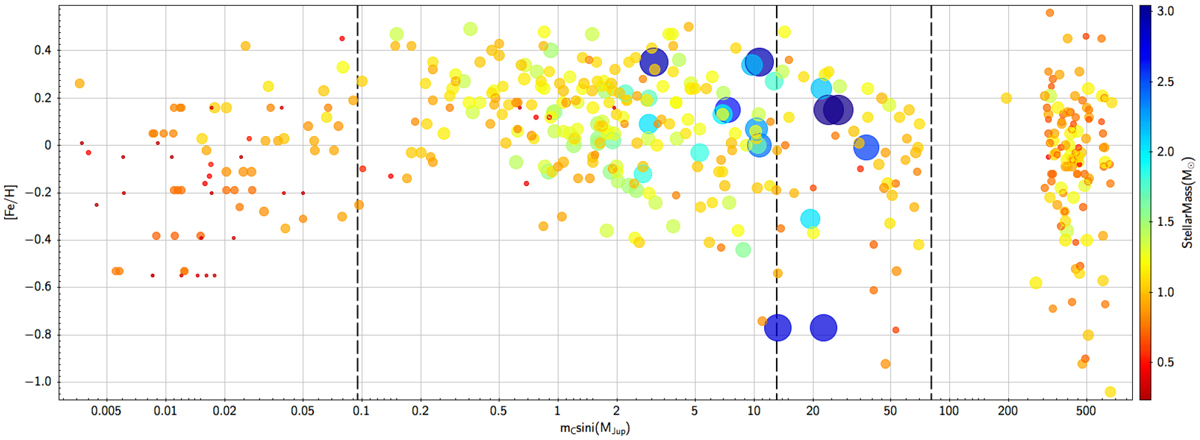
L’immagine allegata (link) mostra la metallicità delle stelle analizzate in questo studio insieme alla loro massa ed a quella del loro compagno sub-stellare. Le linee verticali delimitano i vari regimi di massa dei compagni sub-stellari.[:en]To date, about 4000 exoplanets (planets orbiting around other stars) have been confirmed. Stars hosting planets and sub-stellar companions span a wide range of stellar parameters and even evolutionary phases. For this reason, several studies have been focused on the connection between stellar parameters and the possibility to host planets or sub-stellar companions such as brown dwarfs.
In particular, the study of the connection between stellar metallicity (which is the abundance of heavy elements such as iron over hydrogen) and the frequency of giant planets around stars, provides important insight on the planets formation mechanism. For instance, the core-accretion model (Pollack et al. 1996), which predicts that giant planets form by the accretion of gas from the surrounding environment on massive rocky cores, suggests that the efficiency of planetary formation increases with the metallicity of the circumstellar environment. At low metallicity, in fact, the time required for the formation of a massive rocky core is too long to allow the accretion of the amount of gas required for the formation of a gaseous giant planet. Several studies exists on this field, but they all focus on given products of the planetary formation process (such as giant planets, rocky planets, or brown dwarf separately) or given type of stars (such as giants and low mass main sequence dwarf).
The team led by the astronomer of INAF-Astronomical Observatory of Palermo J. Maldonado, counting the astronomer G. Micela of INAF-OAPA and astronomers of the Universidad Autónoma de Madrid, has analyzed in an homogeneous way a large sample of stars with sub-stellar companion spanning a wide range of stellar and companion properties (59 stars with a brown dwarf, 208 with giant planets, and 78 with low-mass planets), with the aim of studying the connection between the stellar metallicity and the type and frequency of sub-stellar companions. This is the first time that such an analysis is made in an homogeneous way over such a large sample of targets. This study, described in the paper “Connecting substellar and stellar formation. The role of the host star’s metallicity” recently appeared on Astronomy & Astrophysics, shows that the more massive the companion, the lower the metallicity of the host star, suggesting that massive companions likely formed with a different mechanism than the core-accretion model. This mechanism is efficient in forming Jupiter-like planets, with a mass between 0.2 and 2 Jupiter masses. Small rocky planets in low metallicity stars may also formed with the core-accretion mechanism, but more data are needed to confirm this possibility.
The image (link) shows a scatter plot of the metallicity of the stars in this sample over their mass and that of their sub-stellar companion. The vertical lines delimit the mass regimes of the sub-stellar companions.[:]