
[:it]La cronologia del processo di formazione stellare in NGC 6530. Pubblicato su A&A: “Wide-area photometric and astrometric (Gaia DR2) study of the young cluster NGC 6530” di F. Damiani (INAF-OAPA)[:en]The chronology of star formation in NGC 6530. The study: “Wide-area photometric and astrometric (Gaia DR2) study of the young cluster NGC 6530” of F. Damiani (INAF-OAPA) recently appeared on A&A[:]

[:it]Le stelle si formano dalla contrazione gravitazionale di enormi nubi di gas. Durante la contrazione, le nubi si frammentano, dando vita non a singole stelle, ma ad associazioni e ammassi stellari che possono contenere da decine a centinaia di migliaia di stelle. Raramente, però, il processo di formazione stellare avviene in modo monolitico, ossia con un singolo evento di formazione che interessa la regione più densa della nube e che forma rapidamente tutte le stelle che popolano le regioni di formazione stellare. Si tratta tipicamente di un fenomeno dalla cronologia più complessa, con più eventi di formazione stellare spesso interconnessi tra loro.
Studiare la sequenza di formazione stellare è, però, un compito arduo. Si deve per prima cosa ottenere una lista affidabile delle stelle associate alla regione, contaminata il meno possibile da sorgenti che si trovano lungo la stessa linea di vista ma non connesse alla regione di formazione stellare. Successivamente, si devono datare le singole stelle, spesso tramite il confronto tra i colori e le magnitudini osservate delle stelle selezionate come membri con modelli teorici di evoluzione stellare che permettono di legare i parametri stellari con l’età.
Il team guidato dall’astronomo F. Damiani (INAF – Osservatorio Astronomico di Palermo) ha studiato la sequenza di formazione stellare nell’ammasso giovane NGC 6530 e nelle regioni circostanti. Una lista di 3675 stelle associate all’ammasso è stata compilata combinando le selezioni ottenute con vari criteri mirati a identificare stelle giovani appartenenti all’ammasso. In particolare, è stato utilizzato un metodo sviluppato da ricercatori INAF-OAPA che permette la selezione fotometrica di stelle di classe spettrale M associate all’ammasso, insieme alle osservazioni ottenute dal satellite ESA Gaia. Quest’ultimo fornisce dati di alta precisione sulla dinamica delle stelle e la loro distanza, permettendo di identificare stelle appartenenti ad ammassi stellari. Dal confronto della fotometria delle stelle selezionate come membri con modelli teorici evolutivi, gli autori hanno stimato le età individuali di queste stelle ed ottenuto una chiara sequenza di formazione stellare. Ne è risultato un quadro alquanto complesso, con la popolazione più antica (formata circa 4-5 milioni di anni fa) localizzata principalmente al centro dell’ammasso e con l’età media delle altre stelle che tende a diminuire verso le regioni esterne. I dati sulla dinamica delle stelle forniti da Gaia indicano che la nebulosa da cui si è formato NGC 6530 ha attraversato il piano galattico circa 4 milioni di anni fa, potendo quindi essere stato questo l’evento che ha indotto gli eventi iniziali di formazione stellare in questa nebulosa. Questa ricerca è descritta nell’articolo: “Wide-area photometric and astrometric (Gaia DR2) study of the young cluster NGC 6530“, pubblicato su Astronomy & Astrophysics con la collaborazione degli astronomi INAF-OAPA L. Prisinzano, G. Micela e S. Sciortino.
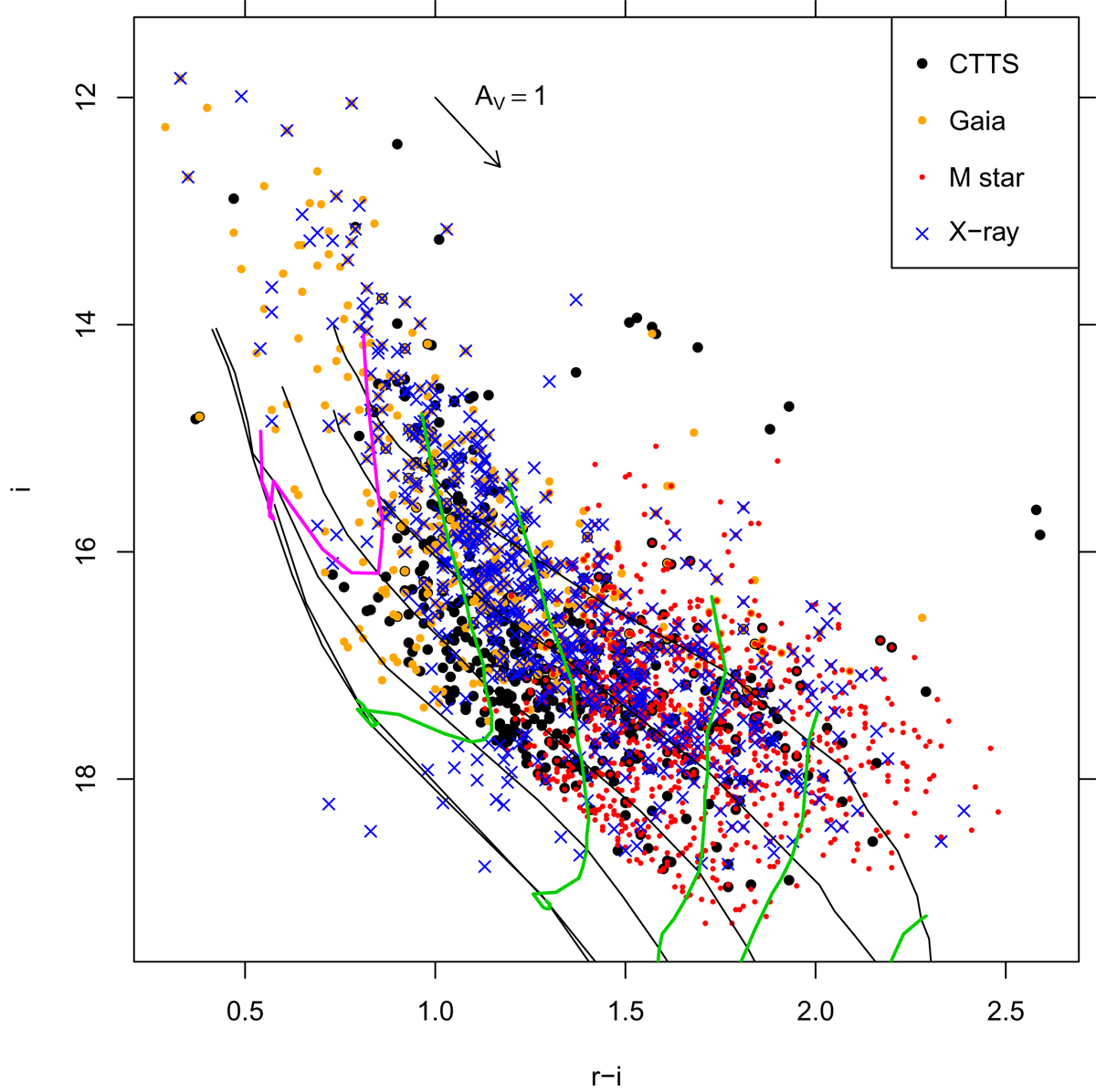
La figura (link) mostra un diagramma colore-magnitudine delle stelle selezionate come membri di NGC 6530. Nel diagramma sono usati diversi simboli per indicare la diagnostica con cui le stelle sono selezionate come membri. Sono anche mostrate le isocrone a 1, 3, 10, 30, 100 milioni di anni (ossia i luoghi popolati da stelle di eguale età e diversa massa) ed alcune tracce evolutive (i luoghi popolati da stelle di eguale massa ma diversa età).
di Mario Giuseppe Guarcello ( segui mguarce)[:en]Stars form from the gravitational collapse of large interstellar clouds. During the process, the clouds fragment in smaller clouds, forming clusters and associations of stars counting from few tens to several hundred thousands stars. The star formation process typically is not a monolithic process, e.g. with a single large event of star formation occurring rapidly and forming all the stars populating the star forming region. Instead, it is typically a long phenomenon with a complex chronology, with more interconnected events of star formation.
The study of the sequence of star formation is a hard task. It is in fact necessary to obtain a reliable list of stars associated with a given star forming region, with a small contamination from stars lying along the line of sight but not being connected with the given region. Then, the age of each single star must be found, typically from the comparison between the observed photometry with theoretical models of stellar evolution which connect observable stellar properties with their ages.
The team led by the astronomer F. Damiani (INAF – Astronomical Observatory of Palermo) studied the sequence of star formation in the young cluster NGC 6530 and its surroundings. The list of 3675 candidate cluster members was compiled by merging the results of several diagnostics aimed at identifying young stars associated with the cluster. In particular, the team deployed a method developed by astronomers of INAF-OAPA useful to select M-type stars associated with stellar clusters, together with the second Data Release of the ESA satellite Gaia. This satellite provides dynamics and distances of stars with unprecedented accuracy, allowing to identify stars associated with stellar clusters. Then, from the comparison between the observed photometry with existing evolutionary models, the team found the age of the candidate members and studied the chronology of star formation in the cluster. This research indicates that the oldest stellar population (4-5 million years old) is mainly clustered in the core of NGC 6530, with the average stellar age decreasing toward the cluster outskirt. Besides, stellar dynamics obtained from Gaia suggest that the cluster parental cloud collided with the Galactic plane about 4 million years ago, likely triggering the first events of star formation. The research is described in the paper: “Wide-area photometric and astrometric (Gaia DR2) study of the young cluster NGC 6530“, recently appeared on Astronomy & Astrophysics with the collaboration of the INAF-OAPA astronomers L. Prisinzano, G. Micela e S. Sciortino.
The figure (link) shows a color-magnitude diagram of all the candidate cluster members, marked with different symbols accordingly to the diagnostic used to select them. Also the 1, 3, 10, 30, 100 Myrs isochrones (the loci of stars with different mass but given age) and some stellar tracks (the loci of stars with different age but given mass) are shown.
by Mario Giuseppe Guarcello ( follow mguarce)[:]