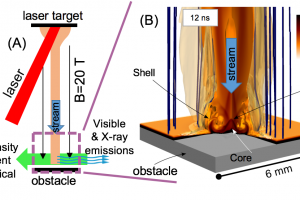
The solar corona is heated by braided magnetic loops, microflares and jets according to the new MHD simulations led by G. Cozzo (CfA; INAF-OAPA))

The solar corona is a structure that extends for several solar radii and is filled with low-density plasma at temperatures of millions of degrees. What heats coronal plasma to such extreme temperatures? It appears to be a combination of complex magnetic phenomena.   X-ray and UV observations of the Sun reveal an atmosphere rich in bright structures that host million-degree

» Read more

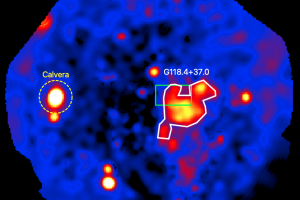
A pulsar and a supernova remnant far from the Galactic plane. The study: “Multi-wavelength study of the high Galactic latitude supernova remnant candidate G118.4+37.0 associated with the Calvera pulsar” of E. Greco (INAF-OAPA) appeared on A&A

The Caldera: a pulsar and a supernova remnant at the remarkable distance of 6500 light years from the Galactic plane, observed in the X-rays by XMM/Newton   In recent years, a few supernova remnants — rapidly expanding nebulae generated by stellar explosions — have been discovered at large distances from the Galactic plane. These objects have drawn significant interest for

» Read more

A green monster is hiding inside the supernova remnant Cas A. A new study led by S. Orlando (INAF – OAPA) explains its properties and morphology

A new theoretical study shows that the holes in the structure observed by the James Webb Space Telescope called “Green Monster” within the Cassiopeia A (Cas A) supernova remnant is due to the interaction between a pre-existing layer of circumstellar material, impacted by the supernova shock wave, and elongated stellar fragments produced by hydrodynamic instabilities.   Supernova remnants are objects of

» Read more

Developed a method to account for spots and limb darkening to retrieve exoplanets atmospheric spectra. The study: “Correcting the effect of stellar spots on ARIEL transmission spectra – II. The limb-darkening effect” of G. Cracchiolo (INAF – OAPA/UNIPA) recently appeared on MNRAS

To date, exoplanetary transits have allowed astronomers to discovery more than 70% of known exoplanets. Besides, by analysing stellar spectra acquired during the transits it is possible to study the atmospheres of the transiting exoplanet. During the transit, in fact, the planet is crossing the stellar disc, causing a small and periodic dimming of stellar observed flux. If the exoplanet

» Read more

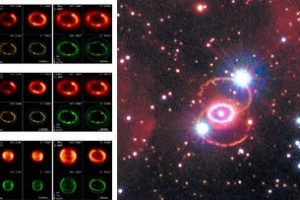
A new model developed in OAPA connects for the first time supernovae, progenitor and the properties of the remnant SN 1987A

Stars more massive than 9 solar masses end their evolution in spectacular supernova explosions. These explosions are triggered by the gravitational collapse of the core of such massive stars, once the thermonuclear reactions are exhausted and the core is not supported against gravity by the pressure produced by the reactions. Supernovae are not simple spherical explosions, but rather complex phenomena

» Read more
1 2